Start from the internal medicine clinic model (free sign-up; running a simulation needs Pro). At a clinic that takes walk-ins, patients crowd in first thing and the waiting room fills. Patients with a fever are seen in the one isolation consulting room, which stays taken while they wait for a test result. In this article, your AI writes a morning at a mock internal medicine clinic and compares the waits with bookings, with one doctor or two, and with patients with a fever waiting elsewhere for their result. It ran the same tools an AI calls over MCP. Every figure and number below comes from that run.
1. The clinic and the morning
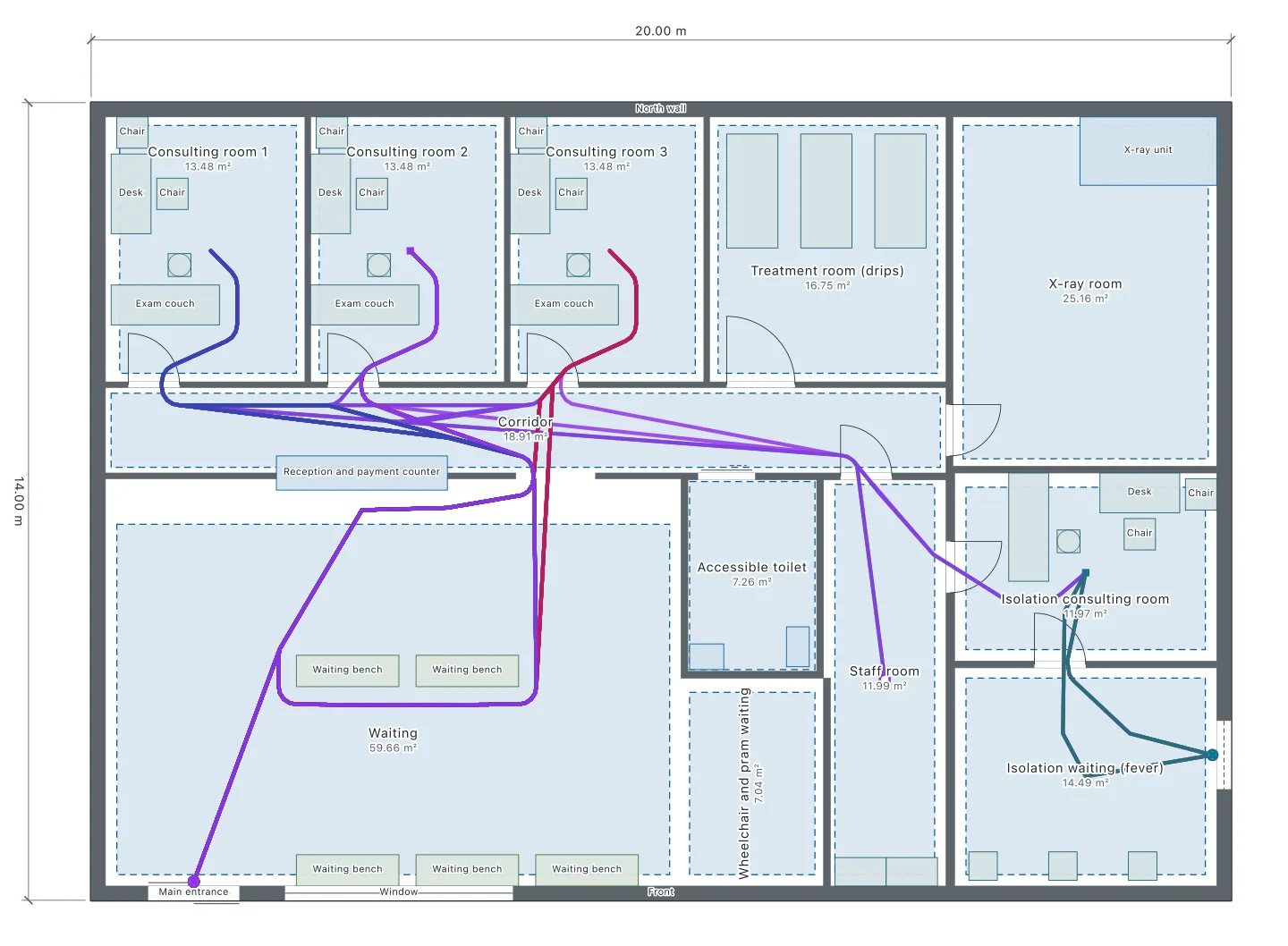
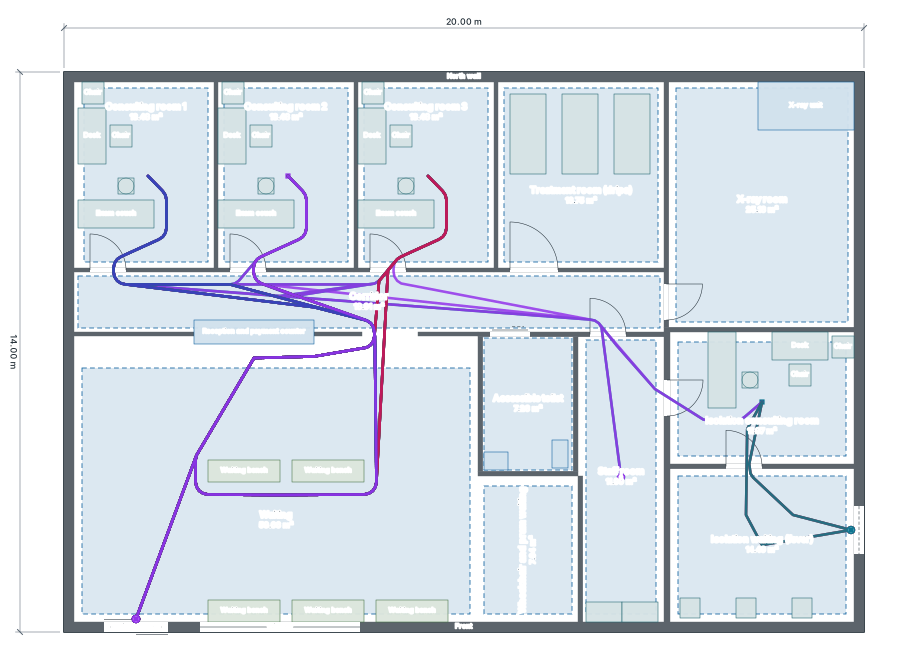
The mock clinic is 20 × 14 m. The main entrance leads to the waiting room and the reception and payment counter; off the corridor are three consulting rooms, the treatment room and the X-ray room. Patients with a fever come in by a separate entrance on the east to the isolation waiting room (three chairs) and are seen in the isolation consulting room, which the doctor enters from the staff room. Your AI reads with get_space where a patient stands in each consulting room (the spot nearest the room’s middle, 35 cm clear of the furniture) and at the waiting room side of the reception counter, and writes this scenario (put_process_scenario):
- Reception is open from 9:00 to 11:30. Patients without a fever come 10 an hour on average. Walk-ins come when they choose (at random, half as many again in the first hour); booked patients come evenly through the morning.
- Patients without a fever check in (1 to 3 min), wait in the waiting room for a free consulting room (in the order they came) and wait there for a doctor. The consultation takes 3 to 15 min (most often 6), and they pay at the counter (1 to 2 min) and leave.
- Patients with a fever come 2 an hour on average, at random. While all three chairs in the isolation waiting room are taken, they wait outside, in their car. When the isolation room is free, a doctor puts on protective clothing (1 to 2 min), examines them and takes a swab (4 to 10 min, most often 6) and takes the clothing off (1 to 1.5 min). The rapid test’s result comes 15 minutes later, waited for in the isolation room; the doctor gives it (2 to 4 min), and they pay there (1 to 2 min) and leave by the fever entrance.
- Two doctors are on duty, and the one who is free walks to the patient (to the isolation room through the staff room).
- Twenty runs, with different random numbers, each until every patient of the morning has left (to 16:00).
Nurses, tests, treatments (drips and the like) and X-rays are left out. The share of booked patients, the doctors, the patients with a fever, where they wait for the result and the consulting rooms in use are the scenario’s parameters. With sweep_process_parameters, your AI runs the same twenty random runs at each combination.
2. How long patients wait today
| Walk-ins, 2 doctors (mean of 20 runs) | Without a fever | With a fever |
|---|---|---|
| Patients in the morning | 25.8 | 5.3 |
| From coming in to leaving | 25.8 min (95 % interval 21.6 to 30.1 min) | 65.0 min (95 % interval 54.9 to 75.1 min) |
| In the waiting room, for a consulting room | 5.8 min | – |
| In the isolation waiting room, for the isolation room | – | 30.8 min |
| Outside (in the car), for a chair | – | 1.1 min |
The last patient leaves at 12:33. Where the waits come from shows when you add up the doctors’ and the isolation room’s time over an hour:
- A consultation takes 8.0 min on average. A patient with a fever takes a doctor 12.4 min: the protective clothing on and off, the examination and swab, and giving the result. With 10 patients an hour without a fever and 2 with, the doctors’ time is 104.8 minutes an hour, 87 % of two doctors’ 120.
- But walk-ins come half as many again in the first hour, which takes 144.8 minutes (121 %), more than two doctors have. The queue in the waiting room forms in the morning.
- A patient with a fever held the isolation room for 33.0 min on average (the examination and swab, the 15-minute wait for the result, giving it and paying). The room sees 60 ÷ 33.0 = 1.8 patients an hour, so with 2 an hour they wait 30.8 min in the isolation waiting room.
3. With bookings
| Booked | 2 doctors: without a fever | 2 doctors: with a fever | 1 doctor: without a fever | 1 doctor: with a fever |
|---|---|---|---|---|
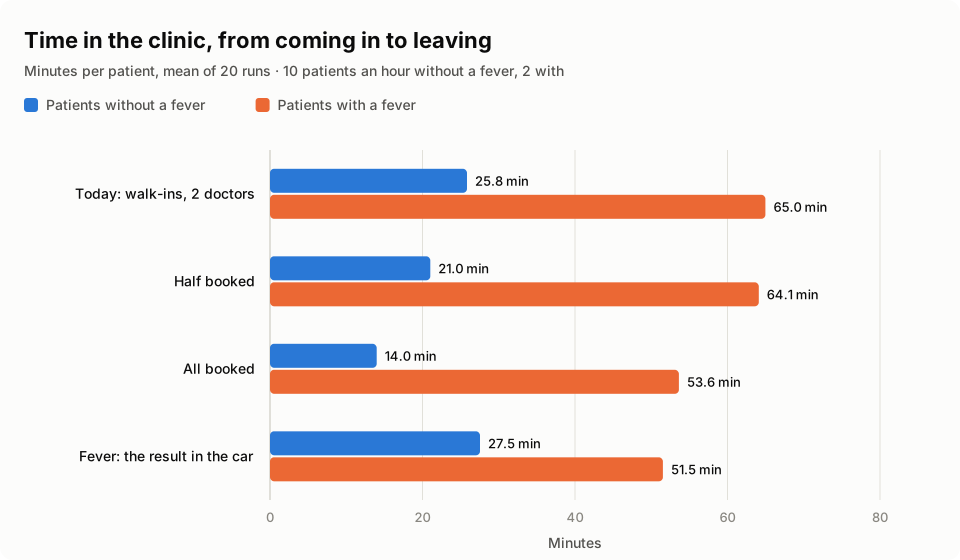
| 0 % (today) | 25.8 min | 65.0 min | 83.1 min | 146.2 min* |
| 50 % | 21.0 min | 64.1 min | 76.6 min | 146.3 min* |
| 100 % | 14.0 min | 53.6 min | 56.5 min | 137.6 min |
The numbers are the time from coming in to leaving (mean of 20 runs). * In 1 of the 20 runs, not every patient with a fever had left by 16:00: the mean of those who had.
- With two doctors, booking half the patients makes the time without a fever 4.8 min shorter (95 % interval 2.4 to 7.3 min), and booking all of them 11.8 min shorter (7.6 to 16.1 min): 14.0 min, with 0.0 min in the waiting room for a consulting room. The morning rush is gone, and the doctors’ time is 87 % in the first hour too.
- Booking everyone also makes the time with a fever 11.3 min shorter (6.3 to 16.4 min): the doctors have time to spare from the start. With half booked, the difference for patients with a fever cannot be told from none (−0.9 min, 95 % interval −3.7 to 2.0 min).
- With one doctor, even booking everyone leaves patients without a fever 56.5 min, and the last leaves at 14:07: the doctor’s time is 104.8 minutes an hour, more than one doctor’s 60. Bookings remove the morning rush, but the waits stay while the patients an hour need more than the doctors’ time.
4. More patients with a fever
| Patients with a fever an hour | The result in the isolation room | The result in the car |
|---|---|---|
| 1 | 43.5 min | 40.1 min |
| 2 (today) | 65.0 min | 51.5 min |
| 3 | 99.4 min | 71.6 min |
| 4 | 134.4 min* | 97.4 min |
The numbers are the time with a fever from coming in to leaving (mean of 20 runs). Waiting in the car, patients go back to their car after the swab and are called back when the isolation room is free. * In 4 of the 20 runs, not every patient had left by 16:00: the mean of those who had.
- With the result waited for in the car, a patient holds the isolation room for 21.0 min instead of 33.0, and with 2 an hour the time with a fever is 13.4 min shorter (95 % interval 8.8 to 18.0 min).
- With 3 an hour, the last patient leaves at 13:43 when the result is waited for in the room, and at 12:18 in the car. With 4, waiting in the room leaves not everyone gone by 16:00 in 4 of the 20 runs, and those who got a chair waited for it outside (in the car) for 35.9 min on average; waiting in the car, everyone leaves in every run (12:49 on average), after 6.6 min outside.
- In exchange, patients without a fever take a little longer, as the doctors see patients with a fever sooner (1.7 min with 2 an hour, 95 % interval 0.8 to 2.6 min).
5. Consulting rooms
- With two doctors, using two consulting rooms instead of three made the time without a fever 1.0 min longer (95 % interval 0.6 to 1.4 min) and the time with a fever 5.6 min shorter (2.7 to 8.5 min). The wait in the waiting room for a consulting room grows from 5.8 min to 9.5 min, but fewer patients wait in a consulting room for a doctor, and a doctor comes to the isolation room sooner.
- With one doctor, the time without a fever was 83.1 min with three consulting rooms and 89.4 min with two.
6. How to use these numbers
- Multiply the patients an hour by each one’s consultation time and compare it with the doctors’ time. In this clinic, walk-ins brought 121 % of the doctors’ time into the first hour, and that is where the waits came from.
- Each patient’s times and the patients in each hour come from the reception records (when they checked in and paid) and the electronic records. Your AI can write the scenario the way your clinic books (the slots in each hour, walk-ins alongside bookings).
- Not calculated: the numbers of nurses and laboratory staff, waits for treatments (drips and the like), X-rays and tests, emergencies, cancellations, doctors who stay in their room and call patients in (here the free doctor walks to the patient), revenue.
- A dental clinic’s booking interval and chairs are compared in the dental clinic waits article.