Start from the dental clinic model (free sign-up; running a simulation needs Pro). Even when patients come at their appointment time, they wait in the waiting room, and in the chair for the dentist. Where they wait, and for how long, comes from the booking interval, the chairs and dentists, and how long each patient takes. In this article, your AI writes a morning of appointments for a mock clinic with five chairs and compares the waits as the conditions change. It ran the same tools an AI calls over MCP. Every figure and number below comes from that run.
1. The clinic and the morning’s bookings
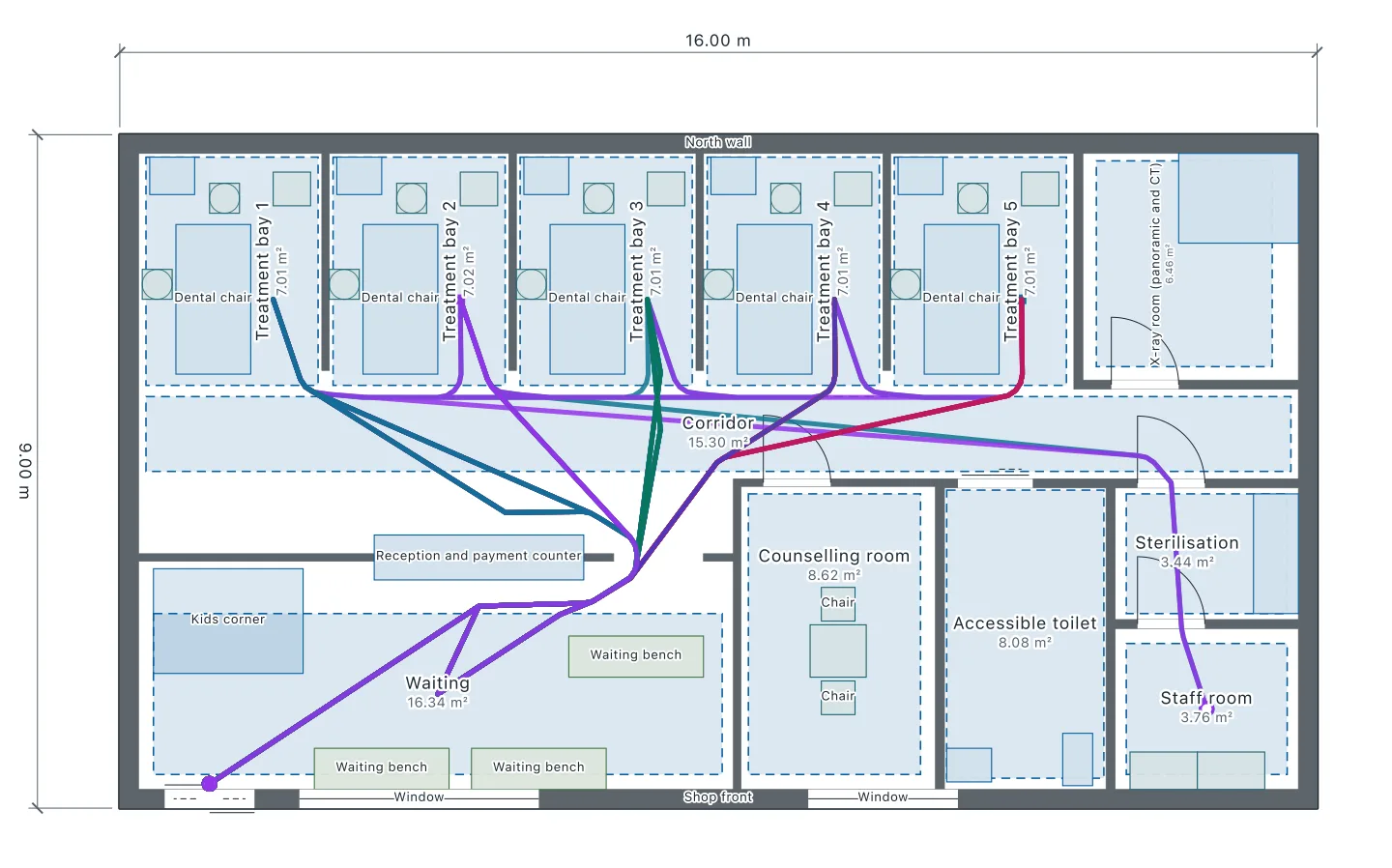
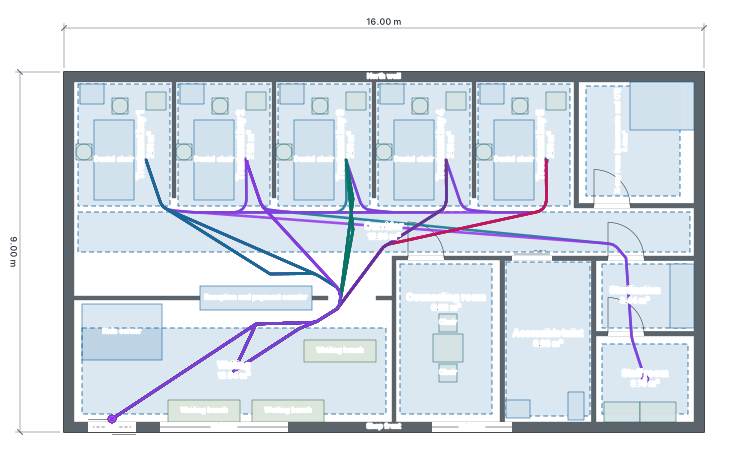
The mock clinic is a 16 × 9 m tenant: five treatment chairs along the north wall, the entrance, the reception and payment counter and the waiting room on the street side, and the staff room at the back. Your AI reads the chairs (1 to 5 from the west) and the reception counter with get_space, and writes this scenario (put_process_scenario):
- Bookings from 9:00 to 12:00, one patient on each chair every 30 minutes (with five chairs, one every 6 minutes: 30 patients).
- Each patient comes up to 10 minutes before or after the appointment, checks in at the waiting room side of the counter (45 to 120 s) and waits in the waiting room for a free chair, in the order they came.
- In the chair, the assistant seats and prepares them (3 to 7 min). Four in ten come for maintenance: the hygienist cleans (15 to 25 min), then a dentist checks (2 to 5 min). Six in ten come for treatment by a dentist (6 to 30 min, most often 15).
- Two dentists are on duty, and the one who is free walks to the chair. The wait in the chair for a dentist includes the walk.
- The chair is free after clearing up (2 to 5 min), and the patient pays at the same counter (1 to 3 min) and leaves.
- Twenty runs, with different random numbers.
The hygienists and assistants are taken to be enough, so patients wait only for a chair, a dentist and the counter. The booking interval, the dentists on duty, the share of maintenance patients, how early or late patients come and the usual treatment length are the scenario’s parameters. With sweep_process_parameters, your AI runs the same twenty random runs at each combination.
2. How long patients wait today
| 30-minute slots, 2 dentists (30 patients) | Mean of 20 runs |
|---|---|
| In the waiting room, for a free chair | 9.4 min (95 % interval 7.0 to 11.7 min) |
| In the chair, for a dentist | 4.6 min |
| At the counter, to check in and pay | 0.5 min |
| The longest wait in the waiting room (each run) | 26.6 min |
| Patients waiting at once (each run’s most) | 4.6 |
| The last patient leaves at | 12:50 |
The last appointment is at 11:54 and its slot ends at 12:24, but the last patient leaves at 12:50. Why they wait shows when you add up each patient’s time over an hour of bookings:
- A patient holds a chair for 28.1 min on average (5 min to prepare, then 17 min of treatment or 20 min of cleaning and a 3.5-minute check, and 3.5 min to clear up). With 30-minute slots, 10 patients an hour take 281 of the five chairs’ 300 minutes (94 %).
- A patient needs a dentist for 11.6 min on average (17 min for treatment, the 3.5-minute check for maintenance): 116 minutes an hour, 97 % of two dentists’ 120.
- Both are above 90 %, so a small delay is never made up and the waits build. A chair stays taken while its patient waits for a dentist, so in the simulation a patient held a chair (from walking to it to clearing up) for 32.8 min on average, longer than the 30-minute slot.
3. Dentists and the booking interval
| Booking interval (patients) | 1 dentist | 2 dentists | 3 dentists |
|---|---|---|---|
| 20 min (45) | × | × | × |
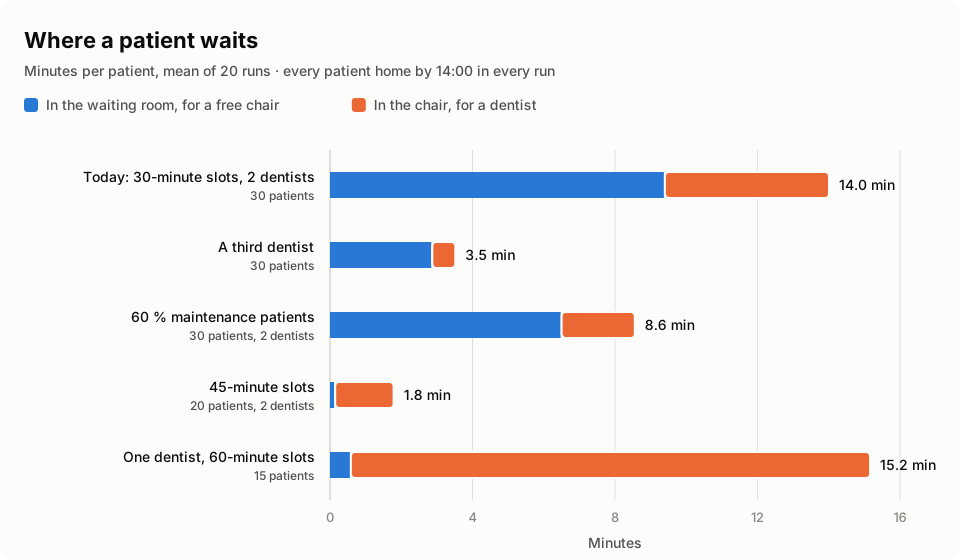
| 30 min (30) | × | 9.4 + 4.6 | 2.8 + 0.7 |
| 45 min (20) | × | 0.1 + 1.7 | 0.0 + 0.2 |
| 60 min (15) | 0.6 + 14.6 | 0.0 + 0.6 | 0.0 + 0.1 |
The numbers are a patient’s minutes in the waiting room plus those in the chair waiting for a dentist (mean of 20 runs). × marks the combinations where, in some runs, not every patient had left by 14:00 (of 20 runs: with 20-minute slots, 20 with one dentist, 19 with two and 2 with three; with 30-minute slots and one dentist, 20; with 45-minute slots and one dentist, 2).
- With a third dentist, patients wait 2.8 min in the waiting room and 0.7 min in the chair, and the last leaves at 12:35. The wait in the waiting room is 6.5 min shorter (95 % interval 4.7 to 8.4 min). The dentists’ time is 64 % of three dentists’ 180 minutes, so nobody waits in the chair for long and the chairs are free sooner.
- With 45-minute slots, two dentists keep the waits short (0.1 min in the waiting room, 1.7 in the chair): the chairs are used 62 % of the time and the dentists 64 %. But the morning books 20 patients instead of 30.
- With one dentist, even 60-minute slots (15 patients) leave patients waiting 14.6 min in the chair: the dentist’s time is 58 minutes an hour, 97 % of one dentist’s 60. The wait moves from the waiting room into the chair.
- 20-minute slots (45 patients) do not work even with three dentists: 15 patients an hour hold the chairs for 15 × 28.1 min = 421.5 min, more than the five chairs’ 300. More dentists cannot make up for too few chairs.
4. More maintenance patients
| Maintenance patients | Chair time a patient | Dentist time | 2 dentists | 3 dentists |
|---|---|---|---|---|
| 20 % | 26.8 min | 14.3 min | 14.8 + 9.2 | 2.4 + 1.4 |
| 40 % (today) | 28.1 min | 11.6 min | 9.4 + 4.6 | 2.8 + 0.7 |
| 60 % | 29.4 min | 8.9 min | 6.5 + 2.1 | 3.4 + 0.3 |
- With two dentists, the more maintenance patients, the shorter the waits. At 60 %, the wait in the waiting room is 2.9 min shorter (95 % interval 1.4 to 4.4 min), and the dentists’ time is 89 minutes an hour (74 % of two dentists). At 20 %, the dentists’ time is 143 minutes an hour, more than two dentists’ 120, and the last patient leaves at 13:09.
- With three dentists it turns the other way: the more maintenance patients, the slightly longer the wait in the waiting room (against 40 %, 0.5 min shorter at 20 % and 0.6 min longer at 60 %). The dentists have time to spare, and the cleanings hold the chairs longer (at 60 %, 294 minutes an hour, 98 % of the five chairs).
- To take more maintenance patients, check that there are chairs and hygienists enough before you think about dentists.
5. Patients early or late, and treatment length
| Conditions | Waiting room | Chair | The last patient leaves |
|---|---|---|---|
| Everyone exactly on time | 8.6 min | 4.6 min | 12:49 |
| Up to 10 min early or late (today) | 9.4 min | 4.6 min | 12:50 |
| Up to 20 min early or late | 10.4 min | 4.8 min | 12:54 |
| Treatment most often 10 min | 6.0 min | 3.6 min | 12:42 |
| 15 min (today) | 9.4 min | 4.6 min | 12:50 |
| 20 min | 13.4 min | 5.5 min | 13:00 |
- How early or late patients come changes the waits little. Against today, the differences are −0.7 min and 1.0 min, and neither can be told from no difference (95 % intervals −2.0 to 0.6 min and −0.3 to 2.4 min).
- Treatment length matters. With the usual treatment 5 minutes shorter (the mean treatment 15.3 min instead of 17), the wait in the waiting room was 3.3 min shorter (95 % interval 2.5 to 4.2 min); 5 minutes longer, it was 4.0 min longer (3.3 to 4.7 min). With the chairs and the dentists both busy around 90 % of the time, a small change in each patient’s time changes the waits a lot.
6. How to use these numbers
- Before you set the booking interval, multiply each patient’s chair time and dentist time by the patients booked an hour, and compare them with an hour of your chairs and of your dentists. In this clinic, 30-minute slots with two dentists took 94 % of the chairs and 97 % of the dentists.
- Each patient’s times come from the appointment book and the treatment records (when they were seated, when they paid). Give your AI the length of each kind of treatment and the share of maintenance patients. Your AI can write the scenario the way your clinic books (by chair, by the number of patients in each hour).
- Not calculated: emergencies and walk-ins, cancellations, the numbers of hygienists and assistants (taken to be enough), booking each patient on a set chair (here each takes the next free chair in the order they came), X-rays, revenue.
- To add a sixth chair, first check that it fits, as in the clinic layout article, then add it to the scenario and compare.