Start from the coin laundry model (free sign-up), or draw your own shop. In a coin laundry with no staff, the security cameras watch the entrance, the change machine and the shop. In this article your AI works out, on a coin laundry model, how many cameras are needed, where they go and how much of the shop they cover, using the same tools an AI calls over MCP. Every figure and picture below comes from those tools.
1. What was done
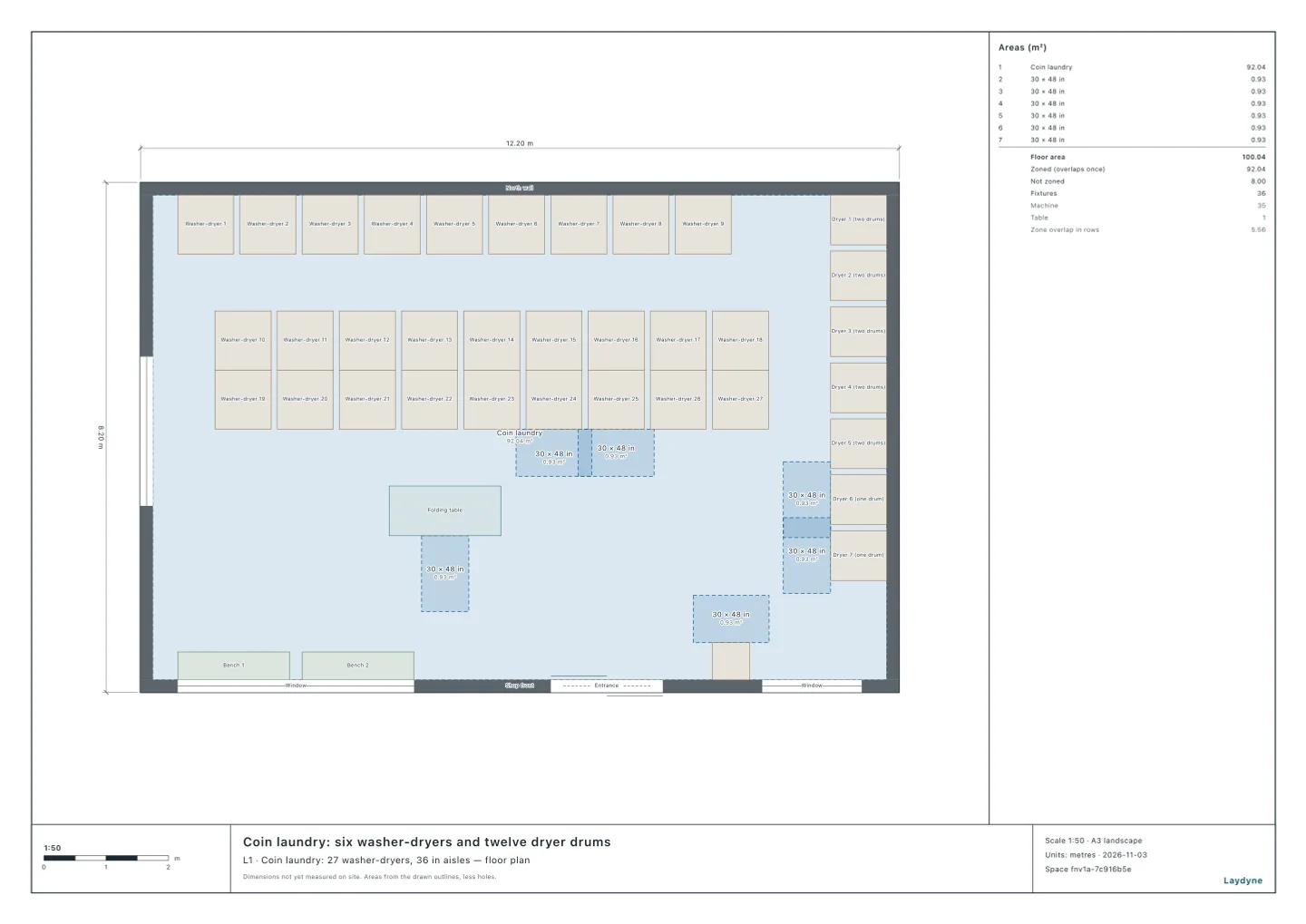
- The model is a one-room shop of 11.8 × 7.8 m with a 3 m ceiling: six washer-dryers along the north wall, six dryer stacks (two drums each) along the east wall, a folding table in the middle, benches by the south windows, and the change and detergent machine by the entrance.
- What must be covered: the entrance and 2 m around it, the change machine and 1.5 m around it (each counted three times), and the floor of the whole room.
- Two kinds of camera (their specifications are assumed): an ordinary camera on a wall, 2.6 m up (90° across, 60° up and down, a range of 20 m), and an all-round camera on the ceiling, 2.9 m up, looking straight down (360°, a range of 10 m).
- With
suggest_camerasthe AI looked for the positions where up to four cameras of each kind cover the most. It counts at floor level (0 m), with the machines and the folding table hiding what lies behind them.
2. Coverage by number of cameras
| Cameras | Ordinary cameras on the walls | All-round cameras on the ceiling |
|---|---|---|
| 1 | 85.6% (82.0% of the room) | 97.5% (97.2% of the room) |
| 2 | 98.3% (98.8% of the room) | 99.2% (99.4% of the room) |
| 3 | 99.4% (99.3% of the room) | 99.8% (99.8% of the room) |
| 4 | 99.9% (99.8% of the room) | 99.9% (99.9% of the room) |
(Shares of what must be covered, with the entrance and the change machine counted three times; in brackets, the share of the room's 76.81 m² of floor that is covered.)
- One all-round camera on the ceiling covers 97.5% of what must be seen, with the entrance and the change machine counted three times. Looking down from the middle of the ceiling, it reaches the floor in front of the machines.
- Ordinary cameras on the walls need two. One covers 85.6%, two cover 98.3%.
3. What the ceiling camera does not see
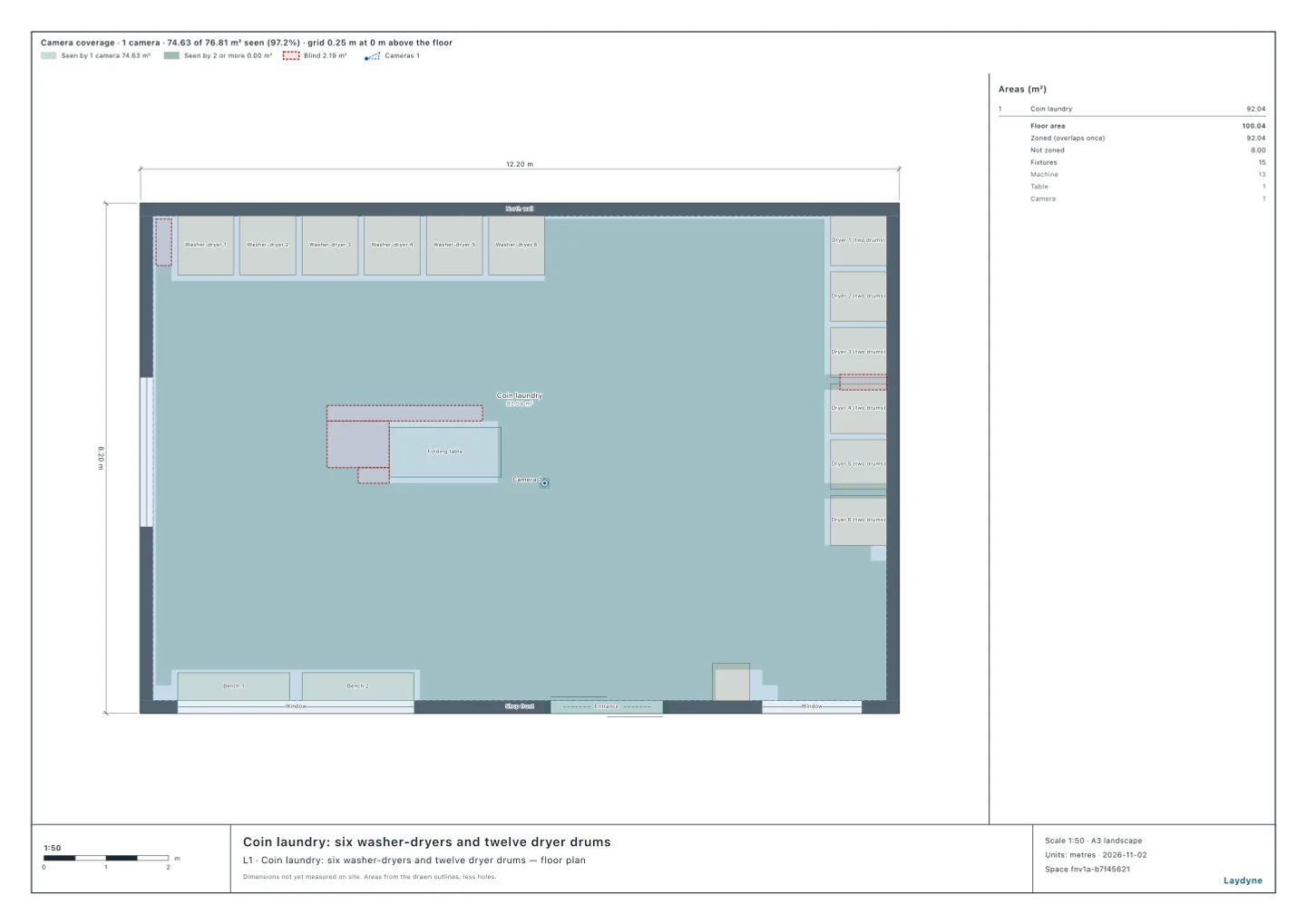
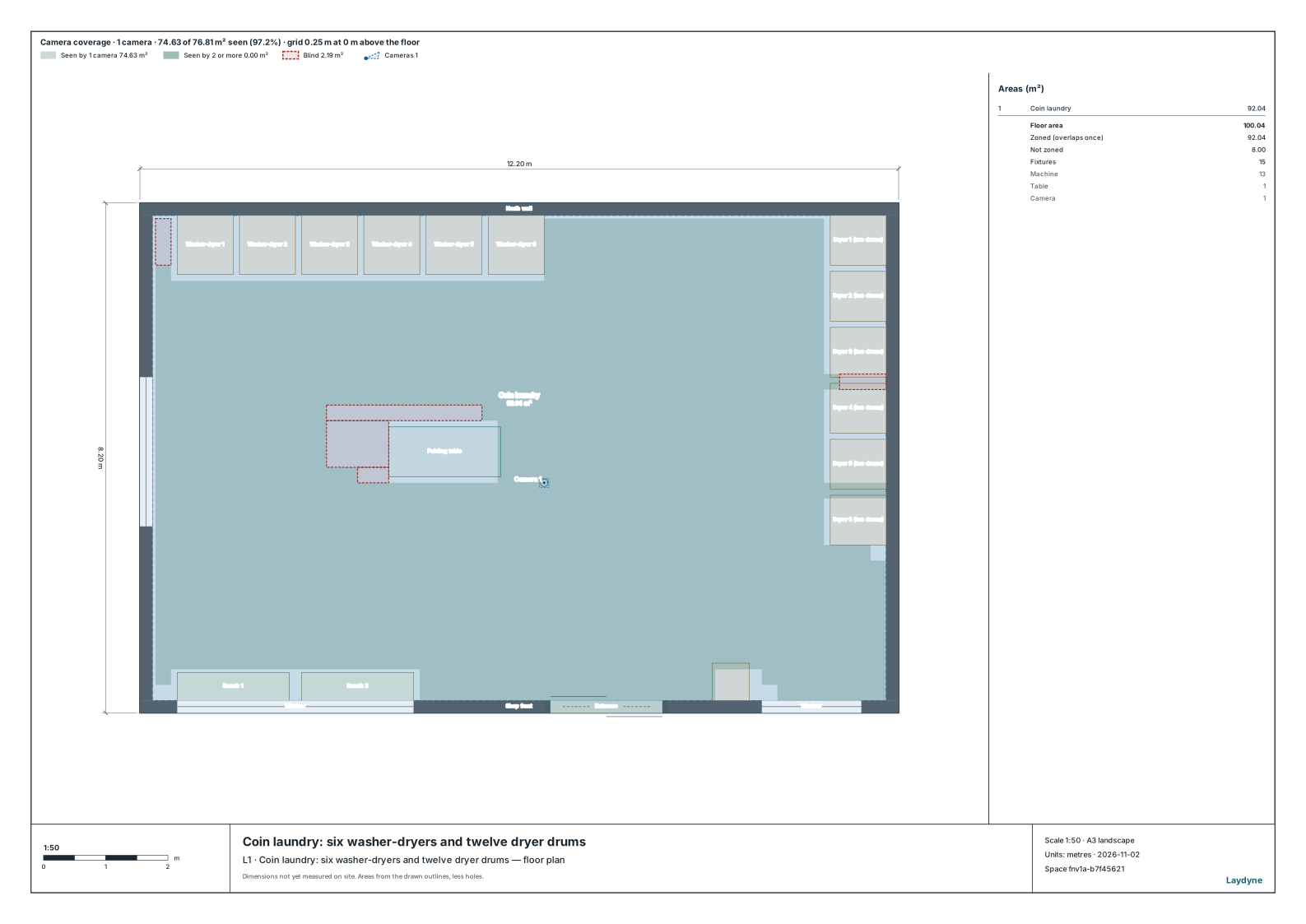
The AI placed the single all-round camera on the ceiling in the middle of the shop (x 6.5 m, z 4.5 m) and used get_visibility to find what it does not see (the blind spots).
- 2.19 m² is unseen. Most of it is the floor north and west of the folding table (1.51 m² together), in the shadow of the 0.9 m high table.
- The rest: beside washer-dryer 1 (0.19 m²) and in the gap between dryers 3 and 4 (0.19 m²).
- Around the entrance 98.1% is covered, and around the change machine 97.0%.
4. How to use it, and what it does not know
- Whether a face can be recognised. Coverage is counted from the field of view and the line of sight alone. Whether a face or hands can be recognised depends on the camera's resolution, the distance and the angle. To film faces clearly at the entrance, add a wall camera facing it and check again.
- The cameras' specifications are assumed. Give the AI the field of view and the range of the cameras you use.
- Put up a notice. The Personal Information Protection Commission's Q&A (Q1-13, in Japanese) says that a security camera filming images that identify a person should be used within its purpose, specified as far as possible, and that where people cannot easily tell they are being filmed, a notice such as "security camera in operation" should be put up (Act on the Protection of Personal Information, Article 20(1)).
Tools used
suggest_cameras: what must be covered, and where cameras goedit_space: place the camera as a partget_visibility: what is covered, and the blind spotsget_view_image: the plan