Start from the restaurant shell model (free sign-up; running a simulation needs Pro). At lunch, customers come in a short rush. If no table is free, they wait at the door or go somewhere else. With the same seats, how the tables are used changes how many people you serve at lunch. In this article, your AI sets out a mock 40-seat restaurant, writes its lunch, and compares keeping the tables for four whole with pulling them apart into tables for two. It ran the same tools an AI calls over MCP. Every figure and number below comes from that run.
1. The restaurant and its tables
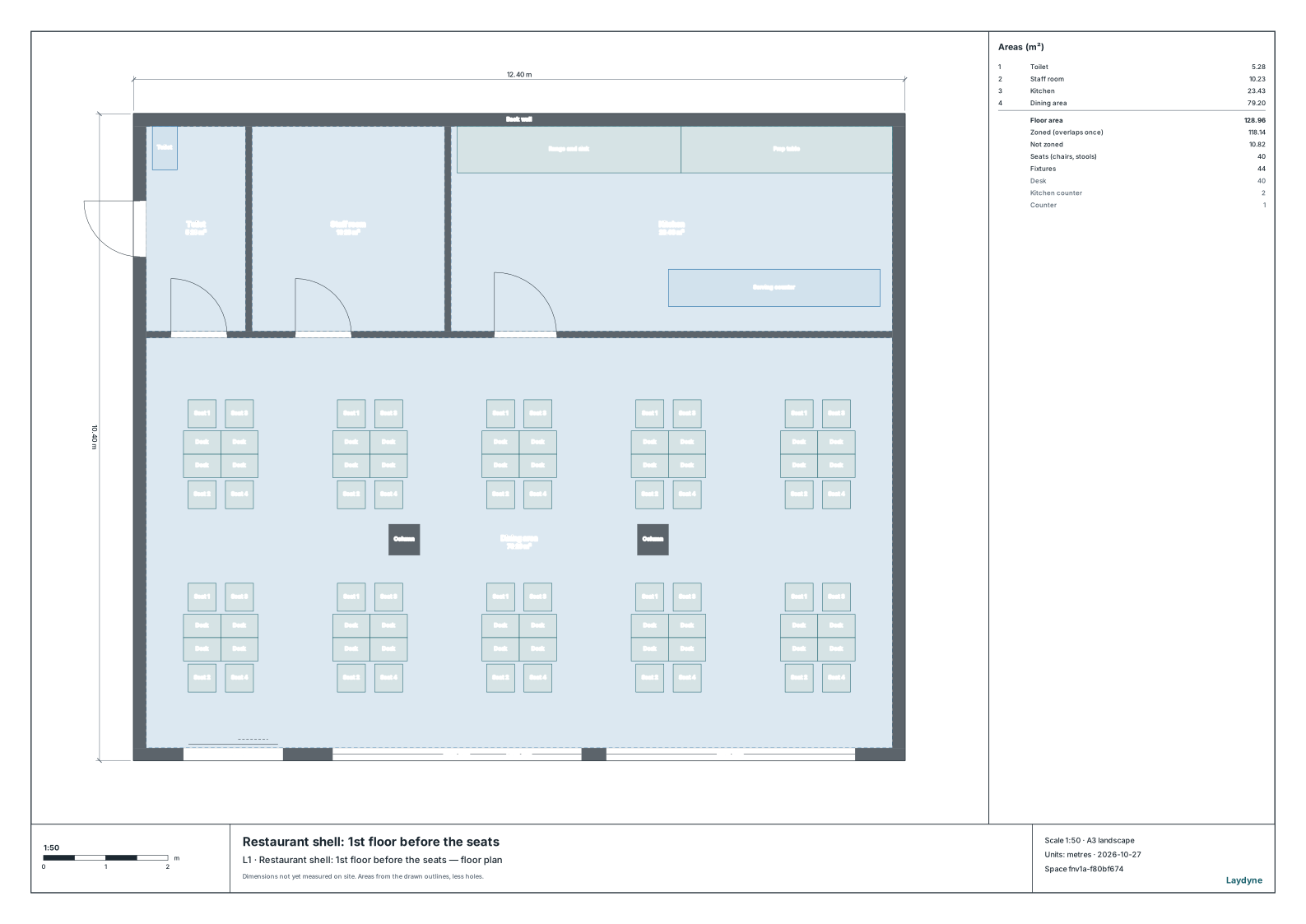
The mock restaurant is a 12.4 × 10.4 m single storey with the kitchen, the staff room and the toilet at the back and the entrance at the front. With suggest_arrangement, your AI set out the dining area (12 × 6.6 m, two columns) with tables for four and 1.2 m aisles (as in How many seats will this restaurant take?): ten tables in two rows of five, 40 seats, and no findings from check_space. A table for four is two tables for two pushed together; pulled apart, it is two tables for two.
2. The lunch
Your AI reads the ten tables and 40 seats with get_seating_chart, and writes this scenario (put_process_scenario):
- From 11:30 to 13:30 parties come in at random: 24 an hour on average from 12:00 to 13:00, and half that in the half hours either side (37.1 parties and 82.1 people on average over the 20 runs).
- A quarter come alone, 45 % in twos, 10 % in threes and 20 % in fours.
- With no table free, a party waits at the door; but when three parties are already waiting it leaves at once, and it waits 15 minutes at most. Parties are seated in the order they came.
- Seated, they order (1 to 3 min), wait for the food (5 to 20 min, most often 10) and eat (15 to 45 min, most often 25), then pay at the register by the door (40 to 90 s) and leave.
- With the tables for four kept whole, every party takes a table for four. Pulled apart, parties of one or two take a table for two, and parties of three or four two of them pushed together (the effort and room to push them together are not calculated).
- Twenty runs, with different random numbers.
A party holds its table for 42.0 min on average (2.0 min to order, 11.7 for the food, 28.3 to eat). Kept whole, the ten tables seat 10 × 60 ÷ 42.0 = about 14 parties an hour. Pulled apart, a party takes 1.3 tables for two on average, so the 20 seat about 22 parties an hour. Kept whole, they are not enough for 24 parties in the peak hour.
3. Tables for four kept whole, or pulled apart into twos
| A day with 24 parties an hour (mean of 20 runs) | Tables for four | Pulled apart into twos |
|---|---|---|
| Parties seated | 27.5 (95 % interval 26.1 to 28.8) | 33.8 (95 % interval 31.6 to 36.0) |
| People served | 60.9 | 75.0 |
| People who left without a table | 21.3 (9.6 parties) | 7.1 (3.3 parties) |
| Turns of the 40 seats | 1.52 | 1.88 |
| Wait for a table (mean of the parties seated) | 3.8 min | 1.2 min |
- Pulled apart into twos, 6.4 more parties are seated (95 % interval 4.8 to 7.9), and the people served go from 60.9 to 75.0.
- 71.1 % of the parties are one or two people. With the tables kept whole, a party of two takes four seats, and nobody can sit in the other two.
4. Busy days and quiet days
| At the peak | Tables for four: served | Tables for four: left | Twos: served | Twos: left |
|---|---|---|---|---|
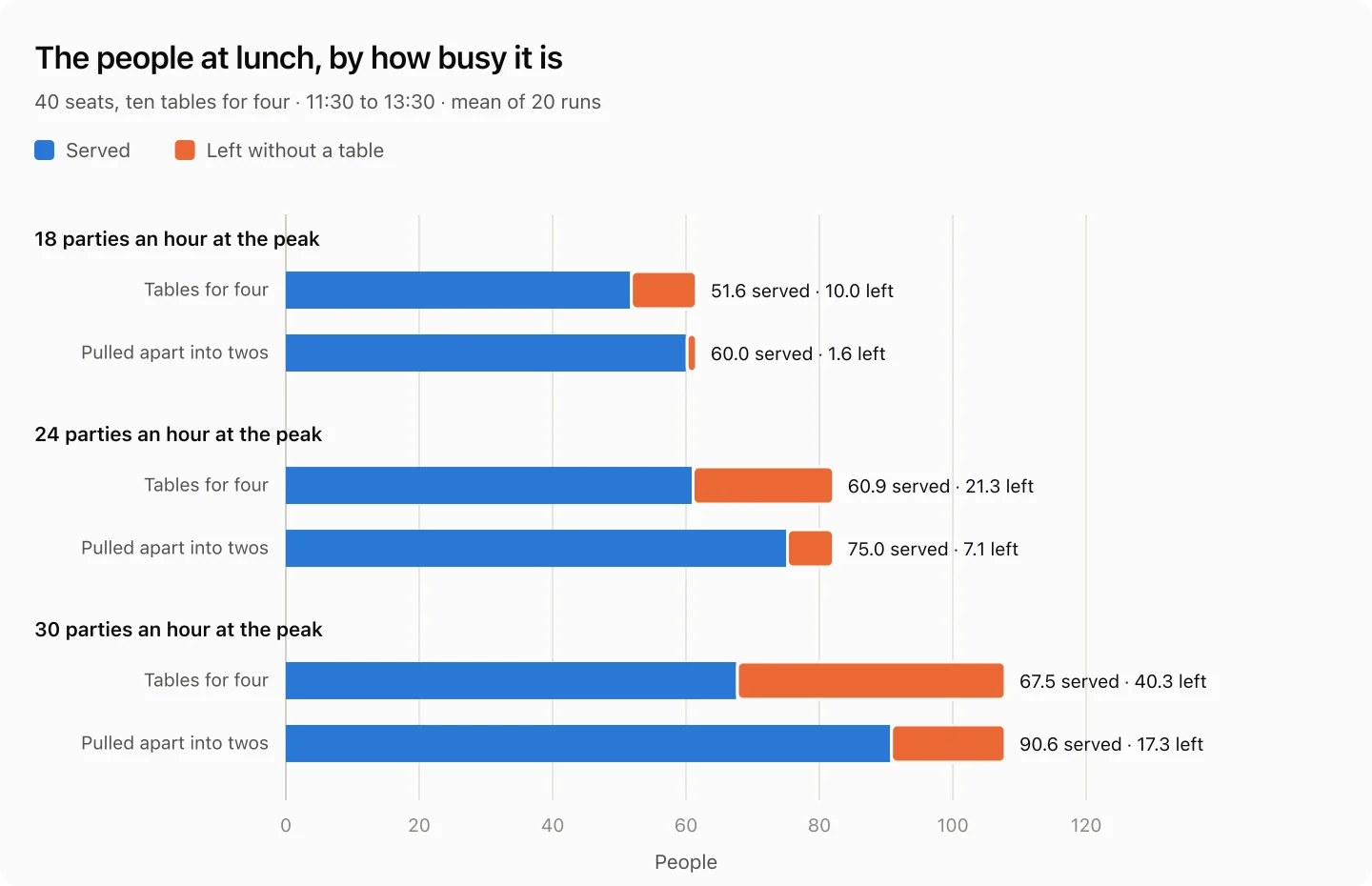
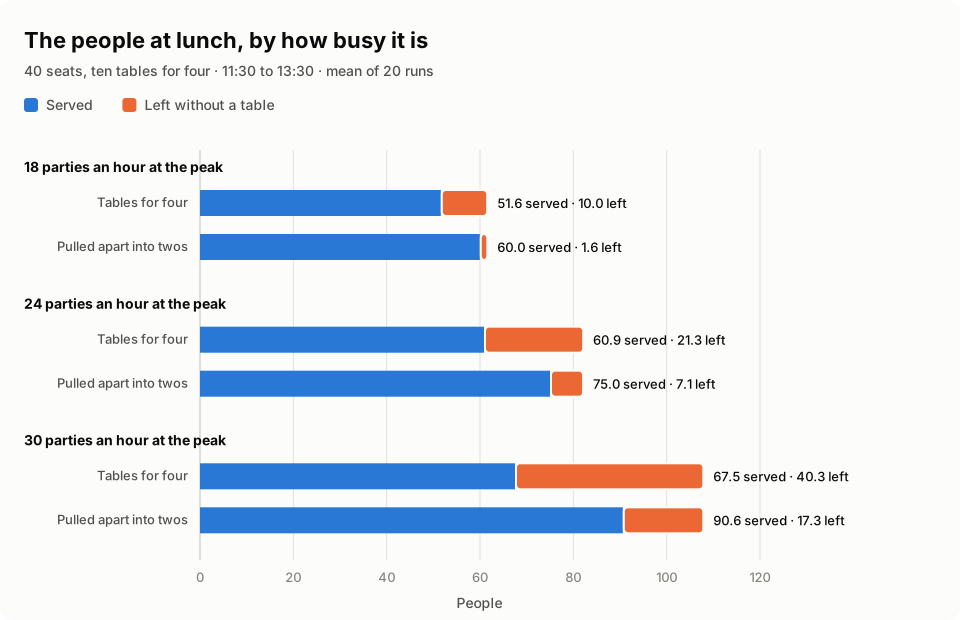
| 18 parties an hour | 51.6 | 10.0 | 60.0 | 1.6 |
| 24 parties an hour | 60.9 | 21.3 | 75.0 | 7.1 |
| 30 parties an hour | 67.5 | 40.3 | 90.6 | 17.3 |
- The busier the day, the larger the difference: with 30 parties an hour, 67.5 people are served against 90.6.
- Even with 18 parties an hour, 10.0 people leave when the tables are kept whole: 18 parties in the peak hour are more than the about 14 an hour those tables seat. Pulled apart, 1.6 leave.
5. More room to wait at the door
| Parties waiting at most | Tables for four: served | left | wait | Twos: served | left | wait |
|---|---|---|---|---|---|---|
| 3 (today) | 60.9 | 21.3 | 3.8 min | 75.0 | 7.1 | 1.2 min |
| 6 | 63.5 | 18.6 | 6.2 min | 77.3 | 4.9 | 2.2 min |
- Chairs at the door for six waiting parties take the people served with tables for four only from 60.9 to 63.5, and the wait grows to 6.2 min; the parties who give up after 15 minutes go from 1.9 to 5.2. Changing how the tables are used does more.
6. How to use these numbers
- The share of each party size and the parties in the peak hour come from your POS records of customers and parties. Give your AI your own times to eat and for the food to come.
- Not calculated: the effort and room to push tables together and apart, sharing tables, counter seats, bookings, takeaway, the food coming later when the kitchen is busy (here it takes the same time however busy it is), revenue.
- How the dining area is set out and how many seats it takes is compared in How many seats will this restaurant take?.