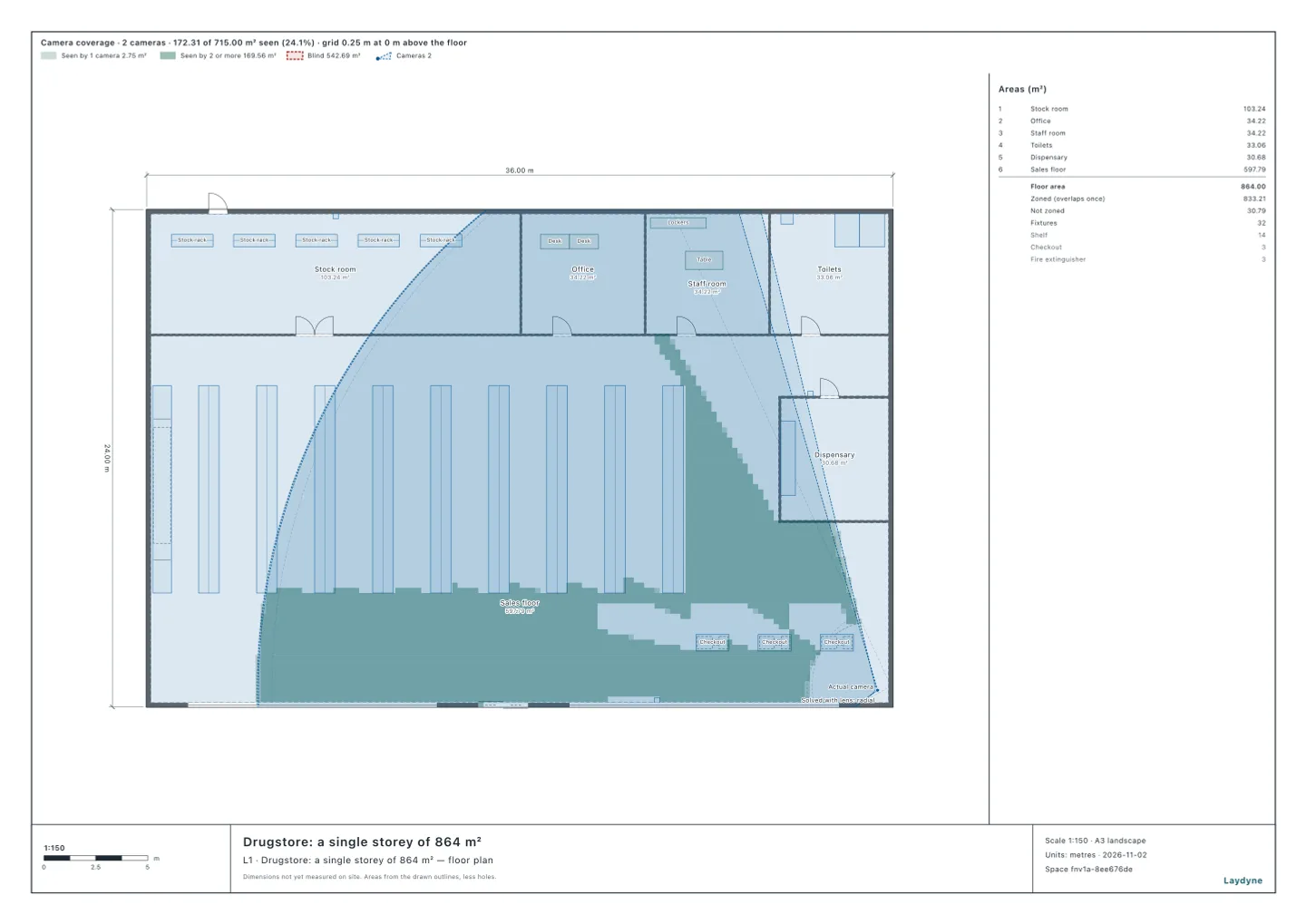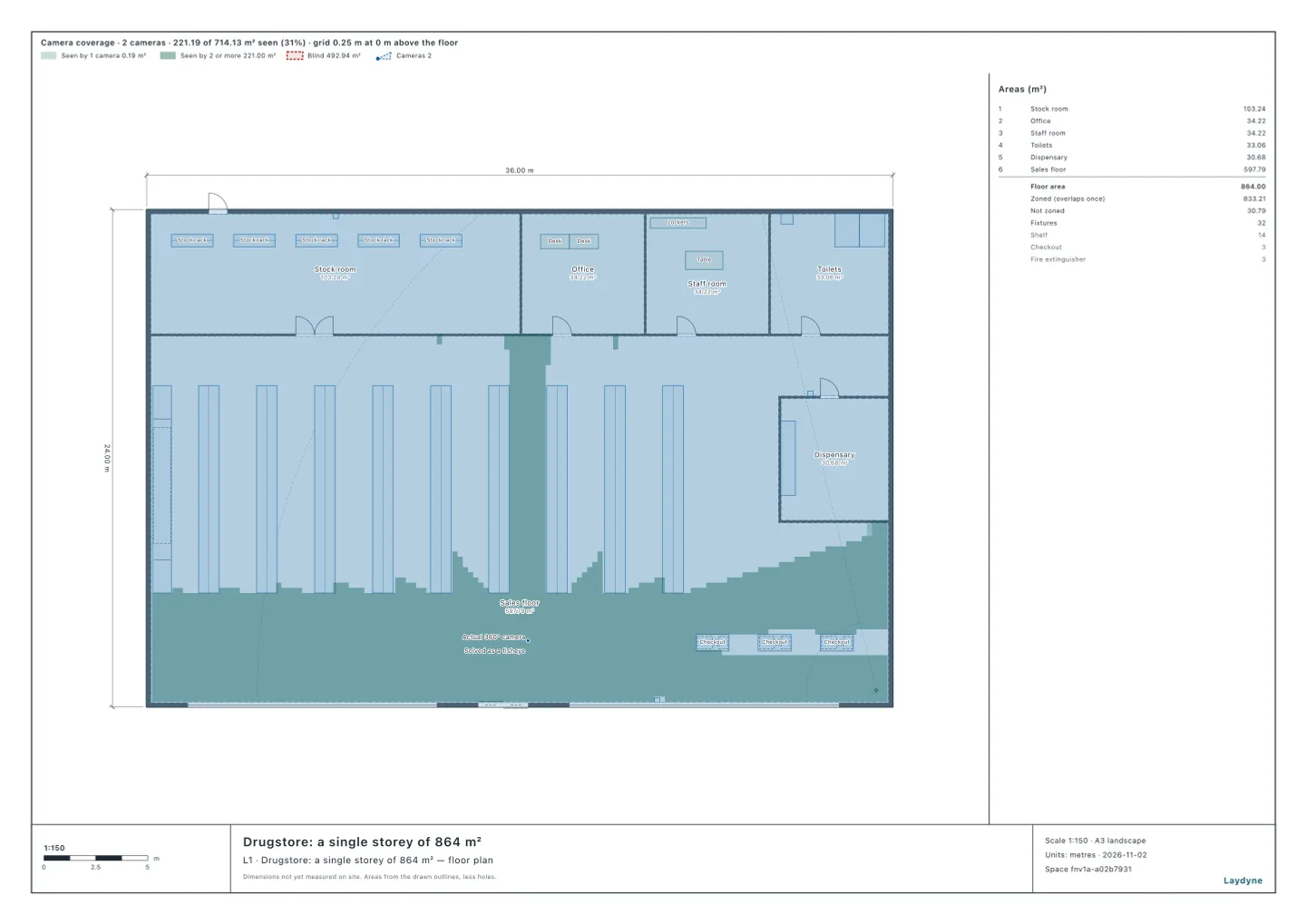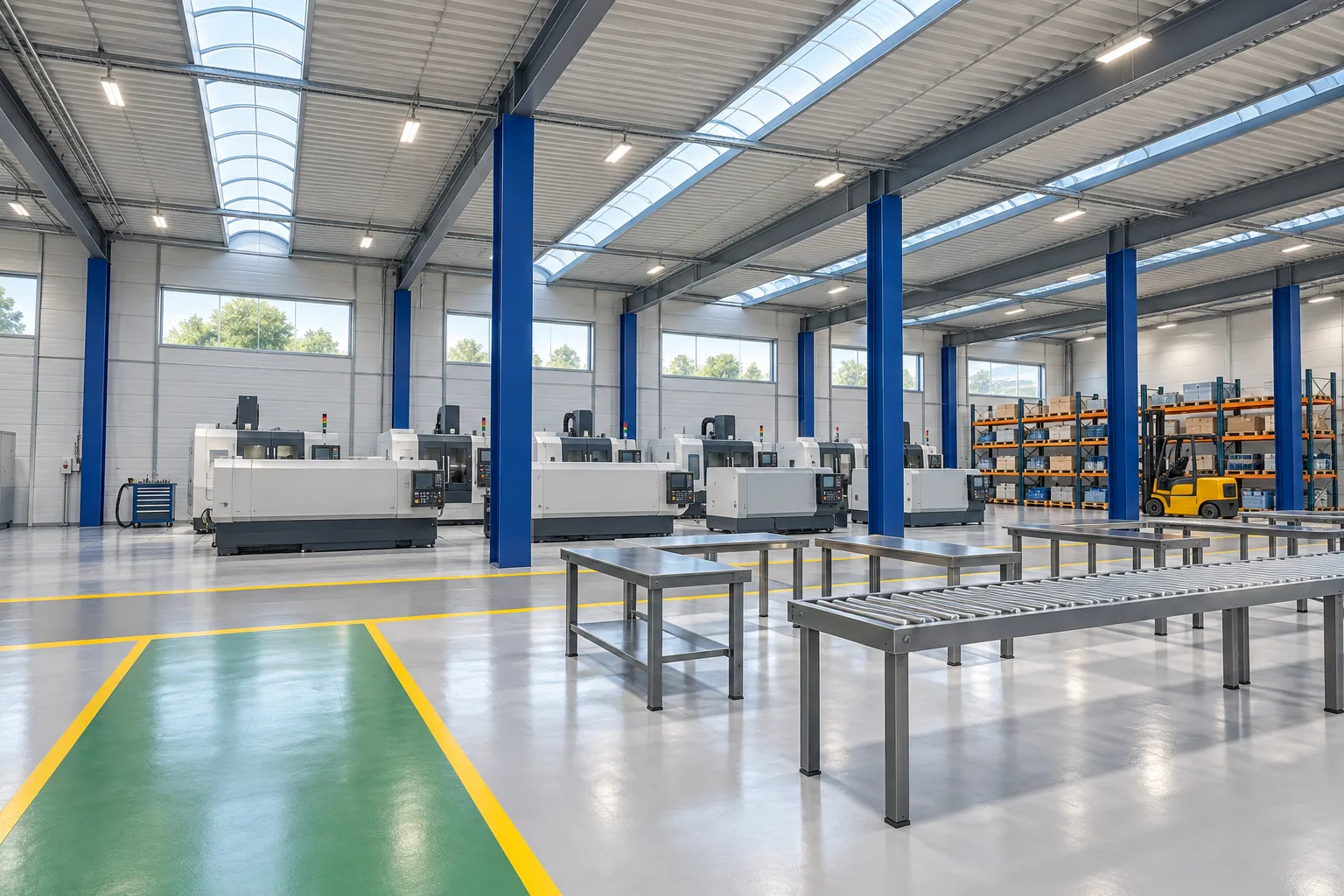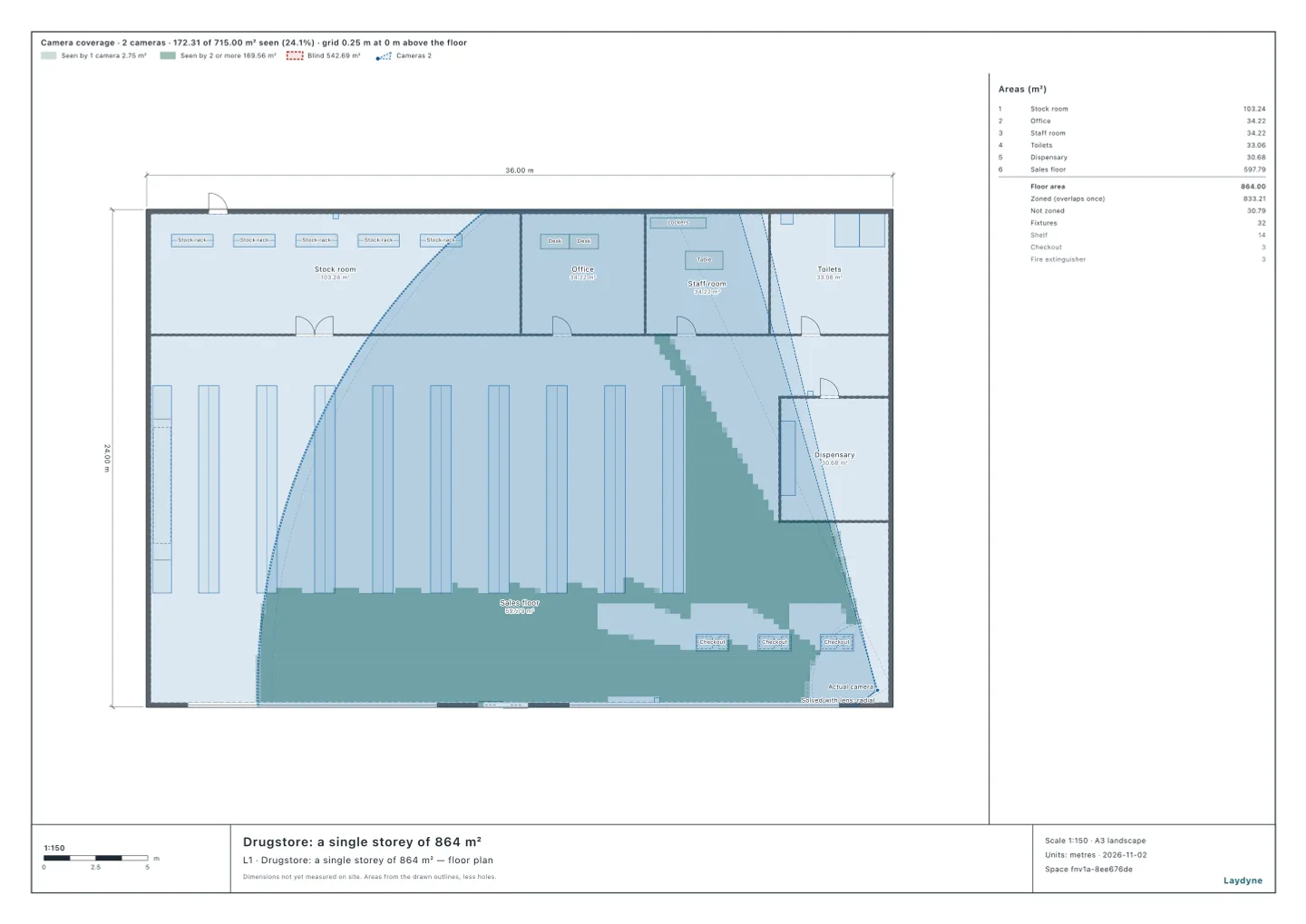
Can photos recover a factory that has no drawings, or a security camera whose position is missing from a plan? Here are results from 3 earlier articles. There are 2 models, a factory and a drugstore. The wide-angle and fisheye cameras are in the same drugstore. The factory was built from 8 photos and a known length. Each camera was solved by pairing points in 1 still with the same points in the model. The tools an AI calls over MCP (solve_photo_camera, with its options for wide-angle and fisheye lenses, and get_visibility) checked its position and coverage.
1. Values from photos compared with the known model
| Article and condition | What was checked | Value from the photos | Comparison |
|---|---|---|---|
| Factory: after comparing with the photos and correcting the model | Hall depth | 24.0 m | Correct 28.0 m, error −4.0 m (−14%) |
| Factory: the same model | Wall height | 9.0 m | Correct 8.6 m, error +0.4 m |
| Wide-angle camera: solved without distortion | Position error | 1.12 m | Mean point miss 6.2 px, floor overlap 0% |
| Wide-angle camera: solved with lens distortion | Position error | 0.06 m | Mean point miss 1.5 px, floor overlap 98% |
| Fisheye camera: solved as an ordinary camera | Position error | 121.37 m | Mean point miss 200.3 px |
| Fisheye camera: solved as a fisheye lens | Position error | 0.02 m | Mean point miss 1.5 px, floor overlap 99.9% |
| The same drugstore: changing the height being viewed | Area seen | The ceiling camera sees 221 m² of floor and 413.13 m² at head height (1.6 m) | The corner wide-angle camera sees 210.13 m² at head height |
2. What they show
- The factory's shape can be built, but its dimensions are estimates. The factory built from 8 photos is 24.0 m deep against the correct 28.0 m, an error of −4.0 m (−14%). Its walls are 9.0 m high against the correct 8.6 m, an error of +0.4 m. The source article says that measuring the width would have removed the largest error.
- Use a solution that fits the lens. Solved with a model of its lens distortion, the wide-angle camera's position came out 0.06 m from the real one, against 1.12 m without it. The floor overlaps are 0% without the distortion and 98% with it. Solving the fisheye as an ordinary camera gives a 121.37 m error. Solved as a fisheye lens, the error is 0.02 m and the floor overlap is 99.9%.
- Floor coverage differs from coverage at head height. The ceiling camera sees 221 m² of floor and 413.13 m² at a head height of 1.6 m. The corner wide-angle camera in the same shop sees 210.13 m² at head height. Lines of sight to the floor hit shelves, while lines of sight at head height can pass over them more readily.
3. The articles
- Build a factory model from 8 photos and measure how far it is off
- Solve a security camera's wide-angle distortion from a photo with an AI
- Recover a ceiling fisheye camera's position and coverage from a photo
4. How to ask an AI
Build the hall and visible equipment from these photos and the known dimensions, and mark estimated dimensions. For the security camera, use a still with no people and matching points in the plan. Solve its position and coverage with a method that fits its lens. Compare with the photos and show what to measure on site and what the photos cannot tell us.
5. What this does not cover
- The factory photos were generated, and the camera articles' photos were also made from a model. Reading errors may be larger with real photos.
- The factory dimensions are all estimates from proportions in the photos. Machines hidden by others, the back of rooms and the office interior are unknown. Lathes and machining centres cannot be told apart either. The drawings show the model to scale; they are not a survey.
- Arrival intervals, handling times and machining times in the factory simulation are assumptions the operator wrote in the prompt. Forklift collisions and real driver behaviour are not calculated.
- The amount of lens distortion and the camera parts' range are assumptions. Coverage counts only the field of view and lines of sight. Image quality, lighting and whether a face can be recognised are not counted.
- The fisheye uses an equidistant projection. Other fisheye projections have not been checked. The fisheye article counts coverage with the back doors closed. Opening them may expose the back rooms or toilet interiors.