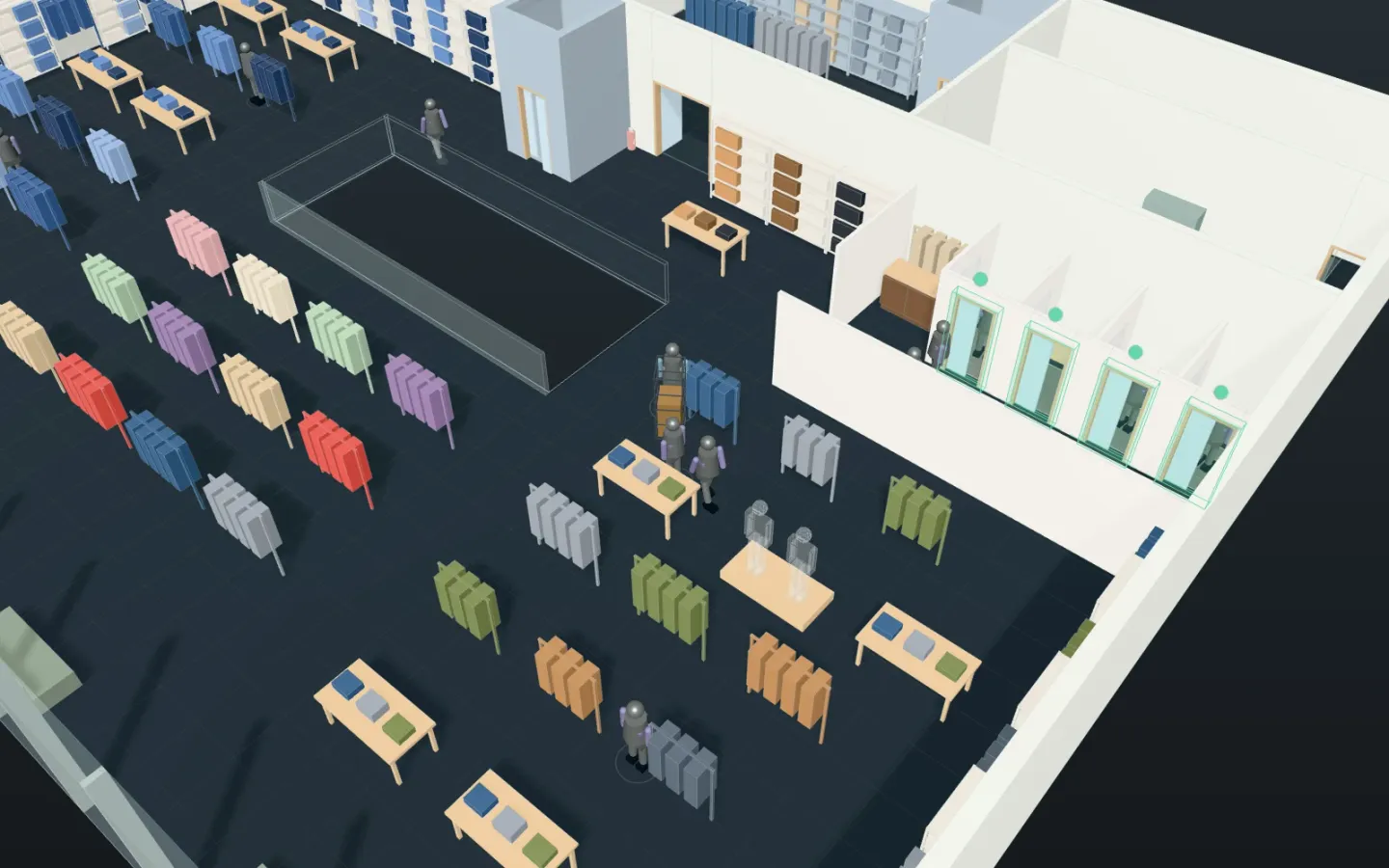
Open the fashion store replenishment (no account needed to open it; running simulations takes Pro). On a Saturday, is one stock assistant enough, or does the floor need a second? With the same gaps on the fixtures, your AI changes the assistants and the work times and compares them in a simulation. This article runs on a synthetic store with the same tools your AI calls over MCP. Every number below comes from that run.
1. The store and the Saturday replenishment
The synthetic store is a two-floor high-street fashion store (the same store as in How many fitting rooms?).
- Over two hours of a Saturday, fixtures run short at random (8 an hour on average, 14.7 over the 20 runs: women’s 35 % and accessories 15 % on the ground floor, men’s 30 % and denim 20 % on the first).
- A gap waits for a free stock assistant, who picks the sizes in the ground-floor stockroom (1 to 6 minutes, typically 3), pushes a trolley to the fixture (by the goods lift for the first floor), fills it (2 to 10 minutes, typically 5) and walks back. A fixture stays short from the gap to the full fixture.
- 120 shoppers an hour shop at the same time without getting in the assistants’ way.
- The times are means over the fixtures filled by four hours (a fixture still short then is not in the mean).
- Not counted: crowd physics, stock levels, sizes sold out, lost sales.
2. The stock assistants
In the saved scenario the number of assistants is not a parameter. Your AI saved a copy with the number as a parameter (put_process_scenario, the saved scenario left as it was) and ran 1 to 3 assistants 20 times with the same random numbers using sweep_process_parameters.
| Stock assistants | Time a fixture stays short | Of which waiting for an assistant | Busy (of the four hours) |
|---|---|---|---|
| 1 (today) | 34.0 min | 24.6 min | 62 % |
| 2 | 12.1 min | 2.5 min | 31 % |
| 3 | 10.0 min | 0.4 min | 21 % |
- With one assistant, 7 tenths of the time a fixture stays short is waiting for the assistant. In 1 run of the 20, one fixture is still short at four hours.
- A second assistant shortens the time by 21.9 minutes (run for run, 95 % interval 15.2 to 28.7). With three it is 10.0 minutes with a 0.4-minute wait; the rest is picking, pushing and filling.
3. A day with more gaps
Your AI made it 12 gaps an hour (22.8 over the 20 runs). The time a fixture stays short:
| Stock assistants | 8 gaps an hour (today) | 12 |
|---|---|---|
| 1 | 34.0 min | 61.1 min |
| 2 | 12.1 min | 18.4 min |
- One assistant is busy 89 % of the four hours, and 1.7 fixtures a run are still short at four hours on average (61.1 minutes is the mean without them).
- Two assistants make it 18.4 minutes and fill every fixture by four hours.
4. One assistant, working faster
Keeping one assistant, your AI shortened the pick and the fill (both their typical times).
| Pick | Fill | Time a fixture stays short |
|---|---|---|
| 3 min (today) | 5 min (today) | 34.0 min |
| 3 min | 3 min 20 s | 30.6 min |
| 2 min | 5 min | 32.0 min |
| 2 min | 3 min 20 s | 28.6 min |
- Shortening both saves only 5.5 minutes (95 % interval 4.3 to 6.7), short of the second assistant’s 21.9. With one assistant, a fixture waits for the assistant longer than the work takes.
5. How to use these numbers
- Give your AI how often fixtures run short (by hour and by department), the pick and fill times, and the way from the stockroom to each department with its lifts, measured in your own store; and an assistant’s hourly cost.
- A shorter time short alone does not show extra sales. Weigh it against the staff cost.
- Not counted: crowd physics, stock levels, sizes sold out, lost sales.