Start from the school gym shelter model (free sign-up; running a simulation needs Pro). The guideline of Japan’s Cabinet Office on a good living environment at evacuation shelters (revised December 2024) asks, following the Sphere standards, for at least 3.5 m² of living space a person and for one toilet per 50 people in the early stage after a disaster and one per 20 in the middle stage, women’s and men’s in the ratio 3 : 1. Its guideline on securing and managing shelter toilets (also December 2024) takes five uses a day on average and asks each shelter to mind the toilets’ waiting time. In this article, your AI counts the people a mock school gym takes and the toilets they need, and simulates the morning’s toilet lines. It ran the same tools an AI calls over MCP. Every figure and number below comes from that run.
1. How many the gym takes
The mock gym is 32.5 × 32.5 m: the stage and two equipment stores to the north, the arena of 32 × 20 m in the middle, and along a corridor to the south two changing rooms, the entrance hall, the women’s toilet (four cubicles), the men’s toilet (two cubicles and three urinals) and an accessible toilet.
With check_space’s floor area a person (areaPerPerson), your AI counts 182 people in the arena’s 640 m² at 3.5 m² each. The stage, the stores and the corridor are not counted. A layout with walkways leaves less area for living space (the layout with cardboard beds and aisles is in Drawing a shelter layout with your AI).
2. How many toilets
For 182 people, the guideline’s numbers are (women’s and men’s split 3 : 1, each rounded up):
| Stage | Evacuees ÷ people a toilet | Women’s | Men’s |
|---|---|---|---|
| Early (one per 50) | 3.64 | 3 | 1 |
| Middle (one per 20) | 9.1 | 7 | 3 |
The guideline counts the building’s own cubicles (Western-style pans used with portable toilet bags) together with the disaster toilets, and not the accessible toilet. This gym has 6 cubicles, 4 women’s and 2 men’s: enough for the early stage’s 4. The middle stage’s 10 need temporary toilets, 3 women’s and 1 men’s.
At five a day, 182 people use the toilets 910 times a day; at 3.7 min a use, that is 55.6 hours of use a day. With the early stage’s 4 toilets, each is in use 13.9 hours a day.
3. The morning’s toilet lines
Your AI writes this morning (put_process_scenario; the numbers are assumptions):
- The 182 evacuees (91 women and 91 men) each go to the toilet once between 6:00 and 9:00 (one of the day’s five). Each one’s time is drawn at random, twice as likely from 6:30 to 7:30 as at other times.
- They walk from the arena to the women’s or the men’s toilet, wait in one line for a free cubicle, use it for 2 to 6 min (most often 3) and walk back. Temporary toilets count in the same line (the walk out to the schoolyard is left out).
With sweep_process_parameters, it runs the same twenty random runs at each number of toilets. The wait in line (mean, and whoever waited longest) and the line at its longest:
| Women’s | Mean | Longest | In line |
|---|---|---|---|
| 2 | 10.0 min | 26.0 min | 14.5 |
| 3 | 1.2 min | 6.8 min | 5.9 |
| 4 | 0.3 min | 3.2 min | 3.6 |
| 5 | 0.1 min | 1.5 min | 2.3 |
| 7 | 0.0 min | 0.3 min | 0.5 |
| Men’s | Mean | Longest | In line |
|---|---|---|---|
| 1 | 87.3 min | 158.3 min | 44.1 |
| 2 | 13.3 min | 31.0 min | 17.6 |
| 3 | 1.9 min | 8.0 min | 7.0 |
| 5 | 0.1 min | 1.6 min | 2.6 |
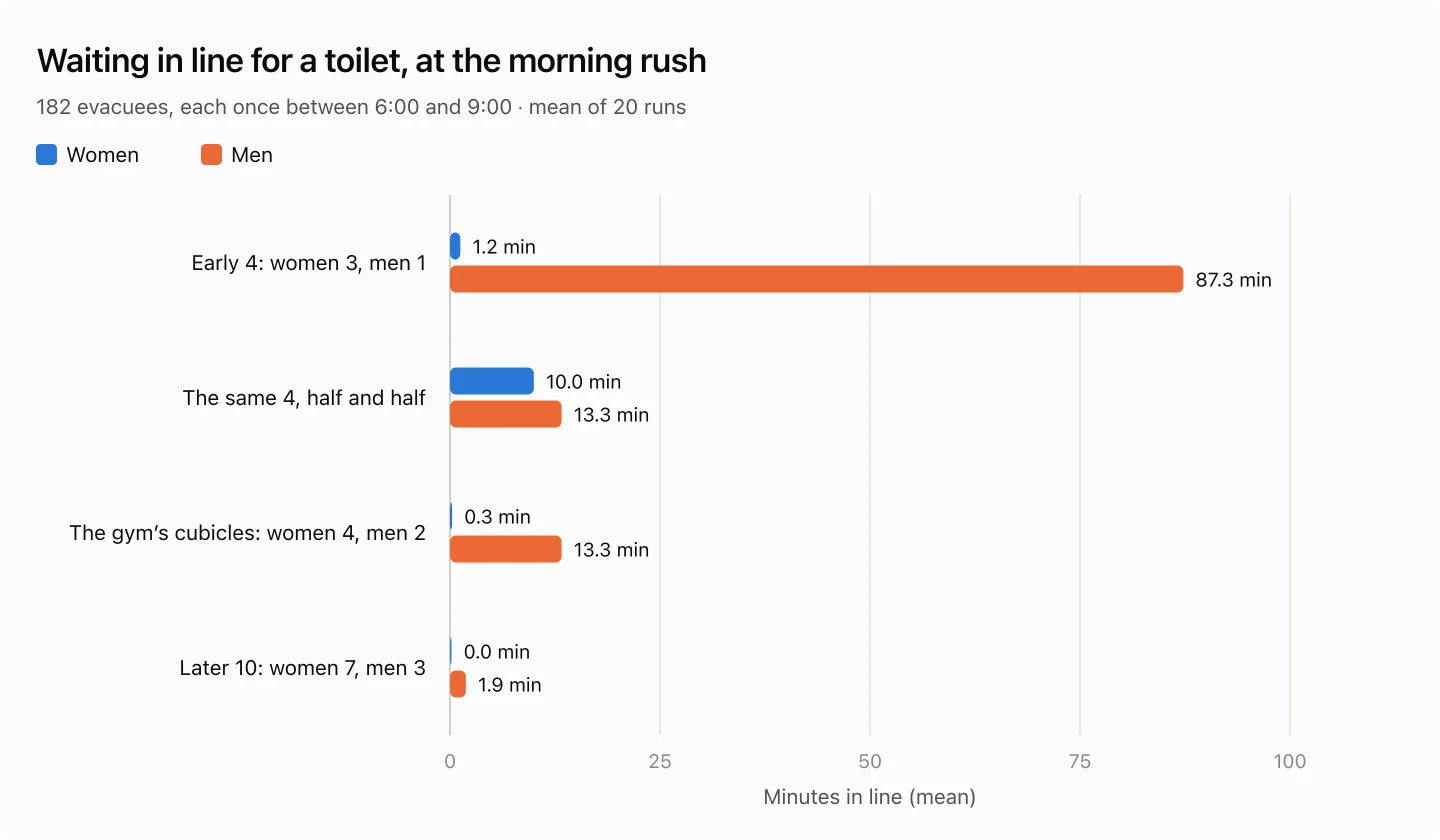
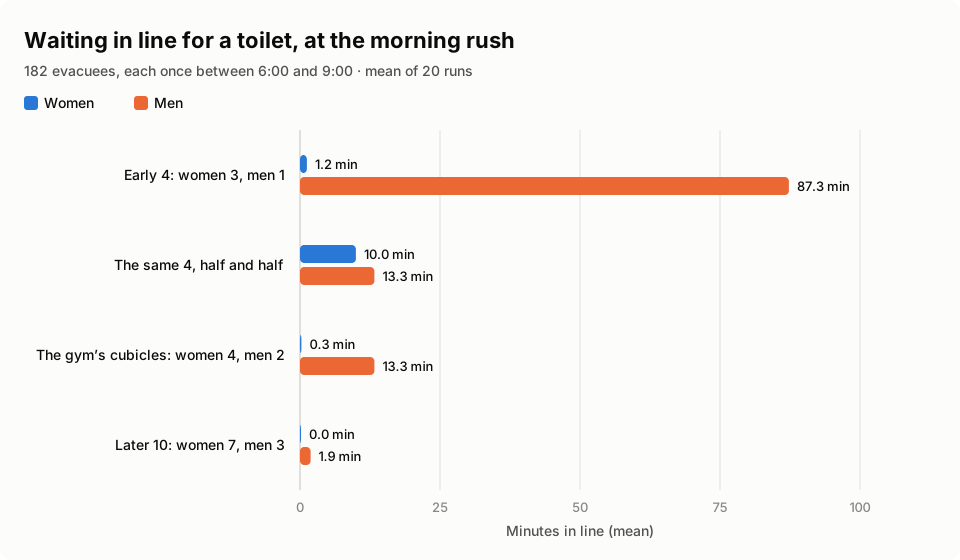
- With the early stage’s 4 split 3 : 1 (3 women’s, 1 men’s), women wait 1.2 min on average, but men 87.3 min, and whoever waited longest 158.3 min.
- The same 4 half and half give 10.0 min for women and 13.3 for men. The women’s and the men’s lines run on the same assumptions, but their times are drawn apart, so the means of 20 runs still differ.
- The gym’s 6 cubicles (4 women’s, 2 men’s) give 0.3 min for women and 13.3 for men.
- The middle stage’s 10 (7 women’s, 3 men’s) give 0.0 min for women and 1.9 for men.
- Under these assumptions 91 women and 91 men each keep 2.8 toilets busy from 6:30 to 7:30. Split 3 : 1, the 4 toilets put that on one men’s toilet.
4. When women take longer
If a woman’s use takes 1.5 times as long (3 to 9 min, most often 4.5), the women’s line becomes (with the men’s 2 as they are):
| Women’s | The same time | 1.5 times as long |
|---|---|---|
| 3 | 1.2 min | 9.7 min |
| 4 | 0.3 min | 2.2 min |
| 5 | 0.1 min | 0.5 min |
| 7 | 0.0 min | 0.1 min |
The guideline asks for more women’s toilets than men’s. The longer women’s uses are, the more a split towards women’s toilets evens out the waits.
5. How to use these numbers
- Give your AI your own shelter’s evacuees (women and men, children and older people), the toilet visits in each part of the morning, and the time a use takes (portable toilet bags included): the times and the bunching here are assumptions.
- The guideline’s numbers are what to secure; the wait comes from when the visits bunch together. Look at the morning and the hour before lights-out to decide how many temporary toilets to add and how to split them.
- Not calculated: the night, children, older and disabled people (the accessible toilet), cleaning the toilets and disposing of the bags, the walk out to temporary toilets in the weather and the dark, water and sewer damage, the health effects of people putting off going.