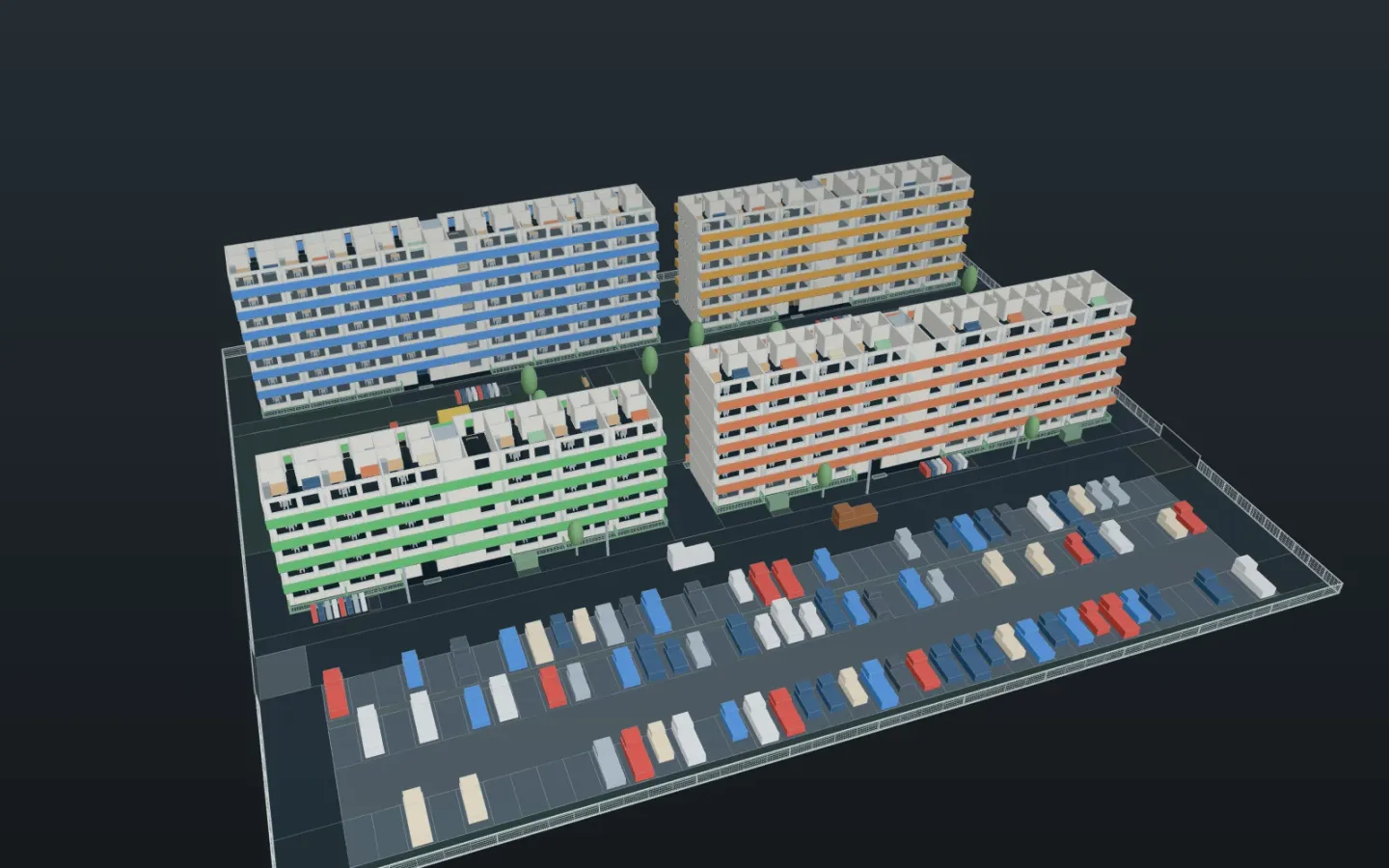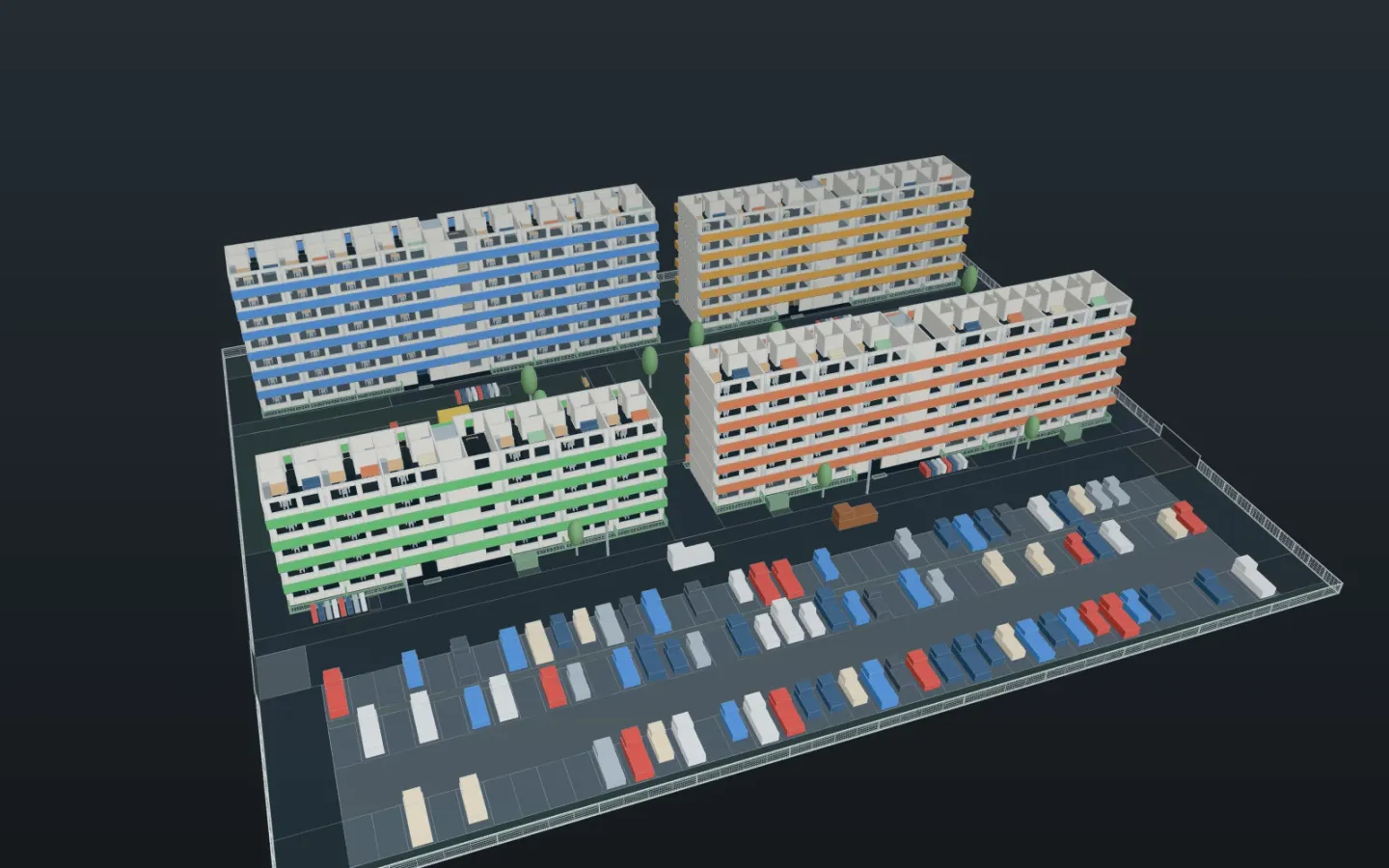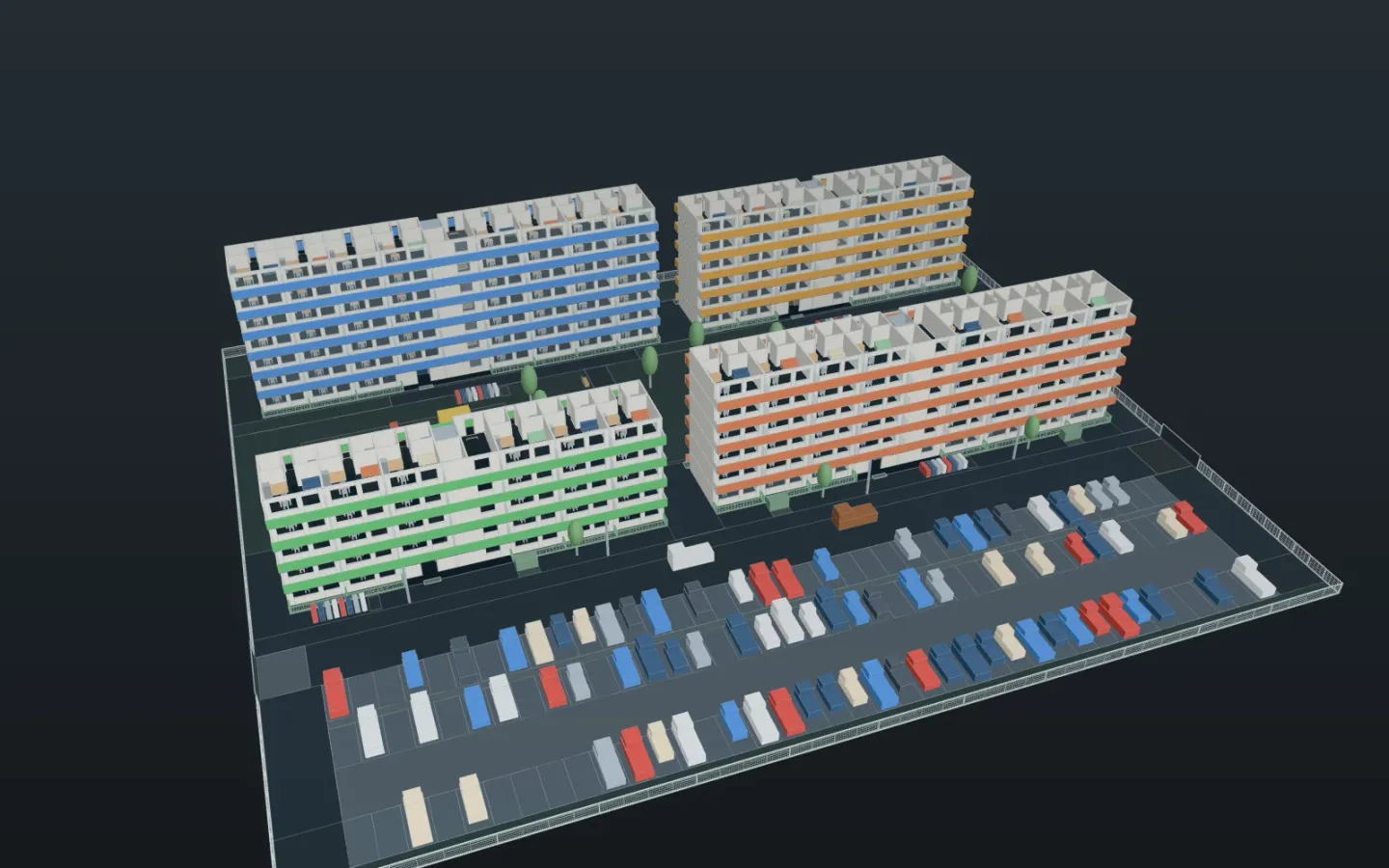
Open the apartment estate model (no account needed). Both sides of the auto-lock door (the inner entrance door that only a resident’s key or the entry phone opens), the delivery boxes, the lift hall: how many security cameras does an apartment entrance need, and where? In this article, on the ground floor of block A of a simulated apartment estate, the AI has suggest_cameras propose camera positions and counts how much is seen for each number of cameras and each lens width. It used the same tools an AI calls over MCP; every figure and picture below comes from that run.
1. What was checked
The shared core of the ground floor of block A (seven storeys, seven apartments on the ground floor) of a simulated estate (four blocks and a community hall). From the main entrance on the south side you enter the vestibule; through the auto-lock door in the glass screen is the lobby (the delivery boxes and a bench), and beyond it the lift hall and the stairs.
The AI gave suggest_cameras these conditions:
- What must be seen (where people stand): outside the main entrance (1.3 × 3.8 m) counts twice; the vestibule and the area in front of the delivery boxes (1.2 × 2.6 m) three times; the lobby once; and the lift hall twice.
- Where cameras may go: the walls of the shared core, 2.5 m above the floor; none inside the apartments, on the planting outside or in the open corridor. There are 99 candidate positions, with directions every 15° and downward tilts of 15, 30, 45 and 60°.
- The camera: two lenses, 90° × 60° and 120° × 70°, both with a range of 20 m (assumed).
- How it counts: for each point of a 0.25 m grid on the floor, whether it is in a camera’s view with nothing in between (walls or the delivery boxes). The glass screen and open doors let the view through.
suggest_cameras adds the camera that sees the most first, then the next, and then swaps one camera for another as long as that sees more. The result is not a proven optimum.
2. The number of cameras and the lens
| Cameras | 90° × 60° lens | 120° × 70° lens |
|---|---|---|
| 1 | 80.7% | 87.5% |
| 2 | 94.3% | 95% |
| 3 | 97% | 98.2% |
| 4 | 98.6% | 98.7% |
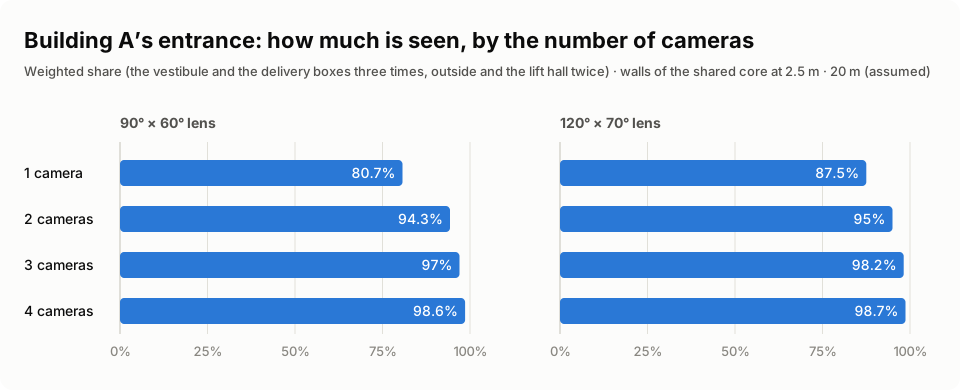
- With the 90° lens, two cameras see 94% and three 97%. The first camera looks down from the lobby’s north-west corner toward the entrance and sees the lobby, the vestibule and the area in front of the delivery boxes at once.
- The wide lens sees 7 points more with one camera (80.7% against 87.5%) but makes little difference from two cameras on (94.3% against 95%). It helps when one camera has to do.
3. Are the faces of the people coming in seen?
The AI counted outside the entrance and the vestibule again at the height of the faces of people coming in (1.6 m), counting a point only when it is seen from in front of their faces (within 60° of straight ahead for people facing north), with the 90° lens.
- One camera sees 85%, two 93.7%, three 96.4%, four 97.5%. The first is in the same place, the lobby’s north-west corner, and sees people coming in from the front.
- Even with four cameras, outside the entrance is 82.5% seen: its edges cannot be seen from in front through the entrance door.
4. Where the two go
Asked for two cameras with the 90° lens, suggest_cameras reaches 95.3% (by area, 94.8%) after one swap. One camera looks down 45° to the east-south-east from the north end of the lobby’s west wall; the other looks west from the wall at the east end of the vestibule’s glass screen.
| What must be seen | Share seen |
|---|---|
| Outside the main entrance | 75% |
| The vestibule | 100% |
| The lobby | 96.2% |
| In front of the delivery boxes | 100% |
| The lift hall | 98.1% |
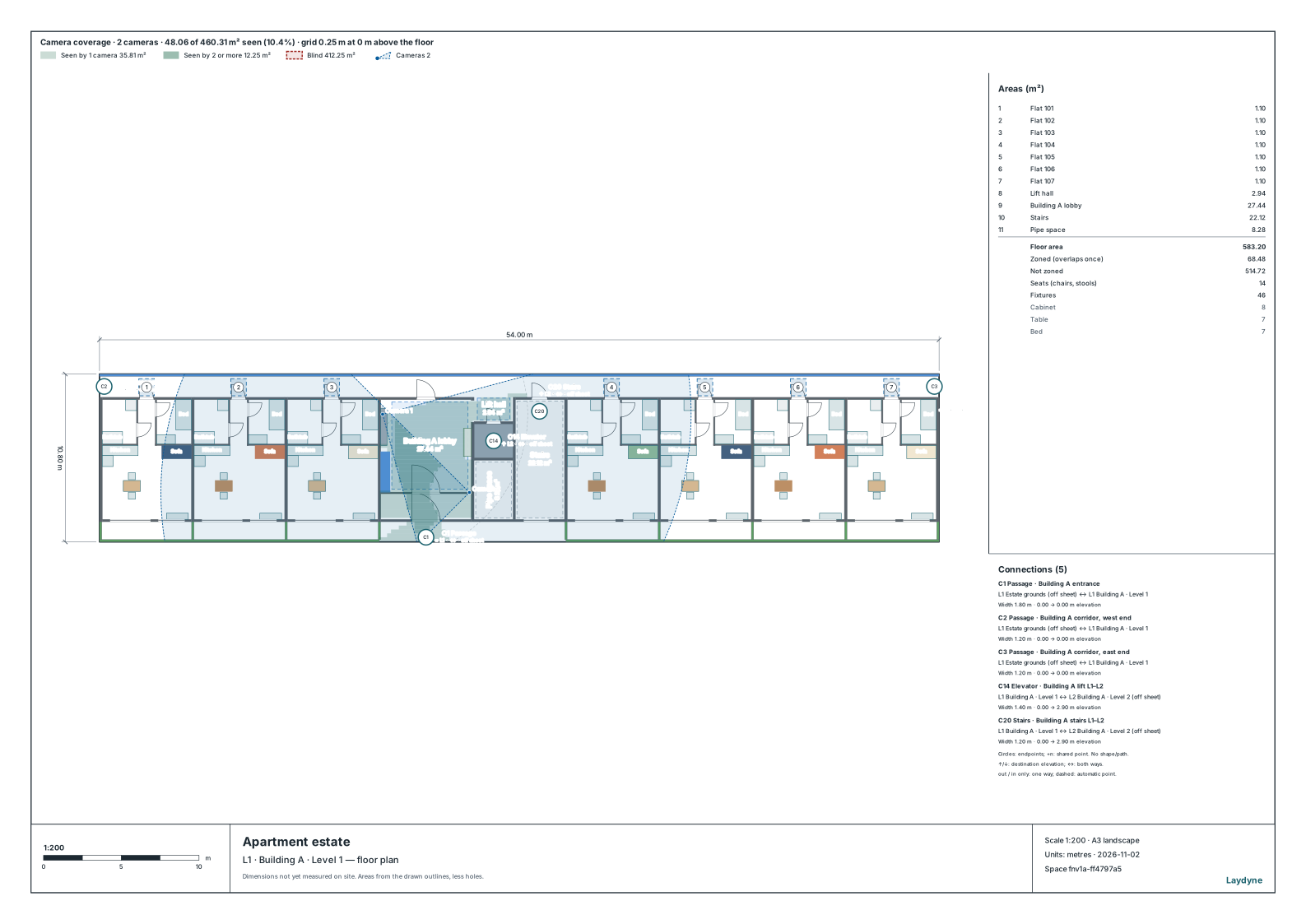
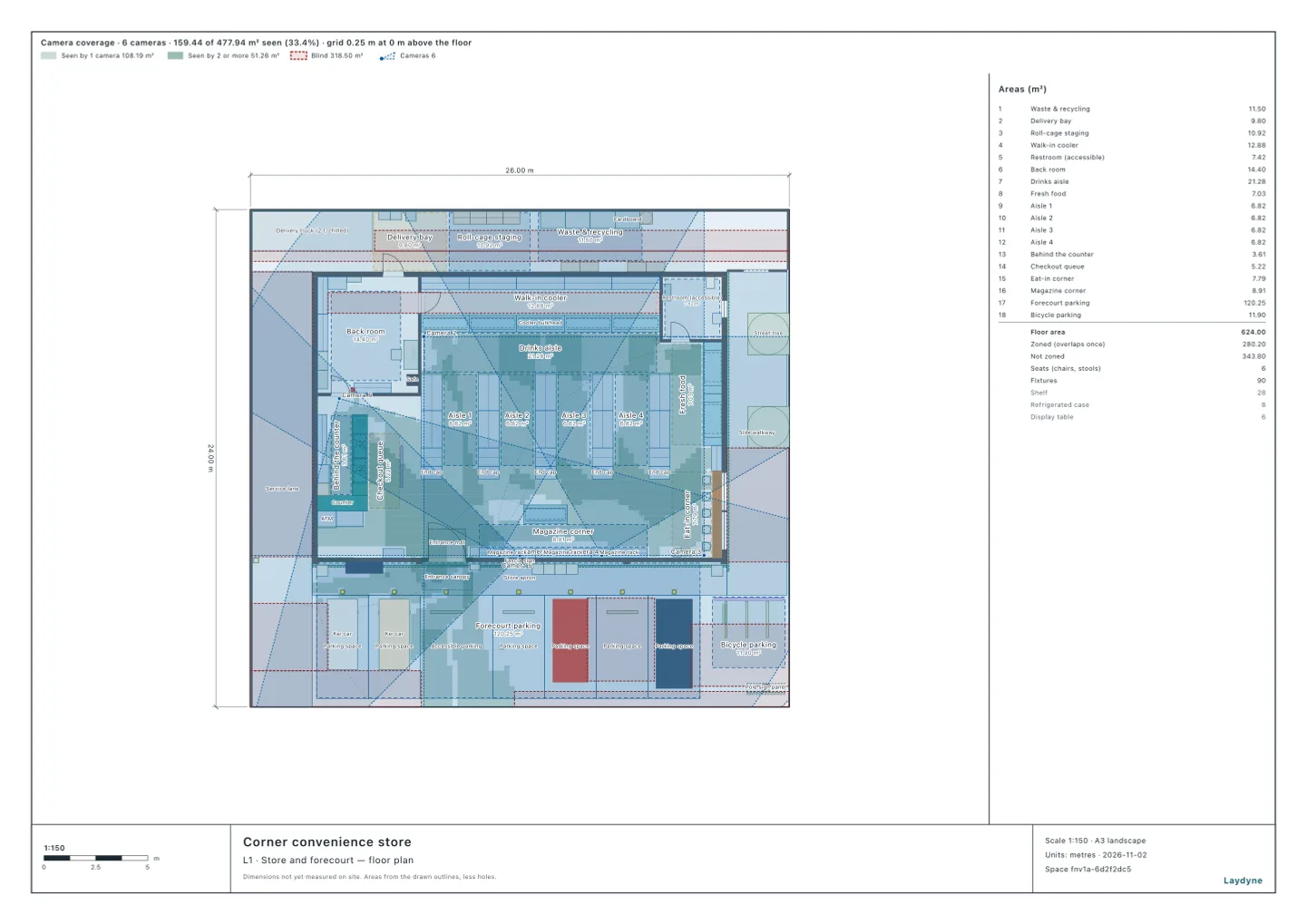
get_view_image’s visibility overlay draws what the two placed cameras see. The drawing covers the whole ground floor (the apartments and the open corridor included), so the figures in the strip above it are for all of it.
5. How to use it, and what it does not tell you
- Decide by the weights. Raising the weight of an area that must be seen (in front of the delivery boxes, the vestibule) gives positions that favour it.
- Choose the lens with the number of cameras. With one camera a wide lens helps; with two the difference is small.
- Put up the notice. The Personal Information Protection Commission’s Q&A (Q1-13) says that a business that uses a security camera to take images in which a person can be identified should specify the purpose as far as it can and use the images only for that purpose. Where people cannot easily tell that a camera is taking their picture, it should take steps such as a “security camera in operation” notice (Act on the Protection of Personal Information, Article 20(1)).
What it does not tell you:
- Whether a point is seen is judged from the field of view and the line of sight only. Image quality, light, glare (such as daylight through the entrance glass) and whether faces can be recognised are not calculated.
- The lift car, the open corridors of each floor, the bicycle parking and the refuse points are not counted.
- The lenses’ fields of view and range are assumed: check them against the cameras you have in mind.
- The estate is illustrative: the sizes are examples.
Tools used
suggest_cameras: from what must be seen and its weights, where cameras may go and the lens, it gives the positions and the share seen for each number of camerasedit_space: places the two suggested cameras as camera partsget_visibility: checks what the two placed cameras seeget_view_image(visibility): draws what they see and their fields of view on the plan