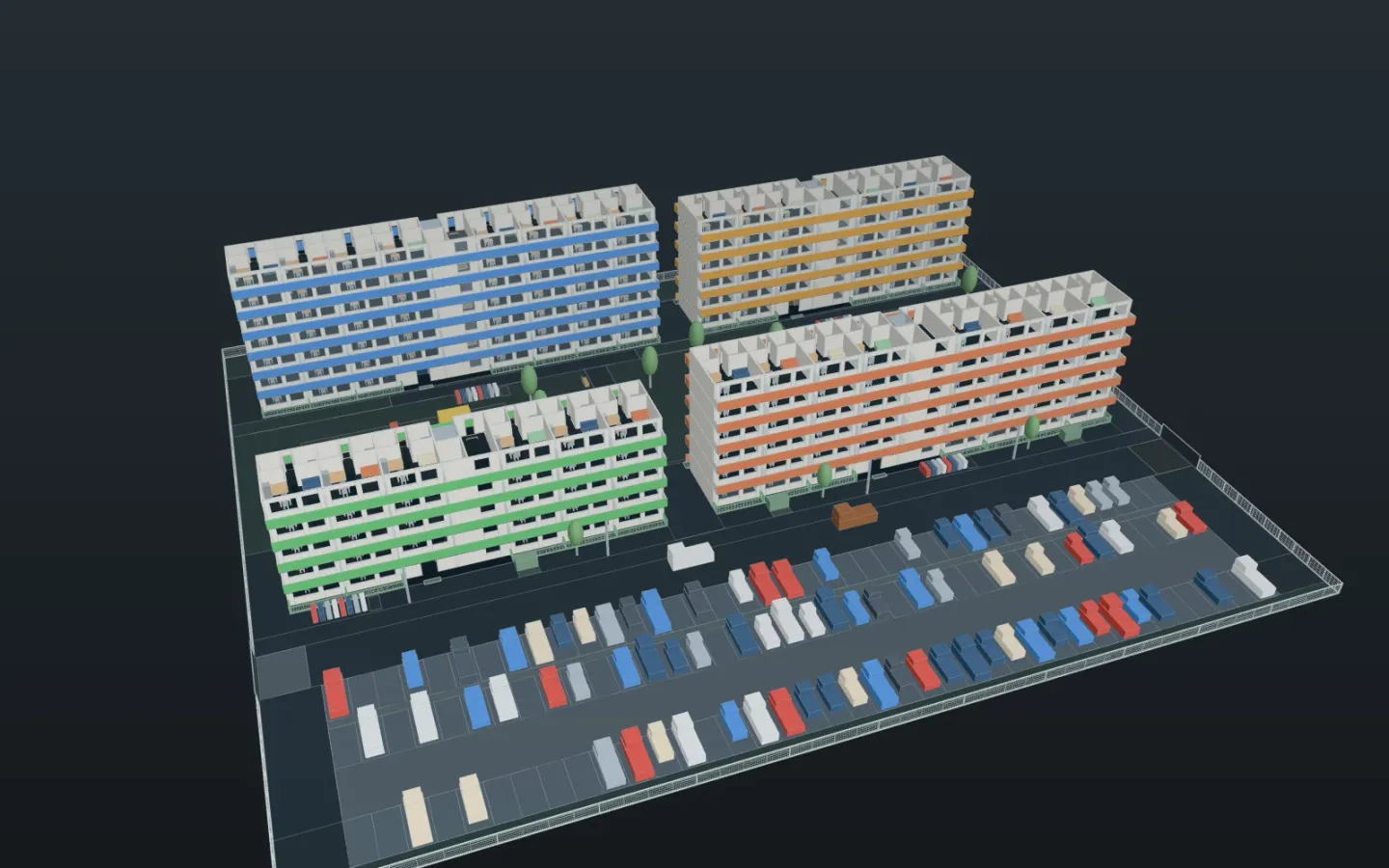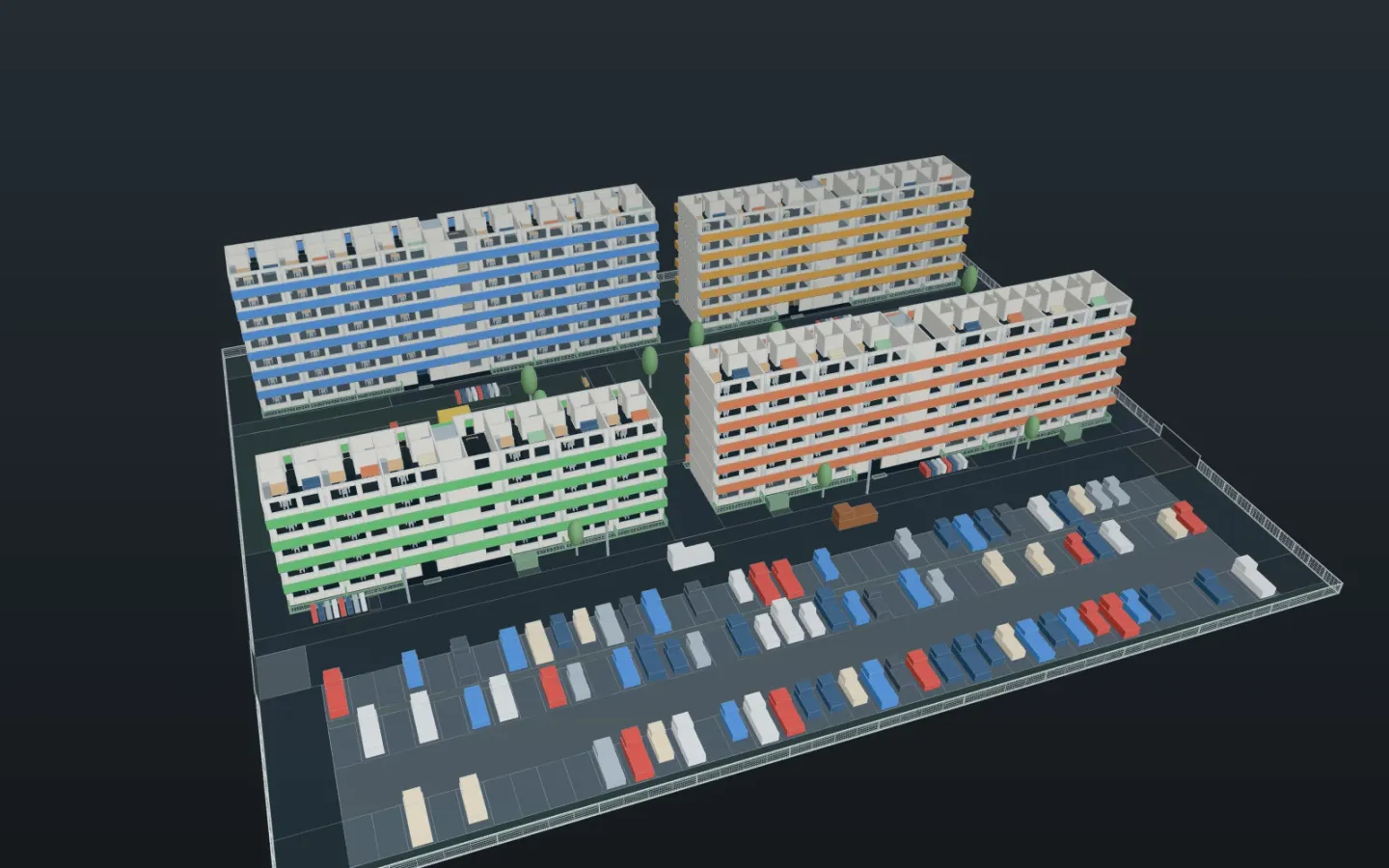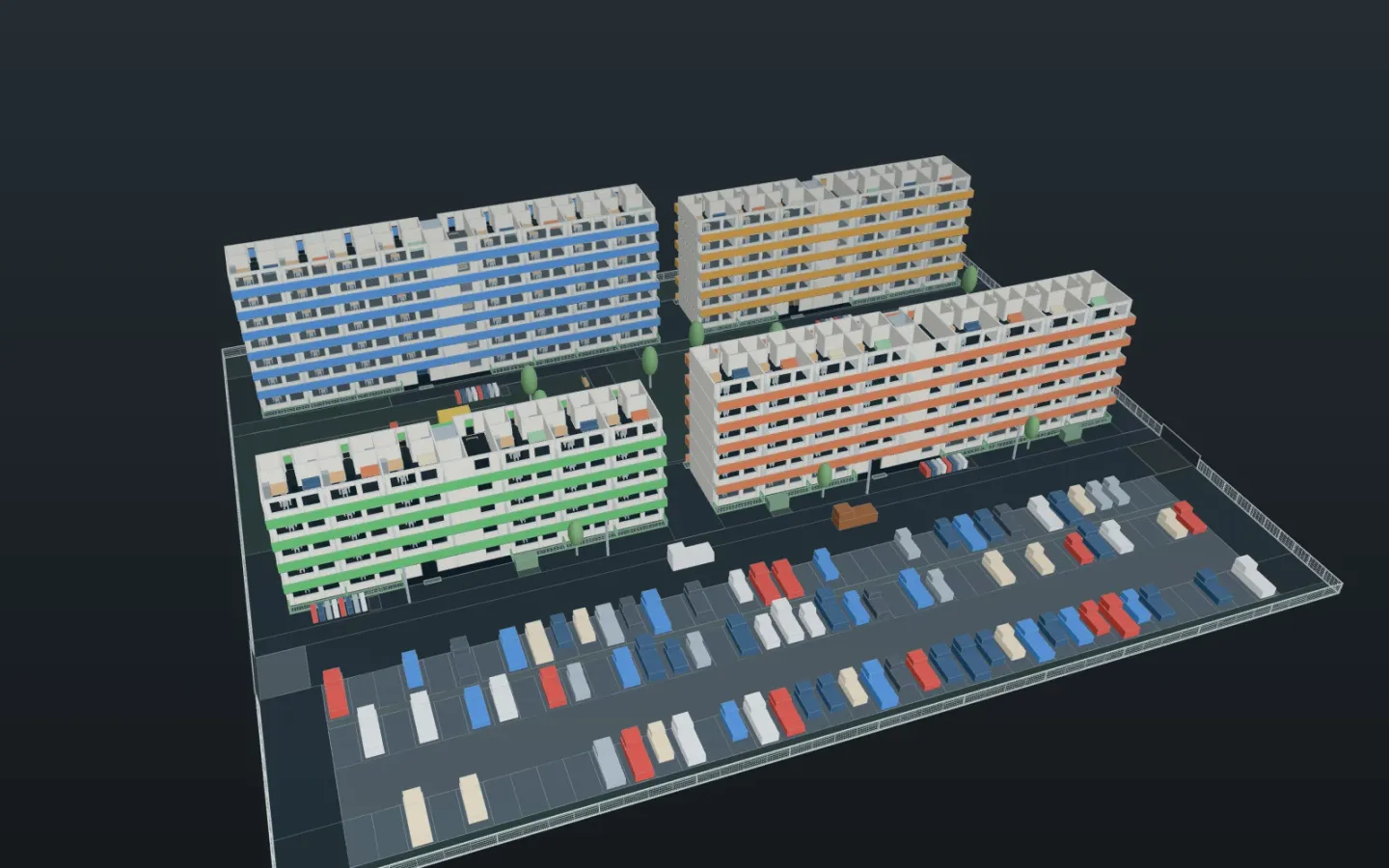
Open the apartment estate model (no account needed). The gates, the building entrances, the bicycle shelters, the refuse points, the car park: how many security cameras does an apartment estate need, and where? In this article, on the grounds of a simulated apartment estate, the AI asks suggest_cameras where to put the cameras and counts how much is seen for each mounting and each number of cameras. It used the same tools an AI calls over MCP; every figure and picture below is their result.
1. What was checked
The grounds of a simulated apartment estate (110 × 90 m): four residential blocks of five to seven storeys (A to D) and a community hall, a vehicle gate to the west and a gate to the station to the east. A road crosses the middle of the site from west to east, with the residents’ car park (117 spaces) south of it. There are four bicycle shelters, three refuse points, and a play area between blocks A and C.
The AI gave suggest_cameras these conditions:
- What must be seen: the two gates, the ground in front of the four entrances, the four bicycle shelters and the three refuse points count three times; the community hall’s forecourt twice; the car park, the play area and the road and paths once.
- Where cameras may go: the outer walls of the four blocks and the hall (every 3 m) and the four street light poles, 3 m above the ground; none on the boundary fence (1.5 m tall).
- The camera: 90° across, 60° up and down, seeing 30 m (assumed).
- How it counts: for each point of a 0.5 m grid on the ground, whether it is in a camera’s view with nothing (buildings, trees, parked cars, the refuse cages) in between. Each storey of a building counts as a box that hides what is behind it up to that storey’s height.
suggest_cameras adds the camera that sees the most first, then the next, then swaps one camera for another as long as that sees more. The result is not a proven optimum.
2. The street lights alone
On the four street light poles alone, eight cameras see 40.3%, and three swaps after choosing them take that to 41.1%. The four street lights all stand on the north side of the road (south of blocks C and D), so the ground in front of the entrances of blocks A and B, the bicycle shelters of blocks A and B, the hall’s forecourt and the play area cannot be seen from any street light (the tool’s result says they are seen by no candidate). They all lie north of blocks C and D, which stand between them and the street lights.
3. With the blocks’ outer walls too
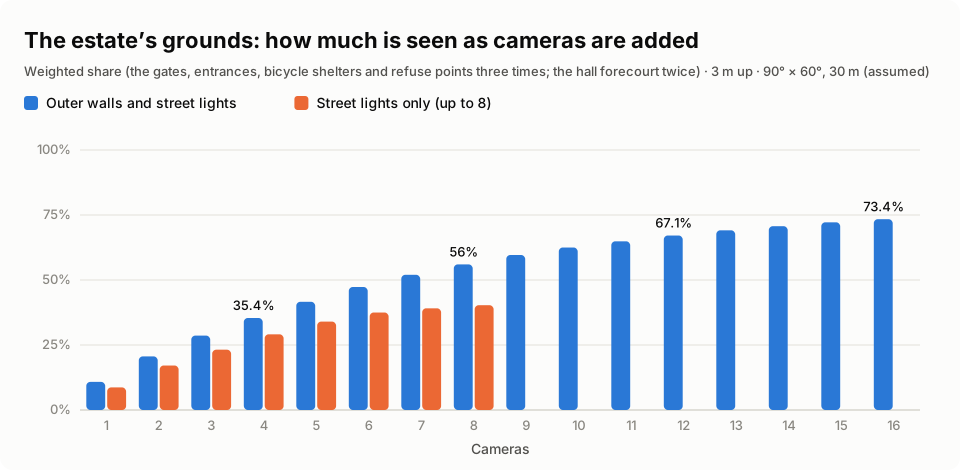
- Added one at a time on the outer walls and street lights: 35.4% with 4 cameras, 56% with 8, 67.1% with 12 and 73.4% with 16.
- After the sixteen were chosen, one swap took them to 73.5% (by area, 71% of 3,557 m²).
| What must be seen | Area | Street lights alone (8) | Outer walls and street lights (16) |
|---|---|---|---|
| The gates (2) | 60 m² | 100% | 93.3% |
| In front of the four entrances | 60.5 m² | 43.8% | 95% |
| The bicycle shelters (4) | 63 m² | 41.7% | 100% |
| The refuse points (3) | 7.5 m² | 100% | 66.7% |
| The hall’s forecourt | 29.3 m² | 0% | 100% |
| The residents’ car park | 1,622 m² | 26.3% | 45.6% |
| The play area | 319.8 m² | 0% | 84.5% |
| The road and paths | 1,428 m² | 59% | 93.5% |
The areas are counted on the 0.5 m grid.
- Fourteen of the sixteen go on the blocks’ outer walls (five on block C, six on D, two on A and one on B) and two on street light poles. Eight of them look from the south walls of blocks C and D towards the road and the car park.
- The eastern refuse point is not seen (the other two are, fully). The cameras are chosen by how much they add to the total, so small places come last. The tool’s result names it as mostly unseen though candidates see it, and says to ask again with only it as what must be seen.
- 29.5% of the car park is seen from no candidate position (the tool’s result says so).
4. Adding where it is not seen
With the sixteen placed, the AI added cameras where they fall short:
- The eastern refuse point: asked for one camera with only that as what must be seen, the tool puts one on the easternmost street light, looking east-south-east, and it sees all of the refuse point.
- The car park: asked for up to six on three new poles 4 m tall on the planting strip south of the car park, the tool takes the seventeen cameras’ 74.2% to 84.8% with 23 (by area, 83.4%), and the car park from the sixteen’s 45.6% to 71.9%.
Coverage of the weighted target area rose from 41.1% with eight cameras on street light poles to 73.5% with sixteen on walls and poles, and 84.8% with 23 after adding cameras for the refuse point and car park.
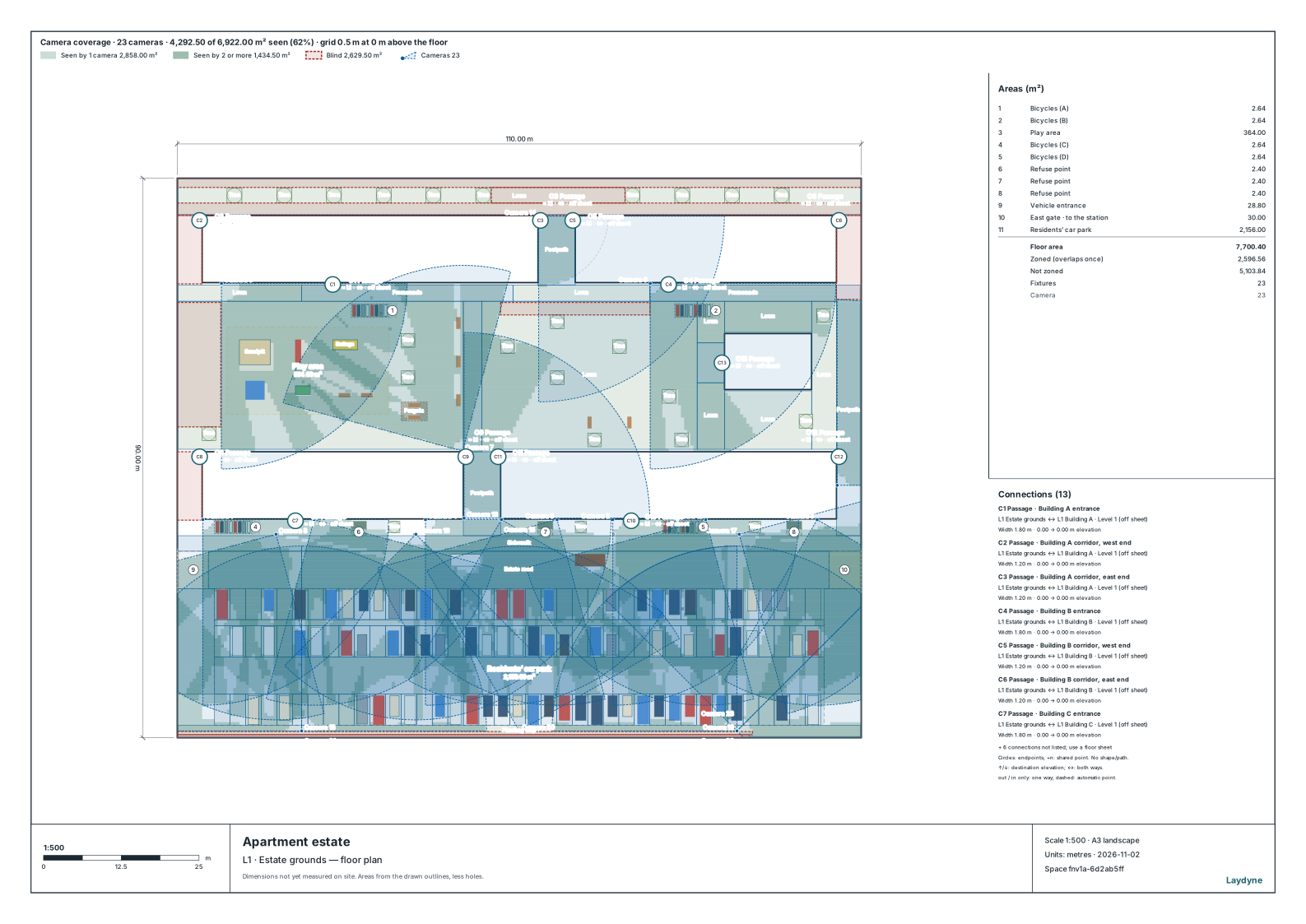
get_view_image’s visibility draws what the 23 placed cameras see. The white rectangles are the buildings. The figures in the strip above are for the whole site, the lawns included, not only what must be seen.
5. How to use it, and what it does not tell you
- Count the buildings’ shadows. On a site plan, the buildings block the view. Street lights alone do not see the entrances and bicycle shelters beyond a building; cameras on the blocks’ outer walls reach them.
- Check small places one by one. The cameras are chosen by how much they add to the total, so a small place such as a refuse point comes last. Read the share for each place, and ask for one more camera for only what is not seen.
- The national guideline. The design guideline for crime prevention in apartment buildings (revised April 2006) of Japan’s Ministry of Land, Infrastructure, Transport and Tourism (MLIT) says that when the shared entrances, bicycle parking, car parks and the like of an existing building are refurbished and the view needed for crime prevention is hard to secure, security cameras should preferably be installed. Where they are, their positions and number should be chosen to make up for the view and to deter crime (Part 4, 2(11)). The guideline imposes no obligation or regulation (Part 1, 2(2)).
- Put up a notice. The Q&A of Japan’s Personal Information Protection Commission (Q1-13) says that a business that uses a security camera to take images in which a person can be identified should specify the purpose as far as it can and use the images only for it. Where people cannot easily tell that a camera is taking their picture, the business should take steps such as a “security camera in operation” notice (Act on the Protection of Personal Information, Article 20(1)).
What it does not tell you:
- Whether a point is seen is judged from the field of view and the line of sight only. Image quality, light at night, and whether faces or number plates can be read are not calculated. The guideline calls for the light the cameras need to work where they are installed (2(11)(b)).
- Each storey of a building counts as a box that hides what is behind it up to that storey’s height. Whether apartments’ windows or balconies come into a camera’s view is not counted.
- Trees count as boxes from the ground to the top of the crown, and parked cars up to their roofs, hiding what is behind them; cars coming and going change that.
- The bicycle shelters’ roofs and the bicycles are drawn as parts people walk through, so they count as not hiding anything. Under a roof or behind a bicycle may be harder to see in reality.
- The cameras’ fields of view and range are assumed: check them against the models you have in mind.
- The estate is illustrative: the sizes are examples.
Tools used
suggest_cameras: from what must be seen and its weights, where cameras may go (the buildings’ outer walls, poles, points of your own), at what height and with which lens, it gives the places and the share seen for each number of cameras; it also reports what no candidate seesedit_space: places the suggested cameras as camera partsget_visibility: checks what the 23 placed cameras seeget_view_image(visibility): draws what they see and the blind spots on the plan
How to ask an AI
Propose cameras for this estate’s gates, building entrances, bicycle shelters, refuse points and car park. Compare the number and coverage when cameras can go only on the street light poles and when they can also go on the buildings’ outer walls, and show what remains unseen.