Buildings / WORKED EXAMPLE
Building deliveries
Send parcel robots from a lobby to two office floors.
Free to open, edit and save a file. Pro to run your changes. Opening a project asks before replacing your current space.
Would another delivery robot help, or would it wait for the same lift?
- Who uses it
- Facilities teams and robot integrators
- How it can create value
- Compare fleet sizes against a delivery-time target before a robot trial. Use the result to screen a purchase or rental plan, then add vendor costs and validate the real lift and operating constraints.
- Bring your site data
- Parcel arrivals, handoff times, floor routes, delivery target and vendor quotes. This model includes lift capacity and travel, not real lift dispatch or robot charging.
01 / SETUP
A model you can inspect.
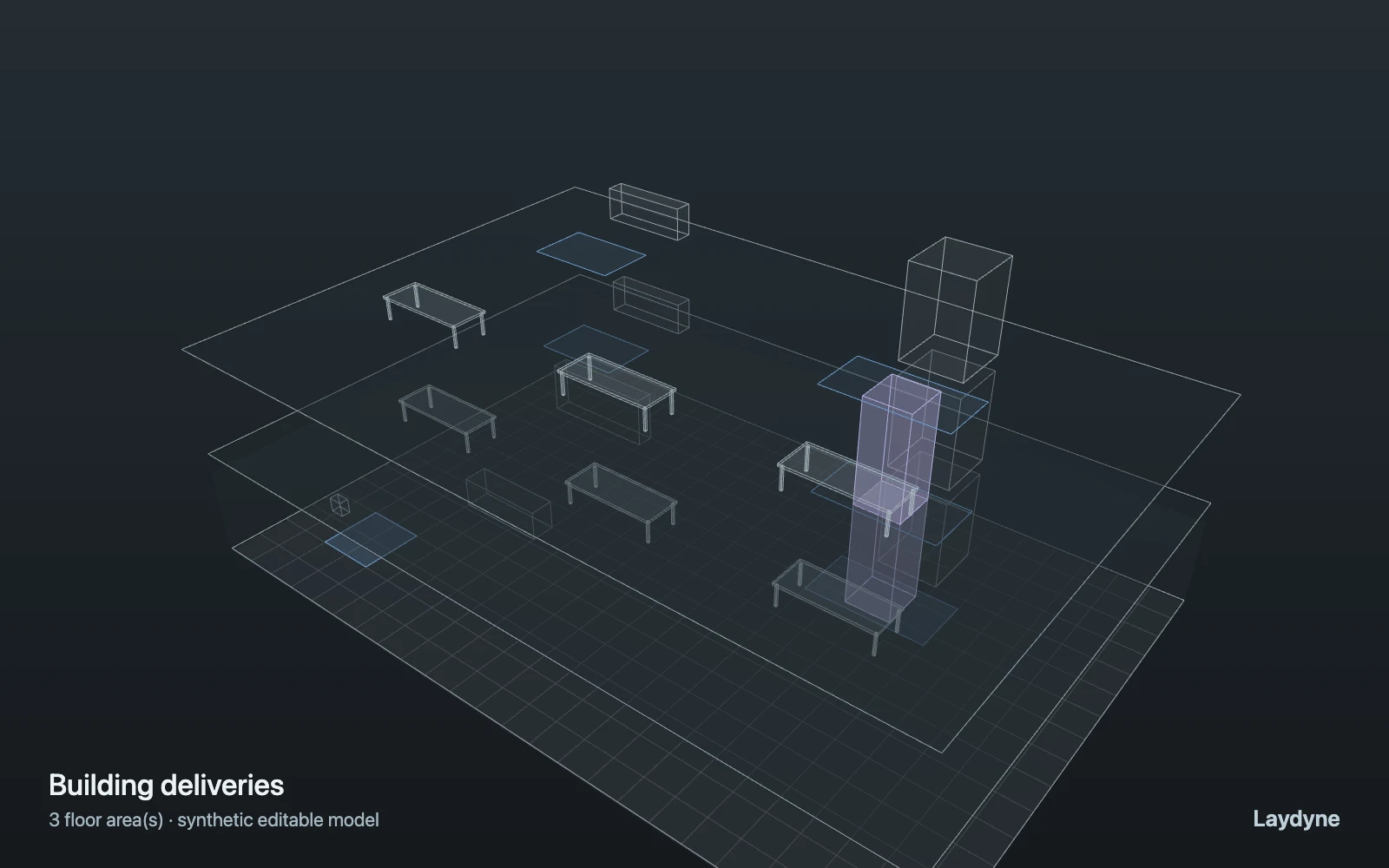
Two delivery robots collect parcels in the lobby and serve two office floors. Compare robot counts with the same orders, or move a delivery point. Robots remain busy on the empty return; job distance excludes that return while robot distance includes it. The lift models travel and capacity only, without car dispatch or door cycles. Inputs are synthetic; vehicle conflicts and charging are not simulated.
Change one thing
Compare 2 and 4 delivery robots with the same parcels.
Read the consequence
Parcel wait, robot utilization and lift use. Lift dispatch is not simulated.
View the starting inputs
- Deliveries per office floor
- 12
- Order interval per floor (s)
- 20
- Parcel loading (s)
- 8
- Parcel handoff (s)
- 15
Agent counts, routes and resource definitions are also saved in the project JSON.
02 / ACTUAL ENGINE OUTPUT
The same demand. A different capacity.
One run, seed 0. Observation window 60 minutes. Arrivals, geometry and the seed set stay the same in every option.
| Scenario | Completed | Mean wait | Mean cycle | Blocked |
|---|---|---|---|---|
| 2 delivery robots | 24 | 6m 44s | 7m 42s | 0 |
| 4 delivery robots | 24 | 2m 16s | 3m 14s | 0 |
Waiting averages cover arrived jobs, including unfinished waits; cycle averages cover completed jobs only. These are synthetic calculations, not measured store performance, revenue or a safety assessment.
Engine, status and output notes
process-des-2.2.0. Status: 2 delivery robots: completed; 4 delivery robots: completed. “Completed” is the engine run status; check the blocked column for unreachable jobs.
- No engine warnings.
Engine inputs and saved comparisons stay with the downloaded project. Any limited trace affects playback details, not aggregate metrics.
03 / MAKE IT YOURS
Plan in 2D. Inspect in 3D. Keep the whole project.
- Open and adjust. Switch between 2D and 3D; edit a part, a floor or an input. Both views describe the same model.
- Connect your agent for free. Sign in, choose Connect AI and connect Codex or Claude Code. Ask it to inspect the example, edit the layout and check a route.
- Save a checkpoint. Export → Project JSON, or ask the agent to export the complete project. Import it later to restore floors, scenarios, saved comparisons and the selected view.
- Compare with Pro. Run an edited scenario or compare frozen options under the same demand. Pro also adds built-in AI and manual cloud saving.