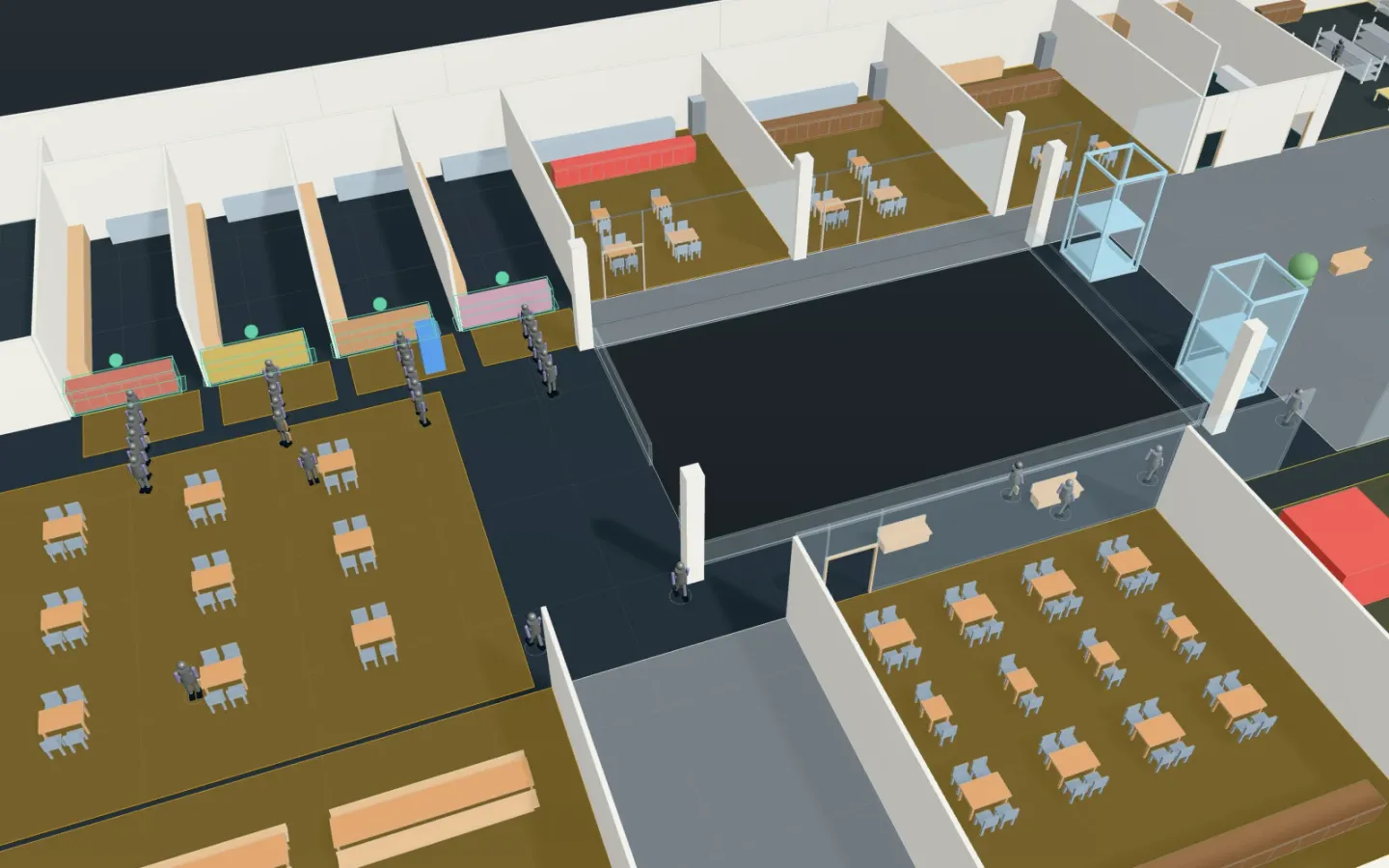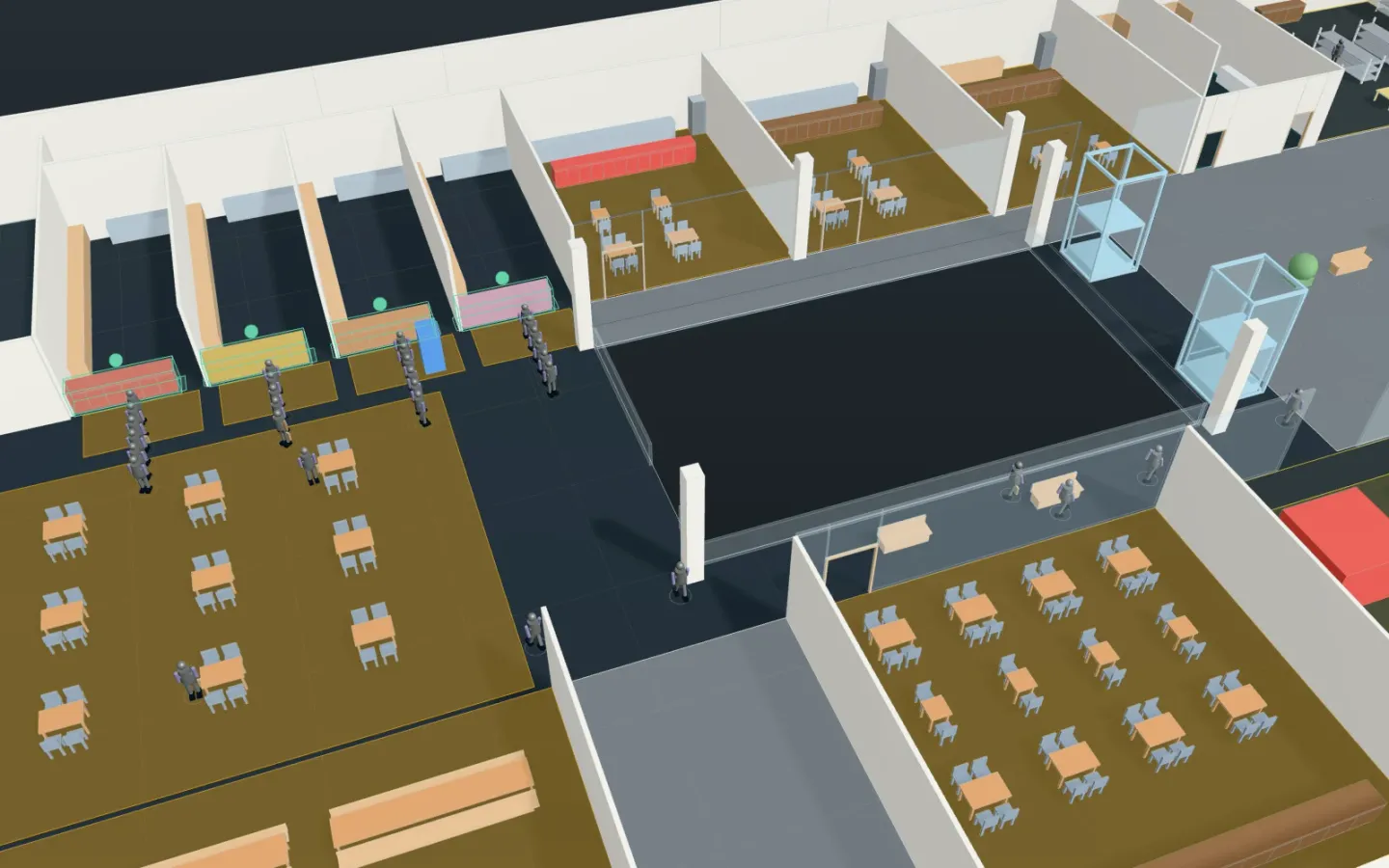
Open the retail campus model (no account needed; running the simulation needs Pro). When two buildings are joined by a bridge, how does the flow of people change? In this article, on a simulated retail campus, the AI uses the saved Saturday afternoon scenario as it is and changes the share of trips that cross the bridge between the main building and the cinema, then compares the plaza and the escalators. It used the same tools an AI calls over MCP; every figure and picture below is their result.
1. What was compared
A simulated site: a main building (three floors), an annex, a cinema and a five-deck car park, joined by a plaza and bridges. Floors are counted as in Japan, the ground floor being floor 1. The saved Saturday afternoon runs for an hour, until everyone has left:
- Arrivals: by car, at a rate of 320 an hour for the first 15 minutes, parking on any deck; three trains (10 people each) and two buses (6 each). People with a pram or a wheelchair come at a rate of 24 an hour for the first 15 minutes and use the lifts only. On average, 175 people come in a run.
- A quarter of those who come by car, train or bus shop in the main building first, then go to the cinema for the next show (30 people a run on average).
- 12 minutes in, an earlier film ends and 44 people come out: 40% go to the food court (on the main building’s floor 3), 35% to their car and 25% to the station.
- Of the trips to and from the cinema, a share (the
bridgeShareparameter, in %) crosses the bridge, which joins the main building’s floor 3 to the cinema lobby on the cinema’s floor 2. The rest go down to the main building’s ground floor and round by the plaza. 0% is the site without the bridge.
The AI read this scenario with list_process_scenarios and ran it with sweep_process_parameters with 100% (now), 50% and 0% of the trips crossing the bridge, 20 runs each (with the same random streams).
2. The result
| Measure | Bridge: every trip (now) | Bridge: 50% | No bridge |
|---|---|---|---|
| Peak number of people on the plaza | 11.5 | 15.4 | 20.2 |
| Cinema escalator (up) | 6.3 trips | 18.0 trips | 29.8 trips |
| Cinema escalator (down) | 13.0 trips | 29.3 trips | 44.0 trips |
| Main building escalator (ground floor → floor 2) | 48.1 trips | 56.9 trips | 64.5 trips |
| Main building escalator (floor 2 → ground floor) | 40.6 trips | 51.3 trips | 61.9 trips |
| Film-goers: from arriving to a seat (shopping in the main building included) | 10.7 min | 10.6 min | 10.5 min |
| The earlier audience: from the screen until they leave the site (the meal included for those who eat) | 9.7 min | 10.3 min | 10.8 min |
| The last visitor out | 47.5 min | 48.1 min | 49.6 min |
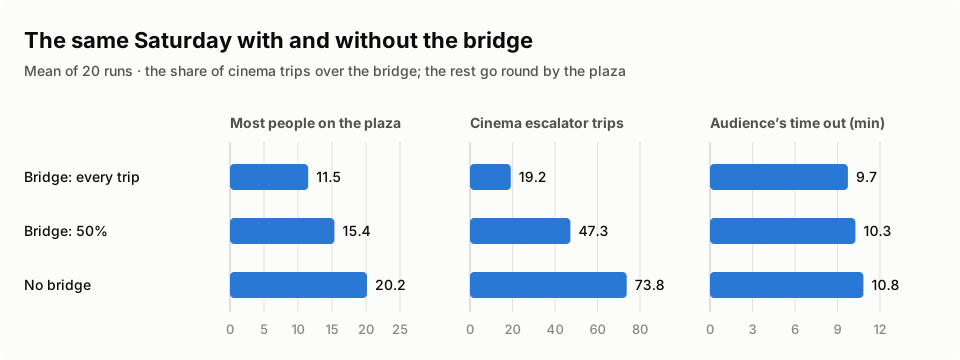
- Without the bridge, the peak number of people on the plaza nearly doubles (from 11.5 to 20.2: 8.7 more, 95% interval 7.8 to 9.5).
- The trips on the cinema escalators nearly quadruple (up and down together, from 19.2 to 73.8). All 44 people of the earlier audience ride the down escalator to the plaza. On the main building’s escalators between the ground floor and floor 2, the trips up go from 48.1 to 64.5 and the trips down from 40.6 to 61.9.
- Still, no escalator ever has a line. In each of the 20 runs, on every escalator, the longest line was 0 people.
- The earlier audience leaves the site about a minute sooner with the bridge (65.5 seconds longer without it, 95% interval 54.8 to 76.2): the food court is on the main building’s floor 3, by the bridge, so with the bridge they walk straight across from the cinema lobby.
- Film-goers are in fact a little slower with the bridge (16.6 seconds shorter without it, 95% interval 2.7 to 30.5): those who shopped on the main building’s ground floor or floor 2 have to go up to floor 3 to use the bridge.
- Without the bridge, the last visitor leaves 2.1 minutes later (95% interval 0.4 to 3.8).
3. On a busier day
With 1.5 times (480 an hour) and twice (640) the visitors by car, with and without the bridge, again 20 runs each:
| Visitors by car (per hour) | 320 (now) | 480 | 640 |
|---|---|---|---|
| Peak number of people on the plaza: with the bridge | 11.5 | 11.9 | 12.1 |
| Peak number of people on the plaza: without it | 20.2 | 20.7 | 21.0 |
| Cinema escalator (up): without the bridge | 29.8 trips | 40.1 trips | 50.0 trips |
- The peak on the plaza barely changes with twice the visitors. Reading the peak in each minute of one run, with and without the bridge, the peak comes in the minute just after minute 15 (after the third train arrives and the earlier audience has come out): 12 people with the bridge, 19 without.
- Even with twice the visitors, no escalator had a line. The model counts the people an escalator holds at once as one per 0.4 m of its length along the slope (an estimate with no source).
4. How to use it, and what it does not tell you
- Look at where the bridge does its work. In this model the bridge does not make everyone faster: it nearly halves the crowd on the plaza when a film ends and takes the audience to the food court sooner. What it does depends on when shows end, which floor the food court is on, and which way the car park and the station lie.
- Compare it on your own site. In the same way, make the share of trips using a link a parameter, and compare how the plaza, the escalators and the trip times change.
What it does not tell you:
- The site and the scenario are illustrative: the sizes and numbers are examples, not a surveyed site.
- People walk at fixed speeds and do not slow down in a crowd (crowd physics is not calculated). The peak on the plaza is a count of people, not a density (people per m²).
- Whether the bridge brings more sales, or which shops people stop at, is not known.
- Escalators are counted by the people they hold at once (the assumption above) and their speed (0.5 m/s) only.
Tools used
list_process_scenarios: reads the saved Saturday afternoon scenariosweep_process_parameters: runs the share crossing the bridge and the visitors by car, 20 runs each on the same random streams, with the differences and their 95% intervalsrun_process_scenarioandget_process_series: run once with and once without the bridge, and read the people on the plaza minute by minute