A room can be empty and still unavailable: its booking has started, but nobody has checked in. Releasing it helps members who need a room now. It also removes a promise made to a group that may be on its way.
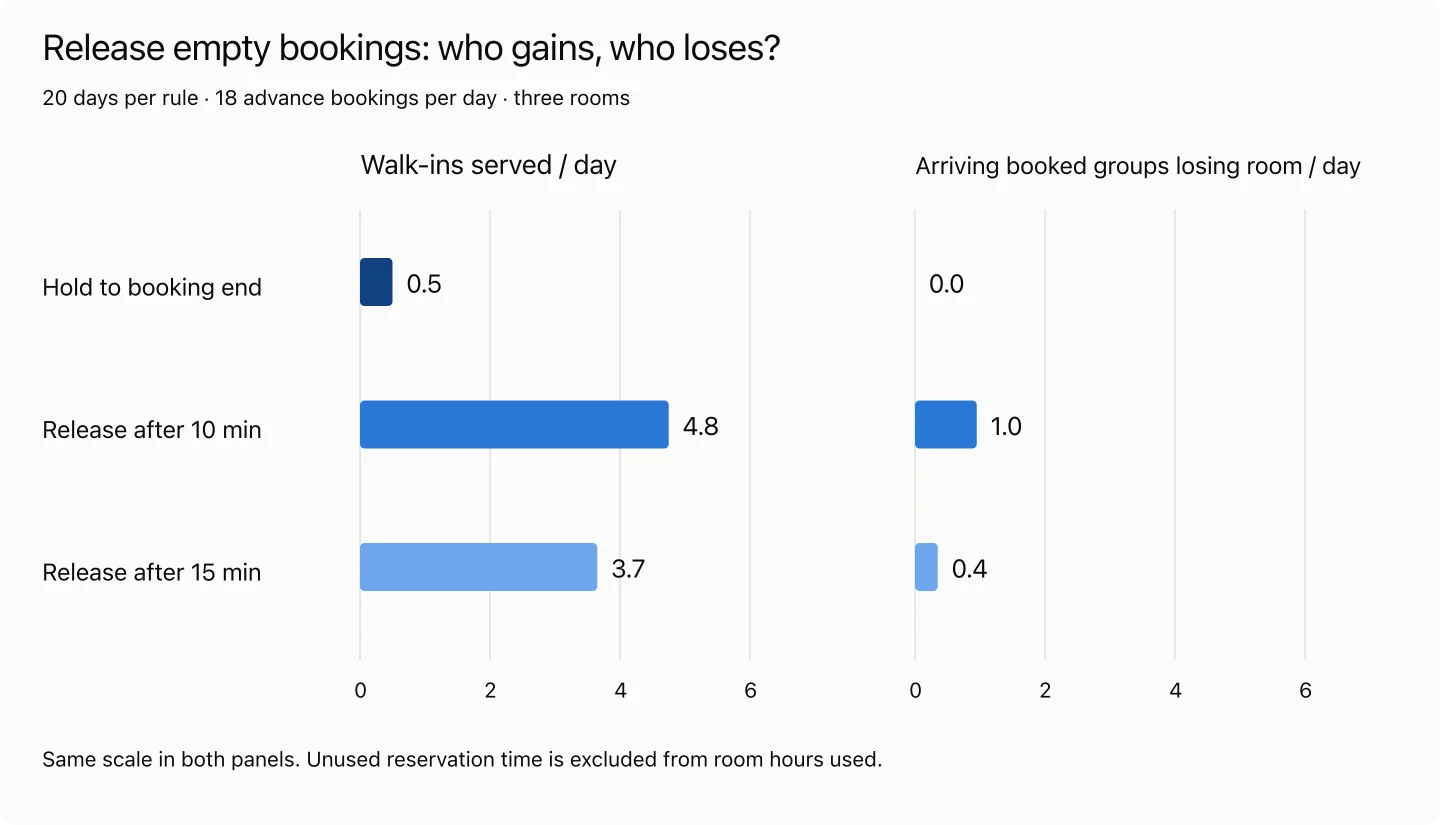
In this scenario, releasing after 15 minutes serves an average of 3.7 walk-ins a day instead of 0.5, at the cost of 0.4 booked groups a day losing their room.
Whether that is acceptable depends on the service promised to booked groups. A shorter deadline helps more walk-ins but puts more late arrivals at risk. There is no universal best deadline in these assumed days.
Start from the coworking space model (free sign-up; running a simulation requires Pro). The comparison uses Laydyne's scenario tools on the original floor. The office meeting-room article asks about room supply and room choice. This article keeps the rooms and the accepted booking calendar fixed, then changes only the release rule. The coworking articles on hot desks and phone booths address separate demand.
The rooms and the accepted bookings
The tools read room A with 8 seats, B with 6 and C with 4 using get_space; check_space reports 0 issues. The model stays as drawn.
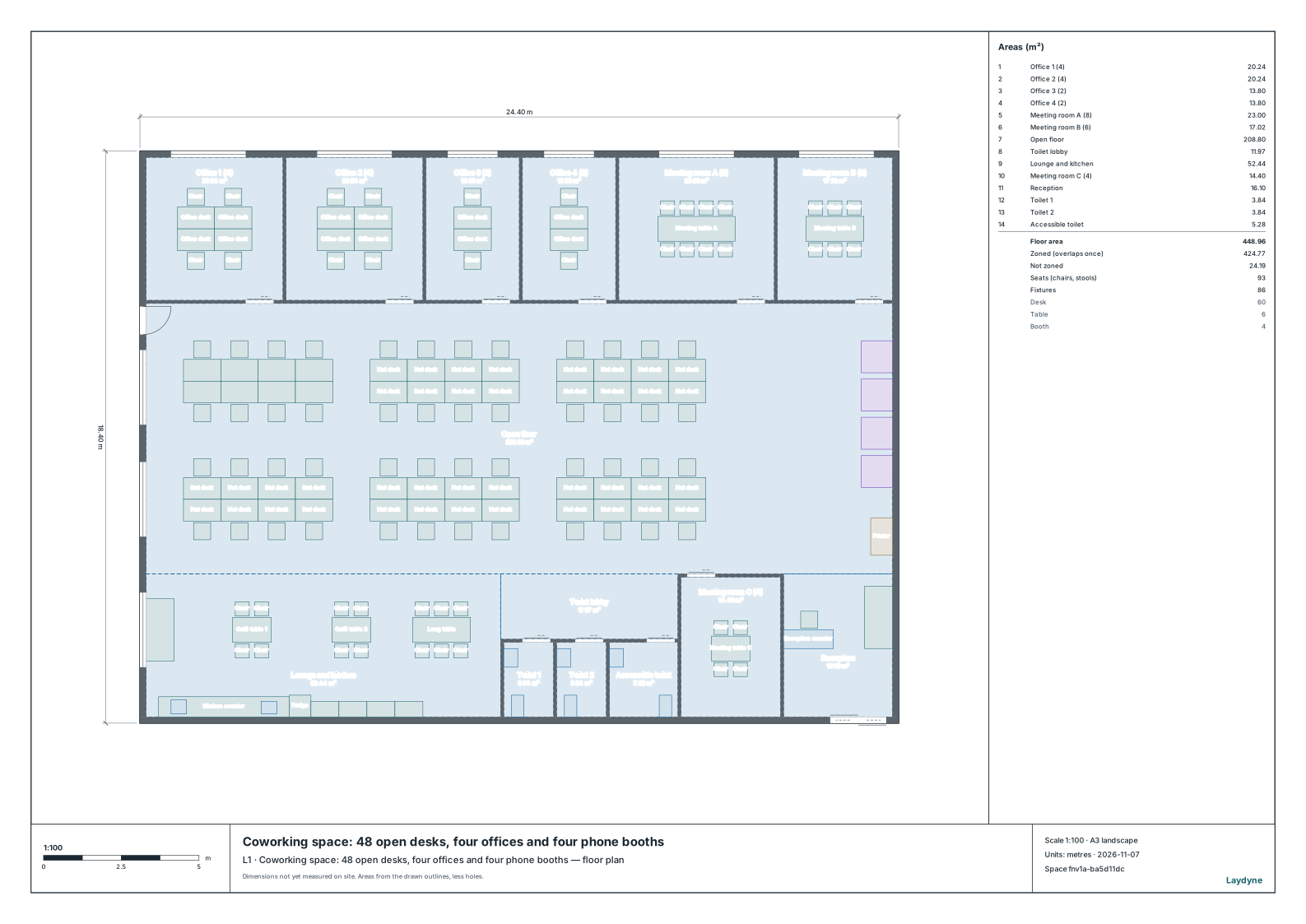
The assumed day opens at 9:00 and closes at 17:00. Its 18 accepted bookings occupy 18.0 of the available 24.0 room hours on the calendar. The same calendar repeats every day; attendance and walk-ins vary.
| Room | Bookings: start–end (people) |
|---|---|
| A | 9:00–10:00 (8); 10:15–11:15 (6); 11:30–12:00 (8); 12:30–14:00 (6); 14:30–15:30 (4); 15:45–16:45 (8) |
| B | 9:15–10:15 (6); 10:30–11:30 (4); 11:45–12:15 (6); 13:00–14:30 (4); 14:45–15:45 (2); 16:00–17:00 (6) |
| C | 9:00–9:30 (4); 10:00–11:00 (2); 11:15–12:15 (4); 12:15–13:45 (2); 14:00–15:00 (4); 15:30–16:30 (2) |
All booking times, group sizes, lengths and demand shares below are assumptions, not measured coworking demand.
- Each booking independently has a 20% chance of being a no-show: nobody ever arrives.
- Among groups that do arrive, 70% check in on time; 10% arrive 5 minutes late, 10% arrive 12 minutes late and 10% arrive 20 minutes late. Check-in happens immediately on arrival. These are discrete assumed cases, not a measured lateness distribution.
- Walk-in requests arrive randomly from 9:00 to 17:00, averaging 3 per hour (a Poisson process). Groups of 2, 4, 6 and 8 have shares of 40%, 30%, 20% and 10%, respectively. Each requests 30 minutes.
- A walk-in needs a fitting room immediately. It takes the smallest free room in which it can finish before the next accepted booking or closing. Otherwise it is turned away from the meeting rooms, with no wait or retry. A room that is free now but cannot fit the full requested time is unavailable.
- A booked group uses only the remainder of its original slot. Late arrival does not extend the end time. It checks only its own booked room; there is no move to another room or later retry.
What release means in this comparison
Compare holding every room until its booking ends with releasing it after 10 or 15 minutes without a check-in. The room is held from the booking's start even while the group is absent. If the group checks in by the deadline, it keeps the room to the original end. Otherwise the room becomes available to walk-ins. A late group may reclaim its room if it is still free; if another group has it, the booked group loses the room for that visit. Existing users are not displaced.
Microsoft's Teams panels documentation describes releasing a room after an unchecked booking passes a configured deadline. That establishes that this is an operating rule in real booking software; it does not supply a typical no-show rate or a recommended deadline. The deadlines here are assumptions. This comparison also assumes that every arriving group checks in correctly.
The run uses put_process_scenario and run_process_scenario, the same tools available to an AI over MCP. A scenario job represents a reservation, holds the room resource, waits for check-in or the release time, and releases it through the engine. Another counter measures the time the room is actually used. Walk-in admission checks the fixed calendar as well as current availability, so a walk-in cannot delay the next booking.
Each rule runs for 20 days with the same random seeds, and the recorded attendance, lateness and walk-in requests match day by day. This is a booking calculation without walking or crowd simulation. It does not add a booking system to Studio.
Who gets a room?
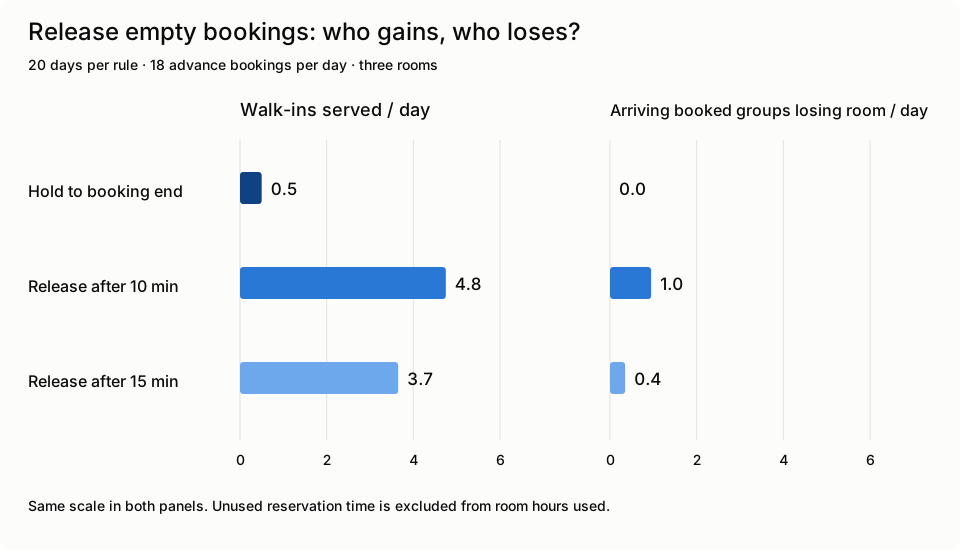
The runs average 23.4 walk-in requests a day. Of the 18 bookings, 3.5 are no-shows and 14.5 groups arrive. Those counts are the same under every rule.
| Rule | Walk-ins served/day | Walk-ins turned away/day | Arriving booked groups losing room/day (share) | Room hours actually used/day |
|---|---|---|---|---|
| Hold to booking end | 0.5 | 22.9 | 0.0 (0.0%) | 13.9 |
| Release after 10 min | 4.8 | 18.7 | 1.0 (6.6%) | 15.2 |
| Release after 15 min | 3.7 | 19.8 | 0.4 (2.4%) | 15.2 |
Daily means across 20 days. The loss share divides all booked groups losing their room by all booked groups that actually arrive; no-shows are excluded. Room hours sum actual use across the rooms, excluding empty reservation holds.
With a 15-minute deadline, a booked group loses its room on 6 of the 20 days; the worst day loses 2 groups. With a 10-minute deadline, losses occur on 13 days and the worst day loses 3 groups. An average below a group per day does not mean a rare complaint.
Late arrival after release does not always mean losing the room: 1.3 groups a day reclaim a still-free room with the 15-minute deadline, compared with 1.9 under the 10-minute rule.
Is the shorter deadline worth it?
Changing from 15 to 10 minutes serves 1.1 more walk-ins a day but costs another 0.6 arriving booked groups their room. Both rules produce 15.2 room hours of actual use when rounded to a tenth of an hour. More walk-in successes do not translate into much more room use here, because some replace a booked group's remaining meeting time.
The 15-minute rule therefore gives a less disruptive starting point for this scenario, if the operator accepts the observed booked-group losses. Holding reservations protects all arriving booked groups, while leaving almost every walk-in without a usable slot. The comparison does not price those outcomes or decide what members should be promised.
Before changing a check-in rule
Use your accepted booking calendar, check-in records and declined walk-in requests. Distinguish true no-shows from people who arrive late or forget to check in. Announce the deadline and how late arrivals will be handled before applying it, and judge both walk-in service and the loss of an accepted reservation.
This model omits early check-in, forgotten check-ins, cancellations before the start, rescheduling, equipment preferences, cleaning, overruns and groups whose arrivals are correlated. It holds the calendar fixed instead of predicting how members change their booking habits. It estimates room access under stated assumptions, not revenue or member satisfaction.
How to ask an AI
Keep rooms A (8), B (6) and C (4) and the accepted calendar above. Compare holding every booking with releasing unchecked rooms after 10 or 15 minutes. Use the stated no-show, lateness and walk-in assumptions for 20 days per rule. Count walk-ins served and turned away, arriving booked groups losing their room, and room hours actually used. Protect the next accepted booking and distinguish empty holds from actual use.