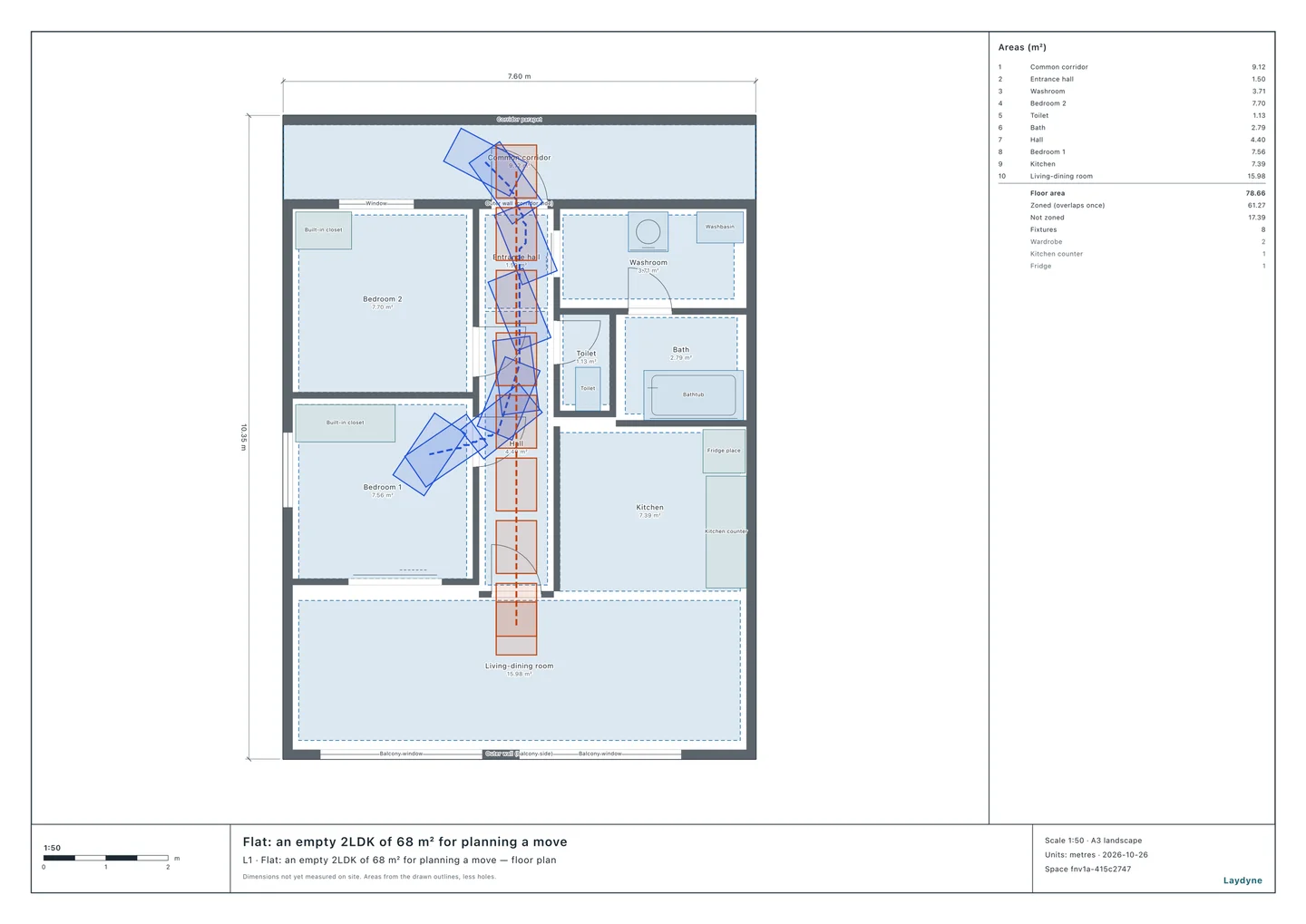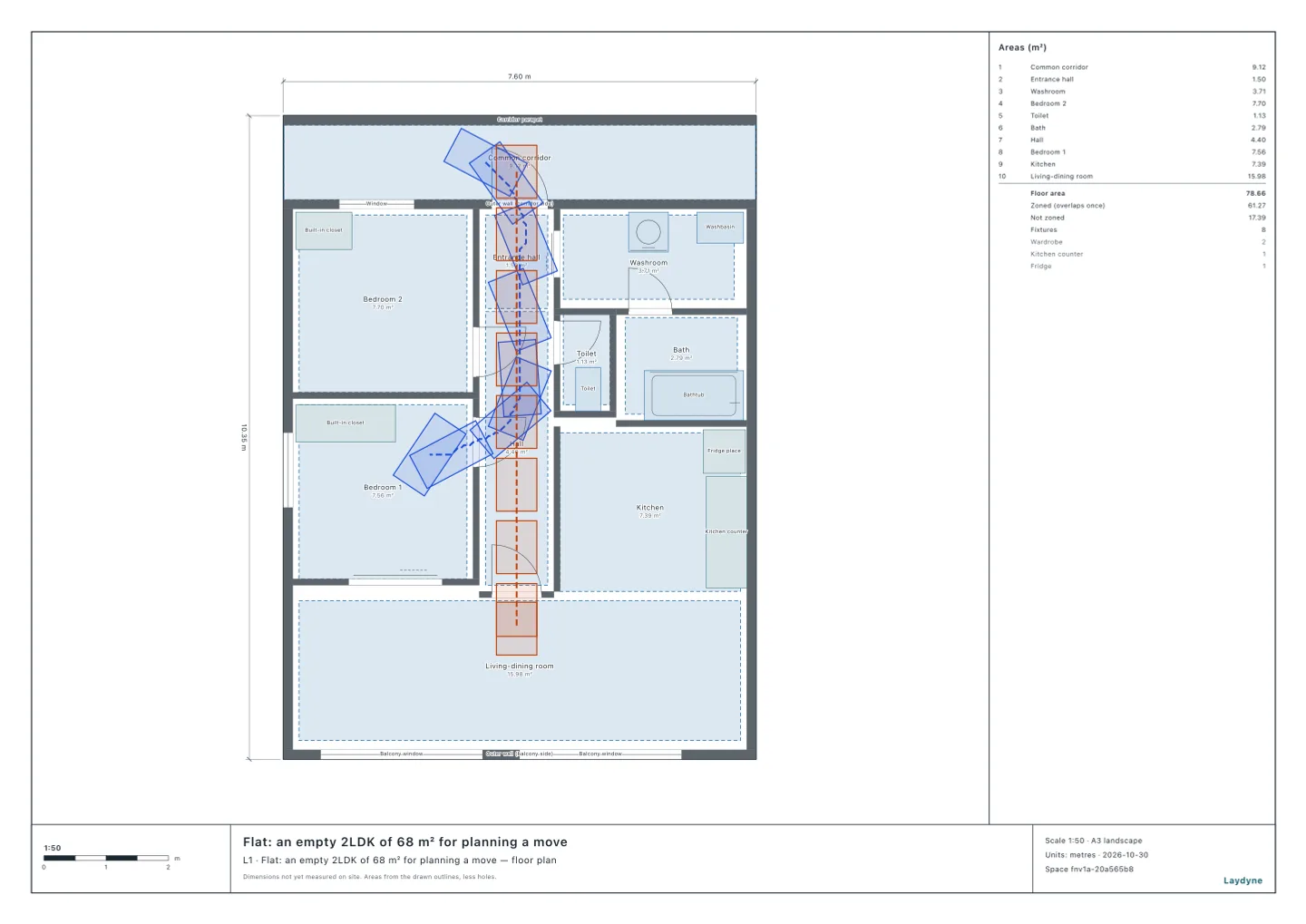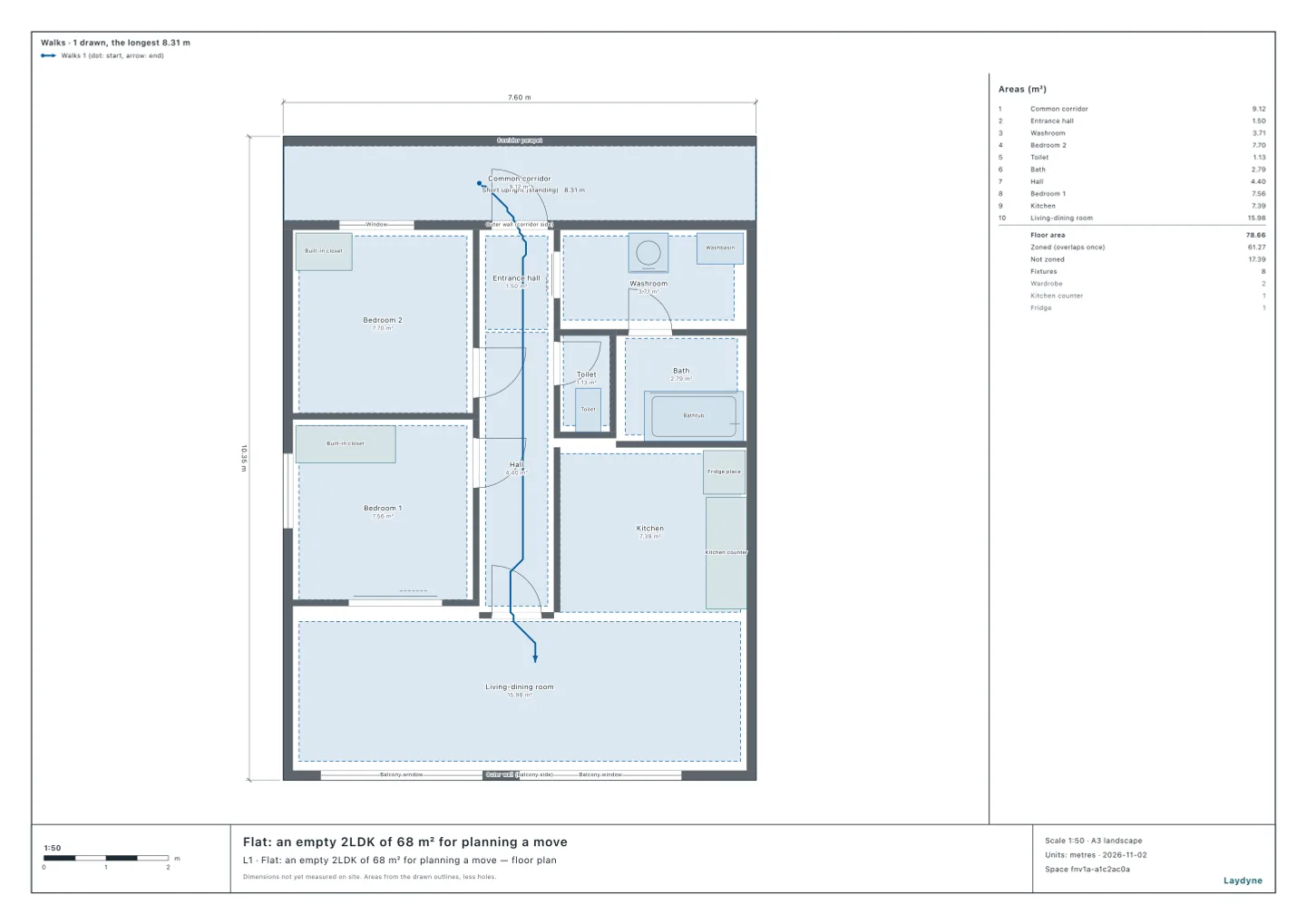
Start from the empty 2LDK model (free account), or draw your own flat. An upright piano is about 1.5 m wide and heavy, and is usually carried standing. Whether it can turn in an entrance or a corridor depends on its depth and on how wide the way is. In this article your AI checks, on a model of a 2LDK flat (two bedrooms plus a living-dining-kitchen), whether pianos can be carried from the common corridor to each room. It uses the same model and the same carry check (check_space) as the article on moving furniture in, and the same tools an AI calls over MCP. Every figure and picture below is their result.
1. What was done
- The model is a 68 m² 2LDK. Outside its front door is a common corridor 1.2 m wide; the front door is 0.9 m wide, the entrance 1.0 × 1.5 m, and the corridor 1.0 m wide. The doors of the living room and the bedrooms are 0.8 m wide, and bedroom 1 also has a 1.5 m sliding door to the living room.
- The pianos' sizes are assumed, typical of such pianos (width × depth × height): a short upright 1.49 × 0.53 × 1.13 m, a full-size upright 1.53 × 0.62 × 1.31 m, a digital piano 1.36 × 0.42 × 0.86 m.
- With
check_spacethe AI checked whether each piano can be carried from the common corridor to each room, first standing, and if not, laid down (on its back or its side). The tool moves the box 2.5 cm clear of walls and doors all the way, turning it at the corners.
2. Which rooms they go into
| Piano | Living room | Bedroom 1 | Bedroom 2 |
|---|---|---|---|
| Short upright (0.53 m deep) | Standing | Standing | On its side |
| Full-size upright (0.62 m deep) | On its side | On its side | On its side |
| Digital piano (0.42 m deep) | Standing | Standing | Standing |
- The full-size upright stops at the front door. Standing, it hits the outer wall that holds the front door (on the common corridor side) as it turns from the common corridor to the door. A full-size upright piano (1.53 m wide, 0.62 m deep) cannot be carried standing into this flat: it cannot turn from the 1.2 m common corridor to face the 0.9 m front door.
- Bedroom 2's door is in the corridor just past the entrance. Standing, the short upright hits the partition wall there and cannot finish the turn; on its side it goes in.
- The digital piano goes into every room standing.
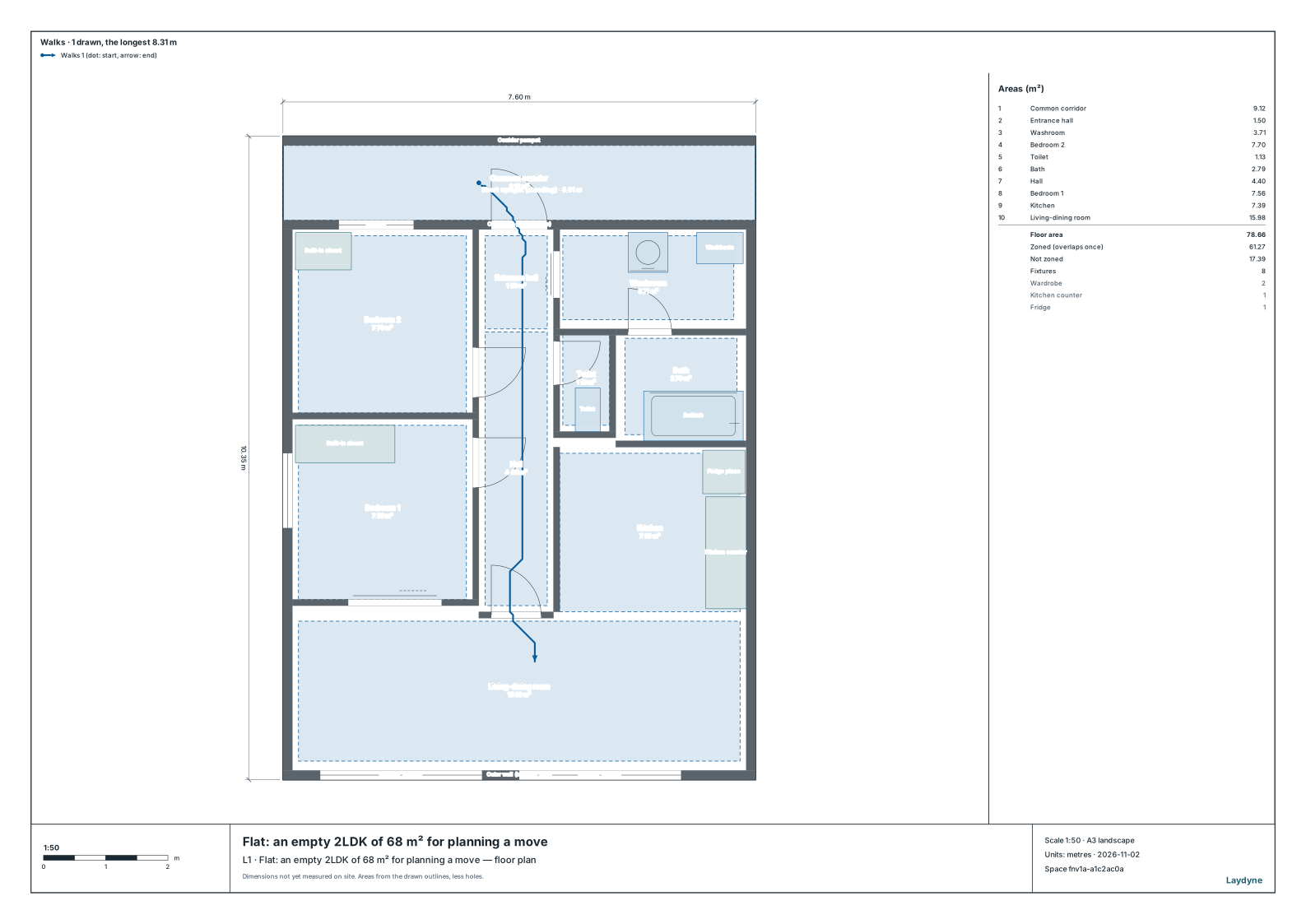
3. How deep a piano can be to go in standing
With a piano 1.5 m wide and 1.25 m high, the AI changed the depth 2 cm at a time from 0.50 m to 0.66 m, and carried each one standing.
| To | Goes in standing |
|---|---|
| Living room | Up to 0.60 m deep |
| Bedroom 1 | Up to 0.60 m deep |
| Bedroom 2 | Up to 0.52 m deep |
- From 0.62 m deep it cannot turn from the common corridor into the front door.
4. How to use it, and what it does not know
- Measure the piano and give its size. Check the width, depth and height in the maker's specifications; the sizes in this article are assumed.
- Whether it may be laid down. Whether and how a piano may be laid down to be carried is for the piano movers to decide. This article checks only whether its shape gets through.
- The floor's strength, and hoisting from the balcony. Whether the floor bears the piano's weight, and whether it can be hoisted in from the balcony when it does not get in by the door, were not checked.
- The building's common parts. Whether it also gets through the lift and the corners of the common corridor can be checked by drawing those parts of the building.
Tools used
check_space: whether each piano can be carried from the common corridor to each roomget_view_image: the plan with the way it is carried