Open the supermarket (no account needed). Is one AED by the entrance enough for a store? The Japan Emergency Medical Foundation's guideline recommends placing AEDs so that a shock can be given within five minutes of a cardiac arrest: close enough that one is within a minute's walk each way. In this article your AI measures, on a simulated supermarket, how far it is to walk to an AED from every point of the sales floor and the back of house, with the same tools an AI calls over MCP. Every figure and picture below is their result.
1. What the guideline recommends
The guideline on placing AEDs (in Japanese; Japan Emergency Medical Foundation, revised 25 December 2018) lists what to consider when placing AEDs inside a building (its Table 3):
- Placed so a shock is possible within five minutes of the arrest: dense enough that one is within a minute each way of wherever it happens. In tall buildings, near the lifts and stairs; in large factories, a way for the AED's keeper to come straight to the scene when called, by bicycle or the like.
- Easy to find: near the entrance, in plain view, where many people pass, with a clear sign.
- Open to anyone: not locked away, or with someone always there who can use it.
- Near the places with a risk of cardiac arrest (sports grounds, gyms).
- Made known: an AED map on the building's guide plan, and the like.
- Where it is hard to break and easy to look after.
The guideline also cites a study finding that bystanders take two to three minutes from seeing an arrest to calling the emergency number. And it says that large commercial premises, among them department stores, supermarkets and restaurants, used by 5,000 people or more per day (about 250 adults there at any time), should have several AEDs placed by plan.
2. How far is a minute?
The guideline's minute is a time, not a distance. This article assumes a walk of 60 m per minute (1 m per second), so a minute each way is 60 m. This is the walking speed that Japan's evacuation calculations (Ministry of Land, Infrastructure, Transport and Tourism Notice No. 510 of 2020 (in Japanese), the floor evacuation safety method) use for people in department stores, exhibition halls and similar buildings, away from stairs. Hurrying is faster; a crowd is slower.
3. The store, and how it was measured
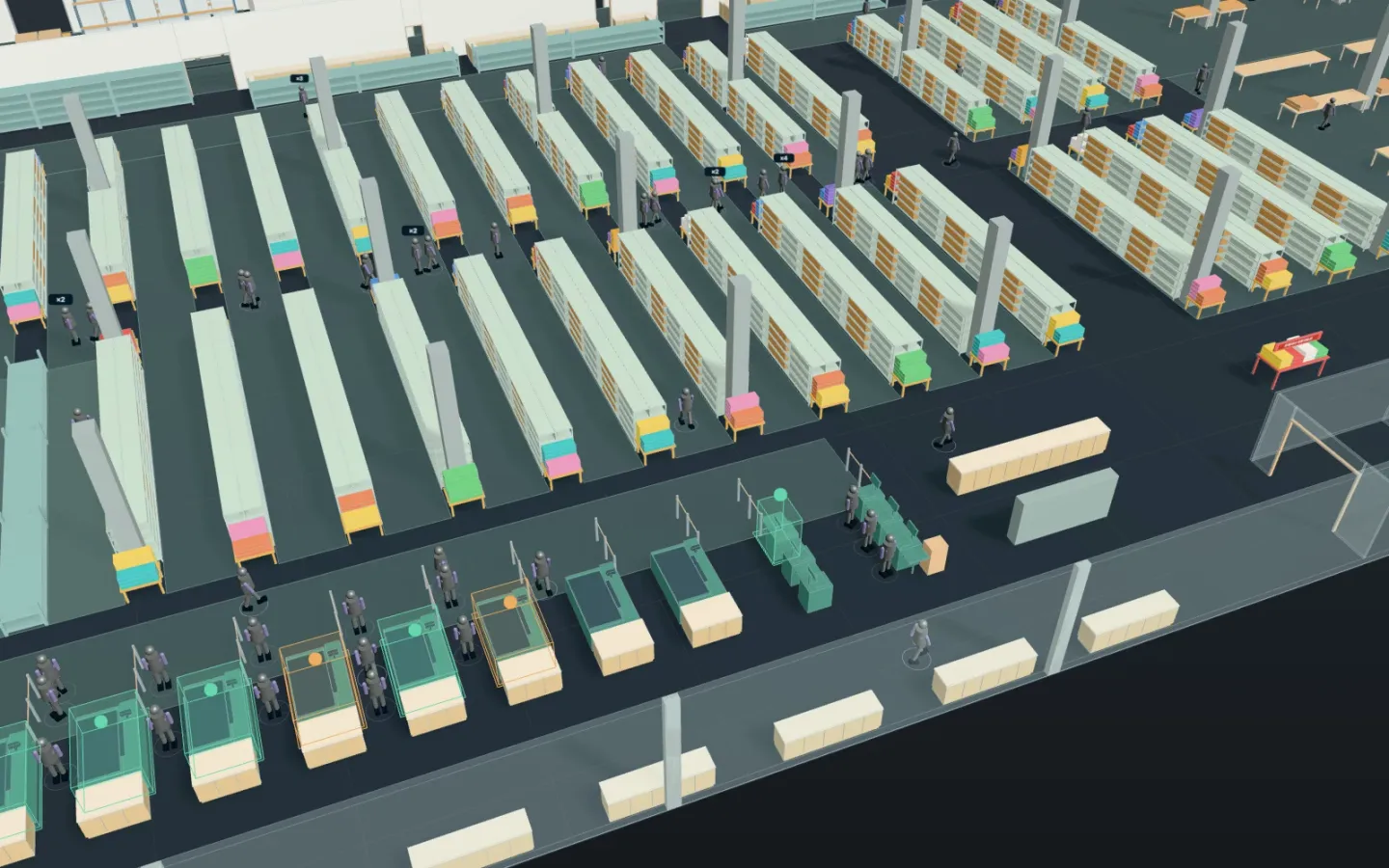
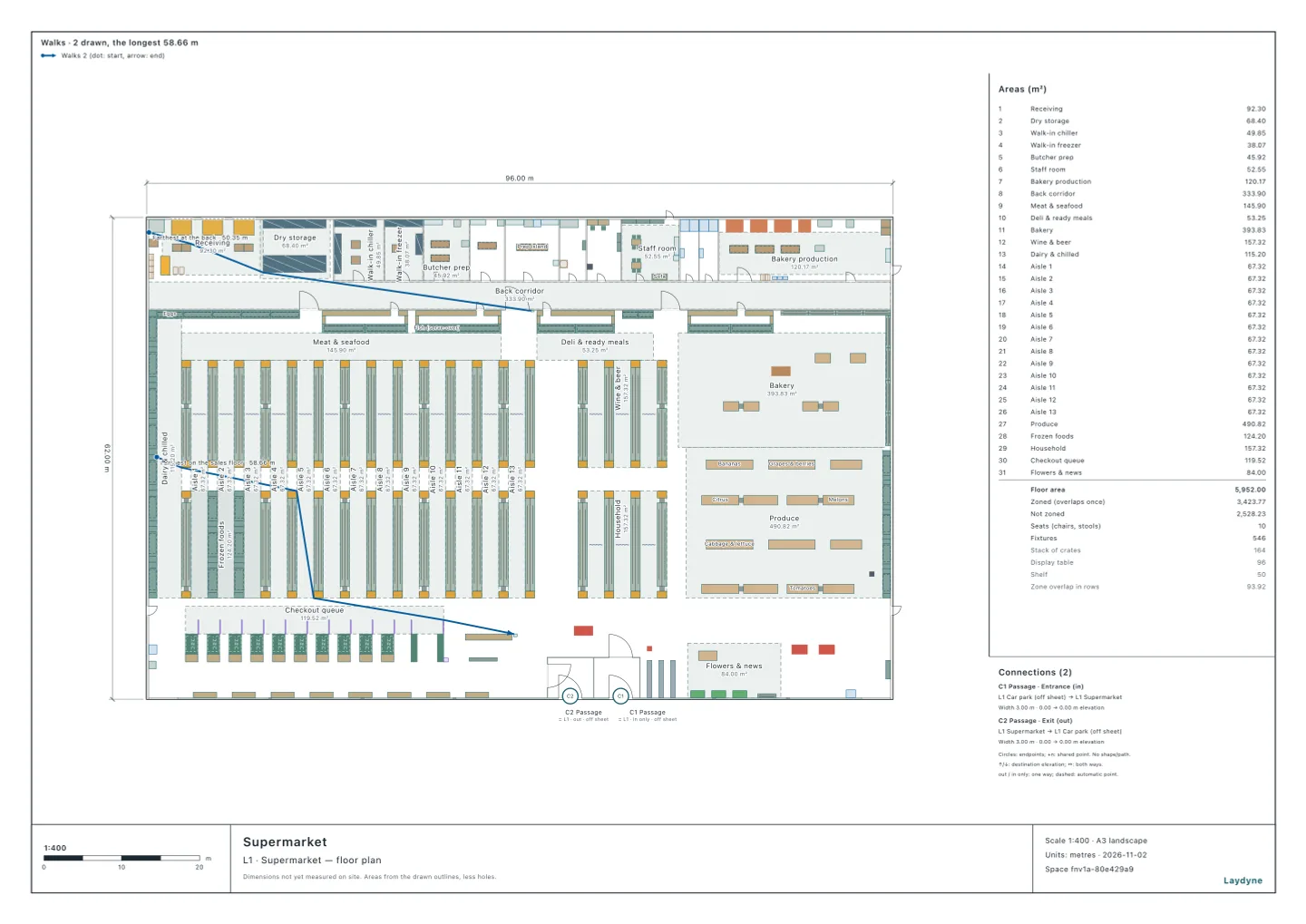
The simulated supermarket is one storey of 96 × 62 m. From the entrance on the south, the checkouts, the self-checkouts and the service counter come first, then the sales floor; beyond its north wall are the receiving bay, the stores, the cold rooms, the prep rooms, the office, the staff room and the bakery, joined by the back corridor. Swing doors and staff doors lead between the sales floor and the back.
The AI made the sales floor and the back of house one area each, and with check_space (its walking-distance check) measured, from every point of each area, the shortest walk to an AED round the walls, the shelves, the cases and the checkouts and through the doors. The check gives the farthest point, its walk (within a margin) and the route. The tool is meant for the walk from a room to a stair (Article 120 of the Order for Enforcement of the Building Standards Act); here the AED is given in place of the stair, and the limit it reports, which is the stair's, is not used. The areas are only for measuring: the AI took them away afterwards.
4. One AED by the service counter
The AI put one AED beside the service counter near the entrance (one edit_space change; check_space found no issues).
| From | The farthest point | Walk to the AED | At 60 m/min | In a straight line |
|---|---|---|---|---|
| The sales floor | The north-west corner of dairy and chilled, where the milk and egg cases meet | 71.45 m | 71 s | 61.27 m |
| The back of house | The north-east corner of the bakery, by the flour sacks | 77.35 m | 77 s | 70.26 m |
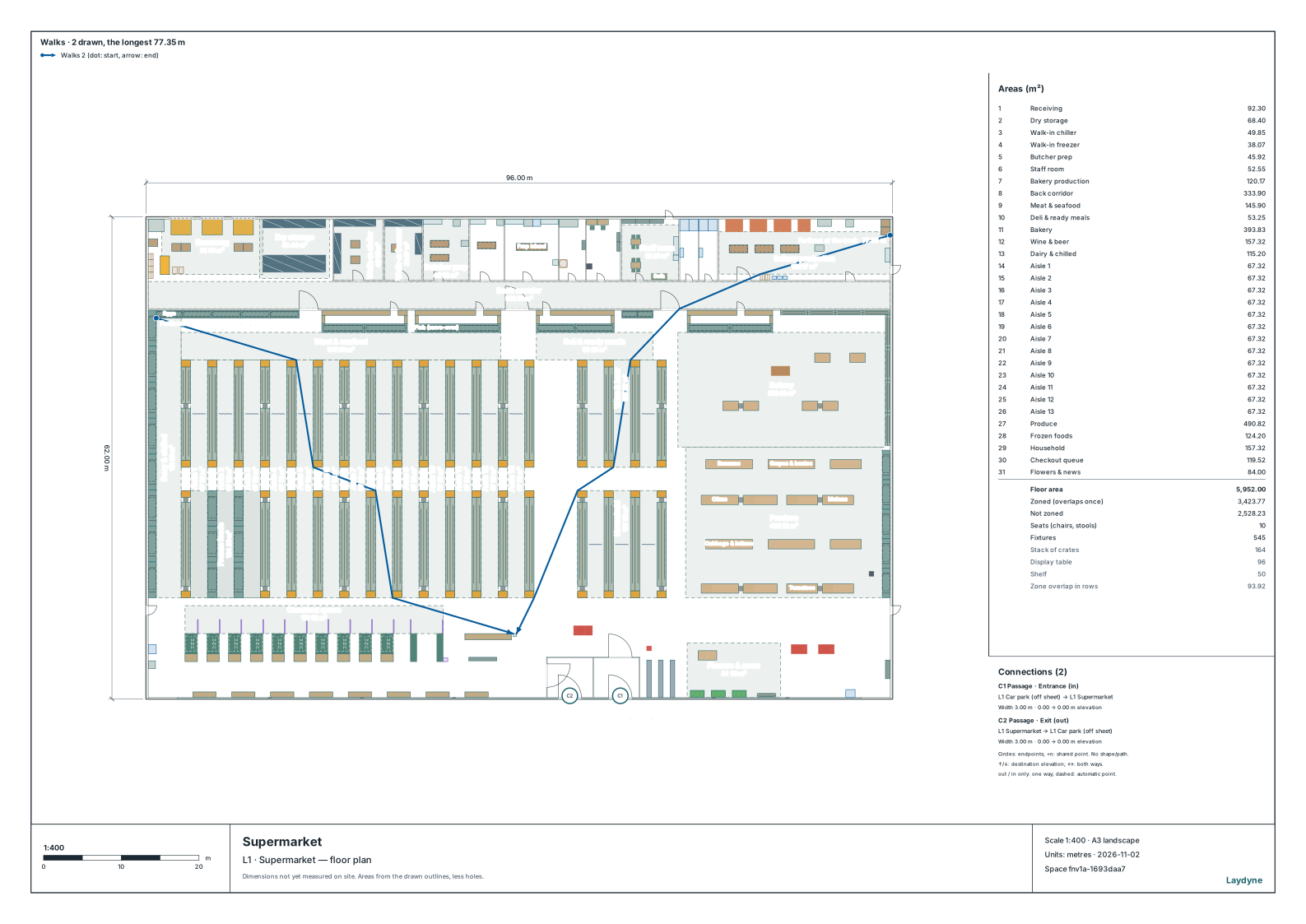
Both are over 60 m. From the far corner of the sales floor it is 61.27 m in a straight line, and 71.45 m round the rows of shelves.
5. A second AED at the back of the sales floor
The AI put a second AED by the main swing door between the sales floor and the back, on the sales floor's side of the wall (check_space found no issues).
| AEDs | From the sales floor's farthest point | From the back's farthest point |
|---|---|---|
| One by the service counter | 71.45 m (71 s) | 77.35 m (77 s) |
| One by the swing door at the back | 79.36 m (79 s) | 50.35 m (50 s) |
| Both | 58.66 m (59 s) | 50.35 m (50 s) |
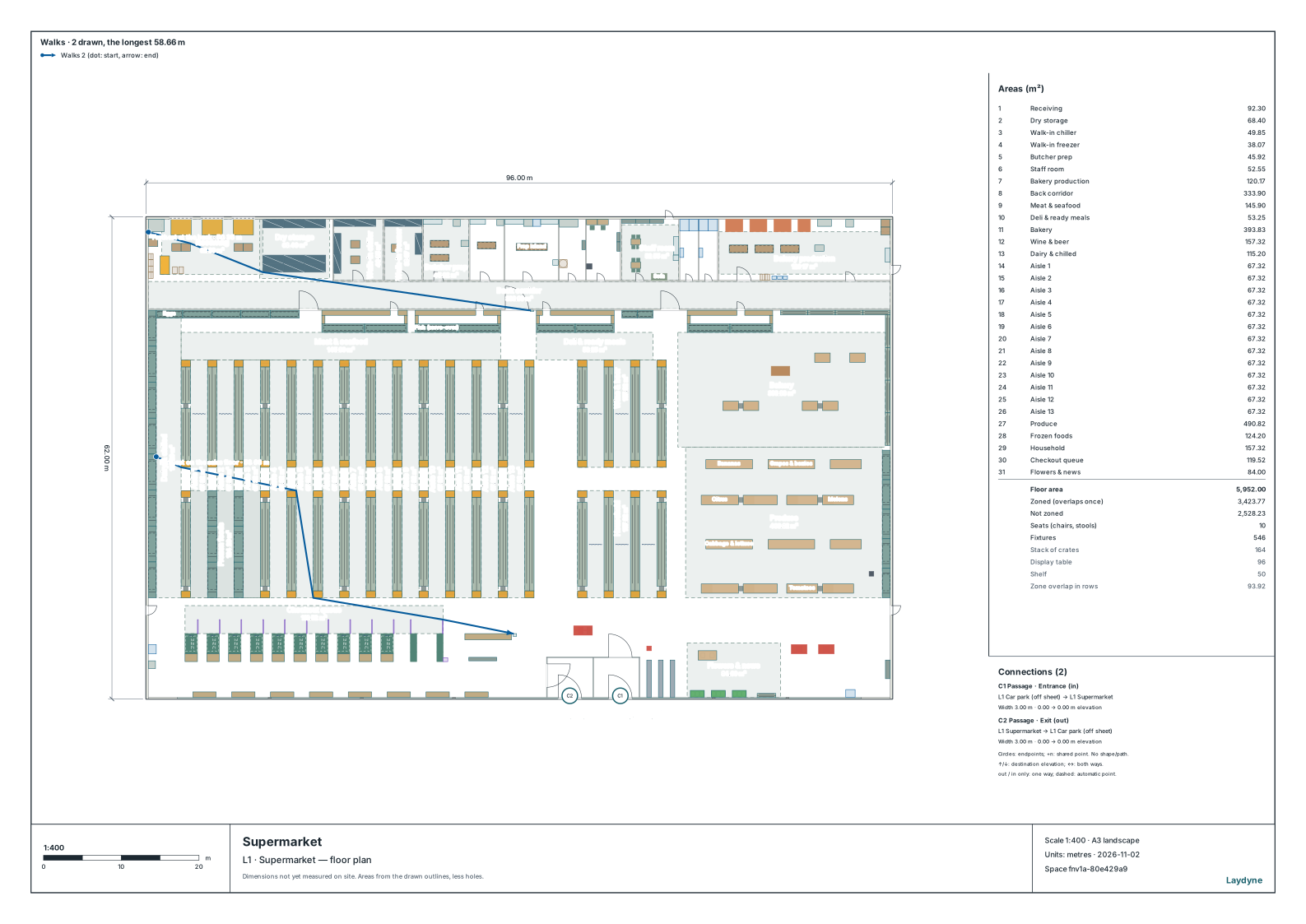
- With only the one at the back, the store's south-west corner is 79.36 m away, so the sales floor is now out of reach.
- With two AEDs, one by the service counter and one by the swing door at the back, every point of the store is within a 60 m walk of an AED (58.66 m at most from the sales floor, 50.35 m from the back of house). The sales floor's farthest point, in front of the chilled cases along the west wall, walks 58.66 m to the service counter, and the back's, in the north-west corner by the cardboard baler, walks 50.35 m to the AED at the back.
- Measured round the walls, columns and other fixed parts only, not the shelves and cases, the sales floor's walk is 52.36 m: the rows of shelves add about 6 m.
6. The rest of where it goes
- Open to anyone. The AED at the back is on the sales floor's side of the wall, for shoppers and staff alike. In the back corridor, shoppers would not see it.
- Easy to find. The service counter is near the entrance and always staffed. The one at the back needs a sign that can be seen from the sales floor.
- The map. The plans above show how far each farthest point is from an AED, and can be the base of the AED map on the store's guide plan.
7. How to use this, and what it does not know
- The speed is assumed. At 60 m per minute, a minute is 60 m. Divide the walks in the tables by the speed you expect in your store.
- Not checked. Where an arrest is most likely, the AED box's height and markings, whether the signs are seen, doors locked at night, the walk back with the AED, and calling for help and chest compressions.
- The walk is from the plan. The route is the shortest round the shelves and walls drawn, within 0.21 m on the sales floor and 0.11 m at the back. On site, check that carts and boxes left in the aisles do not block it.
- The guideline is guidance. It sets out where and how densely to place AEDs; how many, and where, is the premises' decision.
Tools used
edit_space: put the AEDs in; add the areas to measure from, and take them away (one change each)check_space: check for issues once they are in; measure the walk to an AED from every point of the sales floor and the back of houseget_view_image: draw the walks from the farthest points on the plan