Whoever plans the lifts of an office building, a block of flats or an estate, building managers, and anyone stuck in the morning or lunchtime rush
How many lifts? An office's morning and lunch, and an estate's morning
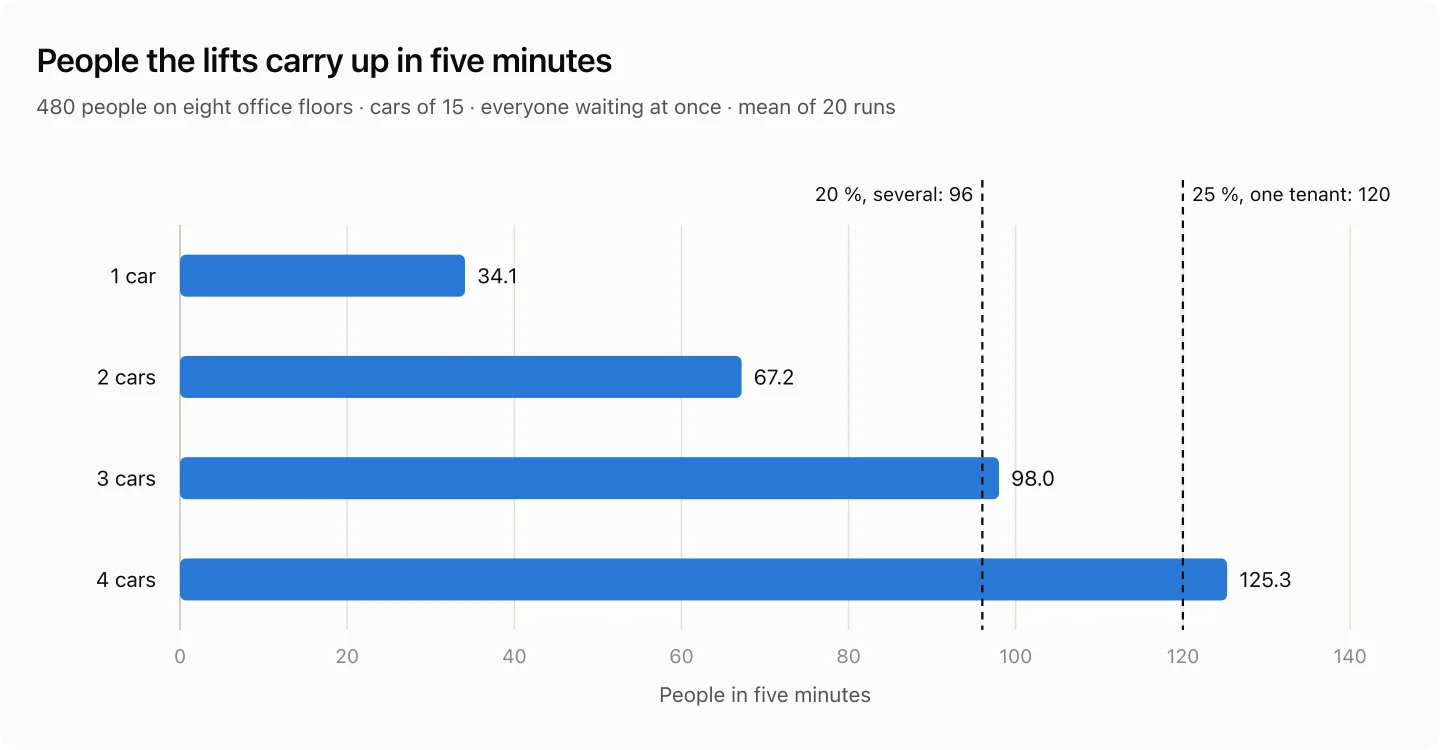
In a nine-storey office of 480 people, one lift car carries 34.1 people up in five minutes and four cars carry 125.3. A staggered lunch cuts two cars' trip down from 4.2 to 1.6 minutes.
The flow
You
Your AI
Laydyne
You1Ask how many liftsFor the morning and lunch in an office, and for an estate.
Laydyne2Run the morning for each number of cars20 runs each.sweep_process_parameters→ In five minutes: 34.1 people with one car, 125.3 with four.
Laydyne3Try a staggered lunchHalf of each floor going out.sweep_process_parameters→ Two cars' trip down: 4.2 minutes, or 1.6 staggered.
Whether the lifts are enough depends not only on the number of cars but on how closely people arrive together. Here are three examples an AI simulated in earlier articles, by the number of cars, with the tool it calls over MCP (sweep_process_parameters); each figure is the mean of 20 runs.
1. People carried up in five minutes in the morning (a nine-storey office building, 480 people waiting on the ground floor)
Cars
Carried in five minutes
1
34.1 people
2
67.2 people
3
98.0 people
4
125.3 people
The standard handling capacity in the National Institute for Land and Infrastructure Management's technical note No. 702 (its lift input) is 0.25 for an office building occupied by one company and 0.20 otherwise. For 480 people that is 120 or 96 people in five minutes: four cars (125.3) for a single-company building, three (98.0) otherwise.
People carried in five minutes: 34.1 with one car, 67.2 with two, 98.0 with three, 125.3 with four
2. The 480 people arriving within 20 minutes in the morning
Cars
Mean wait
2
426.1 seconds
3
107.8 seconds
4
17.3 seconds
3. Lunch (half of each floor going out to eat)
Cars
Lunch
Down (mean)
Max. waiting at the landings
2
Everyone at 12:00
4.2 minutes
150.1 people
2
Staggered
1.6 minutes
35.2 people
3
Everyone at 12:00
2.6 minutes
106.0 people
3
Staggered
1.1 minutes
18.3 people
4
Everyone at 12:00
1.7 minutes
67.2 people
4
Staggered
1.0 minutes
15.4 people
4. An estate's morning (seven-storey block A, from a flat's door to the ground-floor hall)
Leaving per floor per hour
One car
Two cars
6
53.4 seconds
48.7 seconds
12
58.5 seconds
49.3 seconds
18
63.5 seconds
50.8 seconds
5. What they show
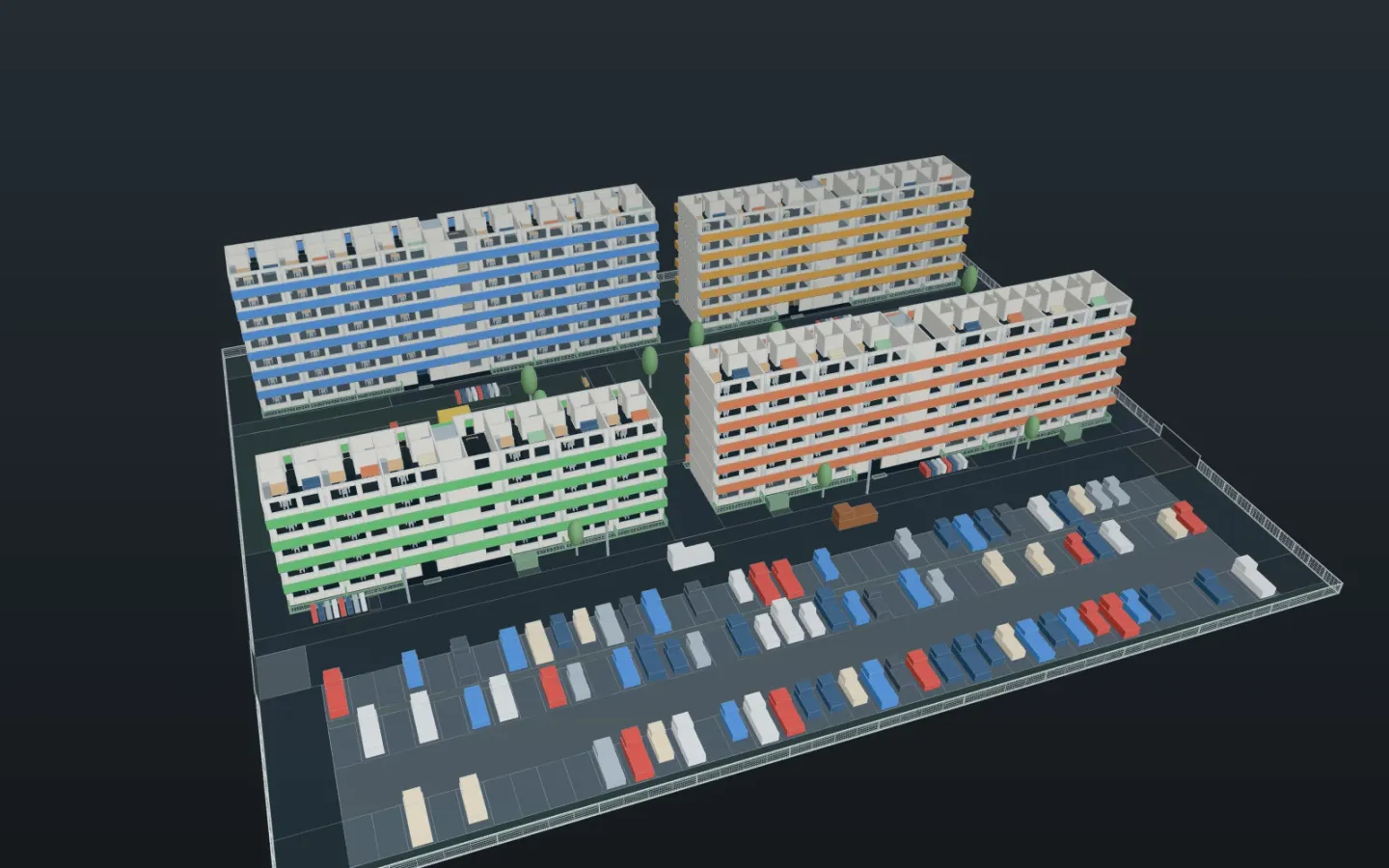
Mornings need cars; lunch needs staggering. When 480 office workers arrive within 20 minutes in the morning, the mean wait for a lift is 107.8 seconds with three cars and 17.3 seconds with four. At lunch, staggering cuts the trip down with two cars from 4.2 minutes to 1.6, shorter than the 1.7 minutes with four cars and everyone leaving at 12:00.
An estate's single car stays near a minute. Even with three times as many people leaving, 18 per floor per hour, the trip takes 63.5 seconds with one car and 50.8 seconds with two.
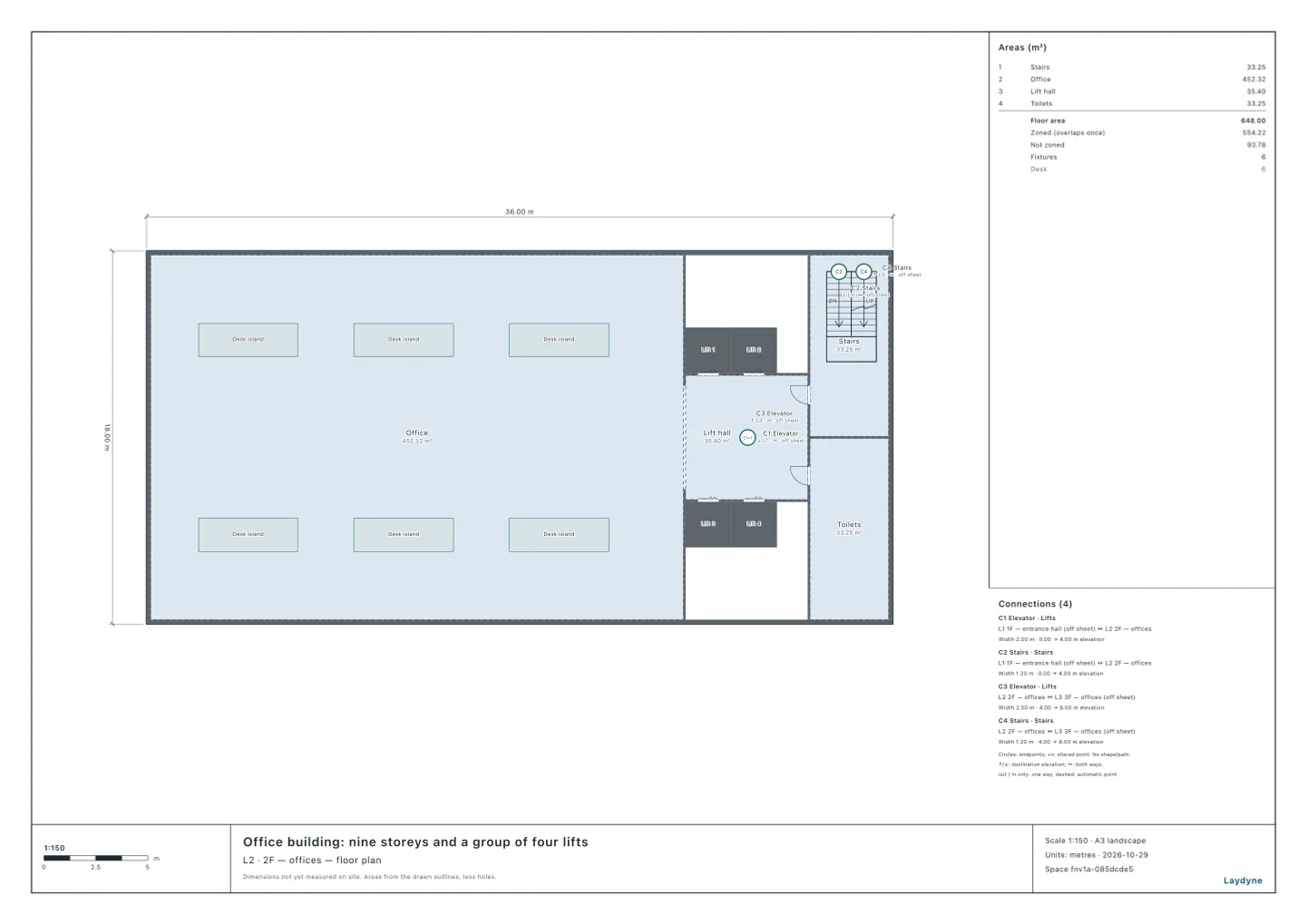
In this building (as drawn, 60 people on each of floors 2 to 9), compare how many people the lifts carry up in five minutes in the morning with one to four cars, 20 runs each.
8. What this does not cover
The cars' speed, the door times, the seconds to get in and out and how people arrive are each article's assumptions. The cars follow Laydyne's fixed collective-control rules, not a manufacturer's group control (destination dispatch and the like). Before planning, check with the manufacturer's traffic calculation.