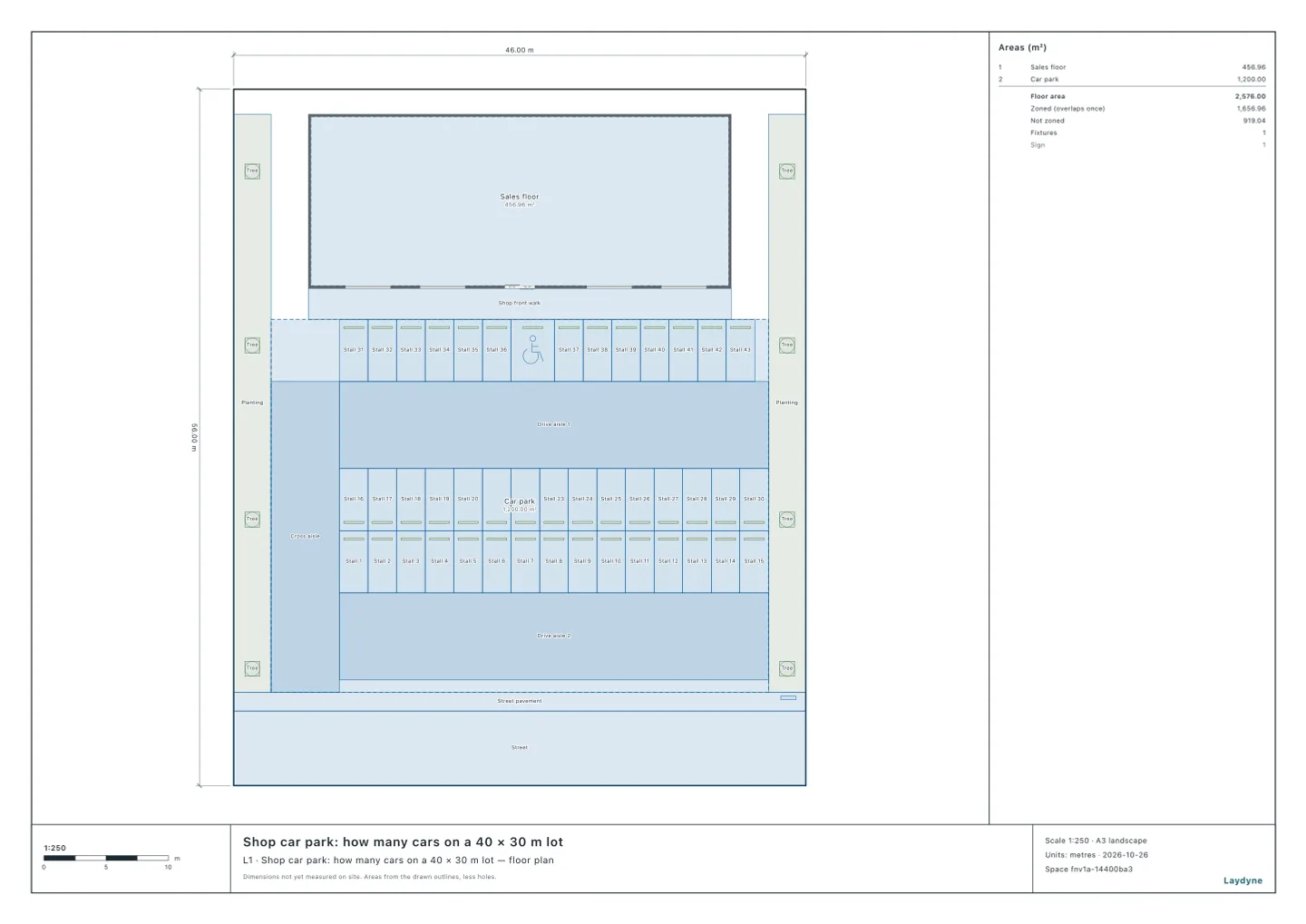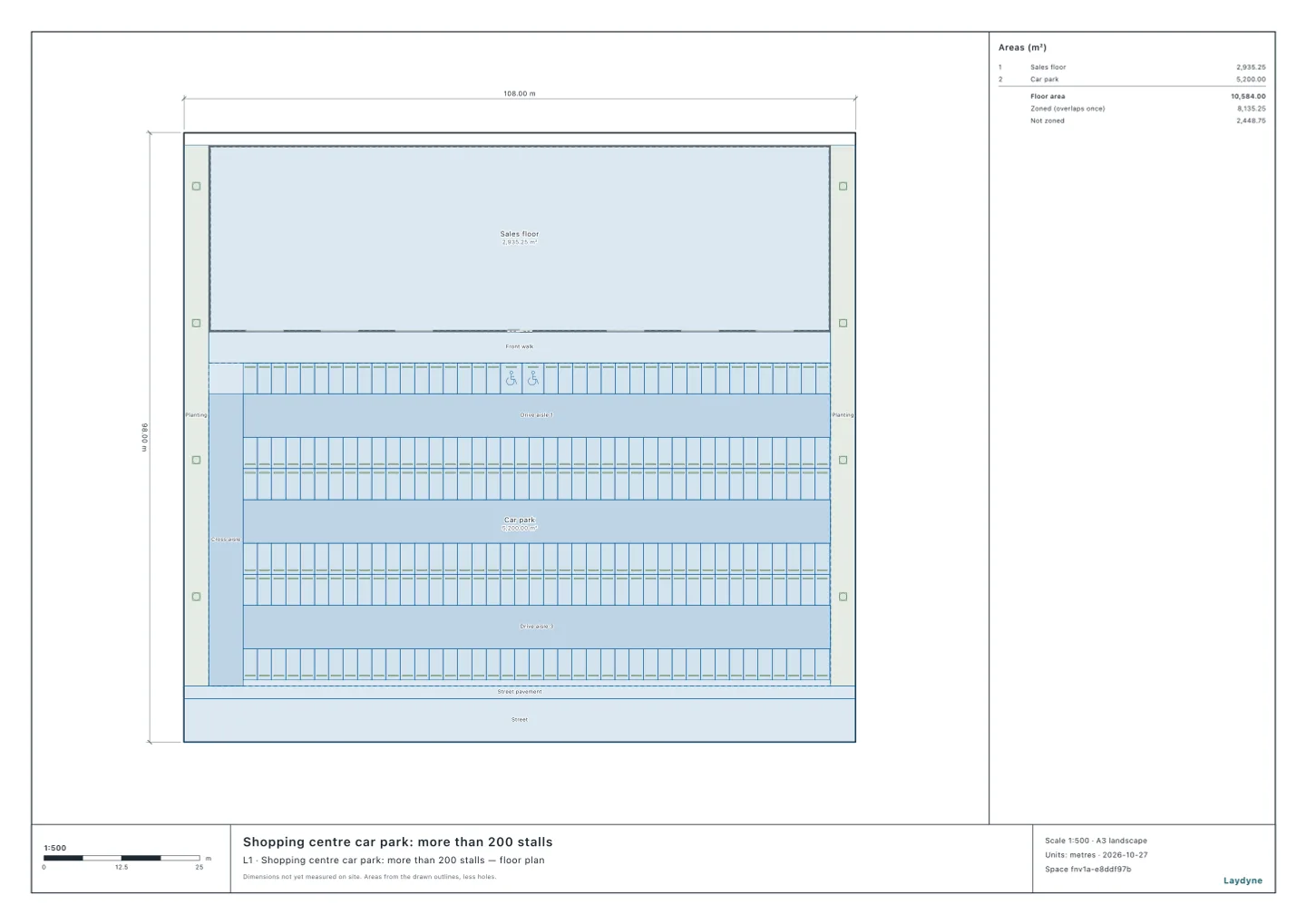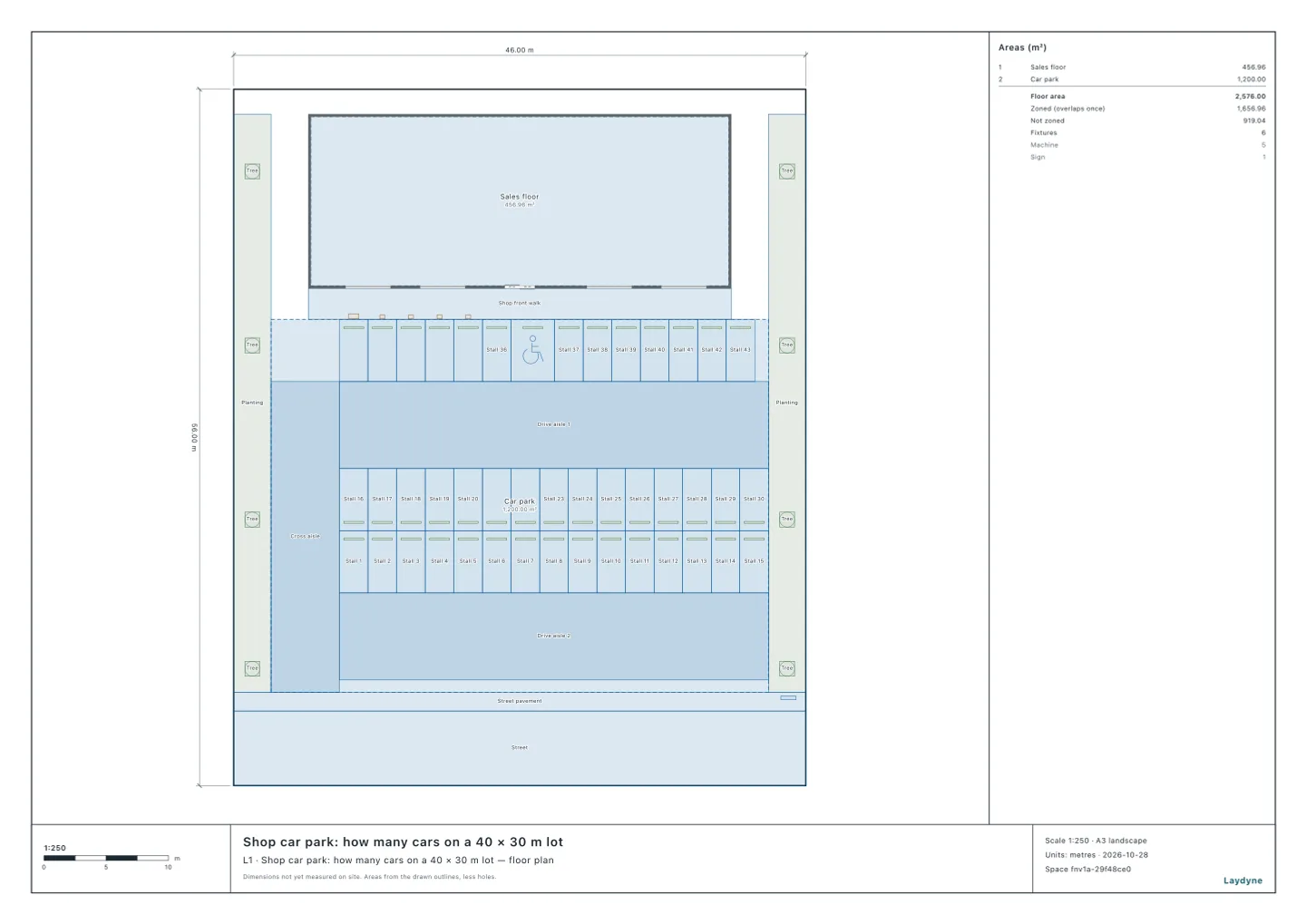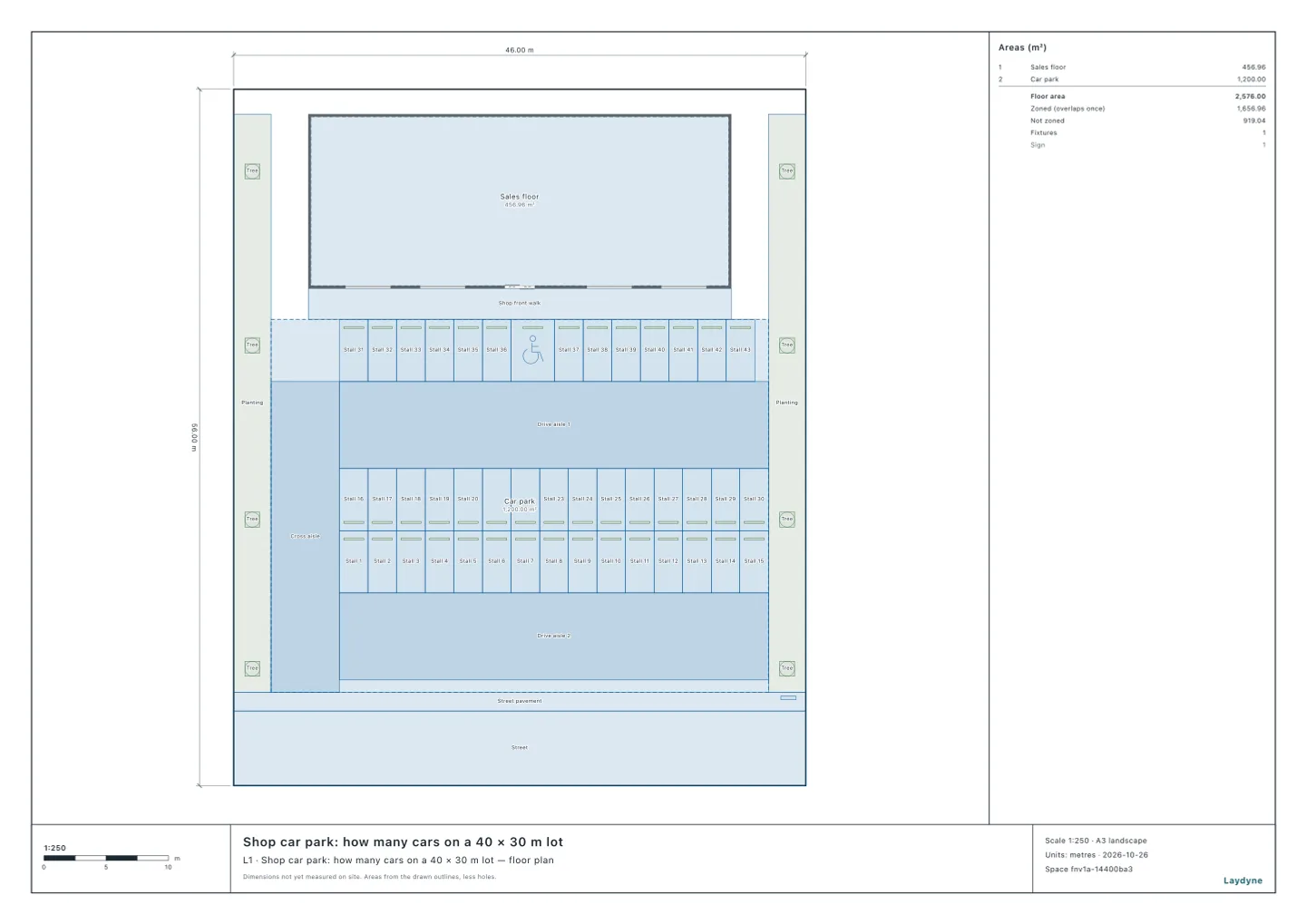
How many cars a car park takes depends on the stall size, the aisles and the layout; how many stalls are enough depends on how many cars come and how long each one stays. Here are five examples an AI counted in earlier articles, with the tools it calls over MCP (suggest_parking, check_space for the wheelchair stalls, and sweep_process_parameters for the simulations).
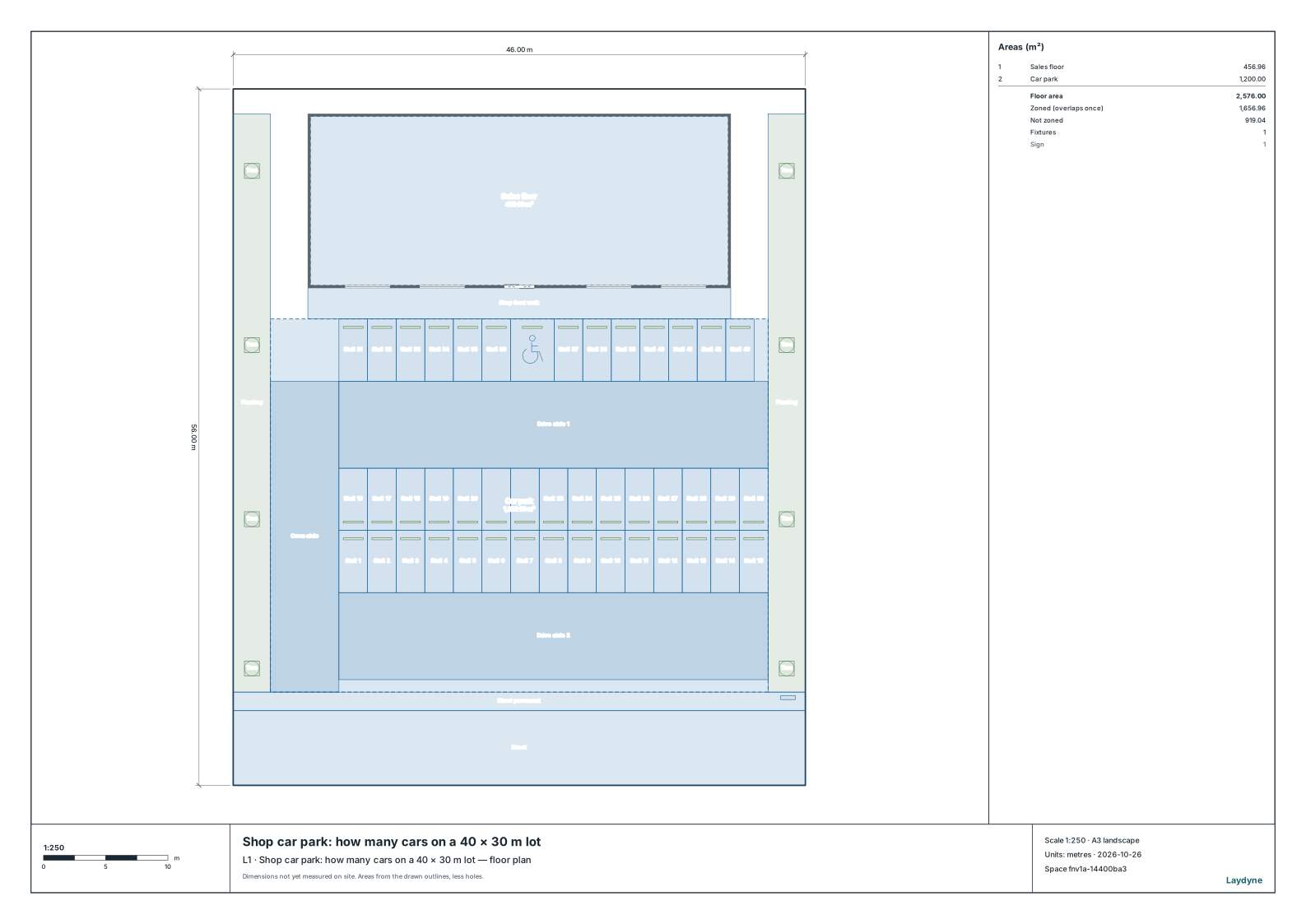
1. Stall sizes and layouts (a shop's lot of 40 × 30 m)
| Stall | Size | Aisle | At right angles | In parallel |
|---|---|---|---|---|
| Kei cars | 2 × 3.6 m | 7 m | 59 | 67 |
| Compact cars (the guideline) | 2.3 × 5 m | 7 m | 40 | 44 |
| Compact cars as wide as standard ones | 2.5 × 5 m | 7 m | 36 | 39 |
| Standard cars (the guideline) | 2.5 × 6 m | 7 m | 36 | 26 |
| Standard cars (the guideline) | 2.5 × 6 m | 5.5 m | 36 | 39 |
- The stall and aisle sizes are from the car park design guidelines of the Ministry of Land, Infrastructure, Transport and Tourism (an aisle that stalls face is 7.0 m where possible, 5.5 m where it is not). Kei cars are Japan's smallest car class.
- Standard cars (2.5 × 6 m) fit more stalls at right angles with 7 m aisles, and more in parallel with 5.5 m aisles.
2. Wheelchair stalls
- A car park of 245 stalls needs 5 wheelchair stalls: 1 in 100 plus 2, rounded up (Order for Enforcement of the Barrier-Free Act, Article 18). The 2 drawn are not enough.
3. How many are enough (simulated)
| Scene | As set up | Per day |
|---|---|---|
| A Saturday's car park (a usual Saturday) | 243 stalls | 1.1 cars turned away |
| A Saturday's car park (20% more cars) | 243 stalls | 40.2 cars turned away |
| A Saturday's car park (20% more cars) | 300 stalls | 0.2 cars turned away |
| A Saturday's car park (40% more cars) | 243 stalls | 167.8 cars turned away |
| A Saturday's car park (40% more cars) | 330 stalls | 0.7 cars turned away |
| EV chargers (3 shoppers an hour) | One quick charger | 3.8 charging-only drivers who left |
| EV chargers (3 shoppers an hour) | One quick, four normal chargers | 1.7 charging-only drivers who left |
| EV chargers (3 shoppers an hour) | Two quick, two normal chargers | 0.3 charging-only drivers who left |
| A drive-through (45 cars an hour at lunch) | Big orders wait at the window | 35.5 cars waiting on the street |
| A drive-through (45 cars an hour at lunch) | Big orders to a parking bay | 4 cars waiting on the street |
- A Saturday's car park (stays of 75 minutes). A shopping centre's 243 stalls turn away 1.1 cars on a usual Saturday but 40.2 cars with 20% more cars, and 300 stalls bring that down to 0.2. With 40% more cars, 243 stalls turn away 167.8 cars a day and 330 stalls 0.7.
- EV chargers. With one quick charger only, 3.8 drivers a day who came only to charge leave without charging. Normal chargers for the shoppers bring that down; with two quick and two normal chargers, it is 0.3.
- A drive-through. With 45 cars an hour at lunch, 35.5 cars wait on the street; with big orders sent to a parking bay, 4 cars do.
4. The articles
- How many cars? Set out a shop car park
- How many wheelchair stalls does a big car park need?
- How many stalls does a shopping centre's car park need?
- How many EV chargers for a shop's car park?
- Do drive-through cars spill onto the street?
5. How to ask an AI
How many compact-car stalls fit on this lot (as drawn, 40 × 30 m, the road to the south)? Compare right angles and parallel, and put a wheelchair stall by the door.
6. What this does not check
- The cars that come, their stays and their charging times are each article's assumptions. Put in your own car park's records.
- The stall counts that the Parking Act and local bylaws require, and mechanical car parks, are not covered.