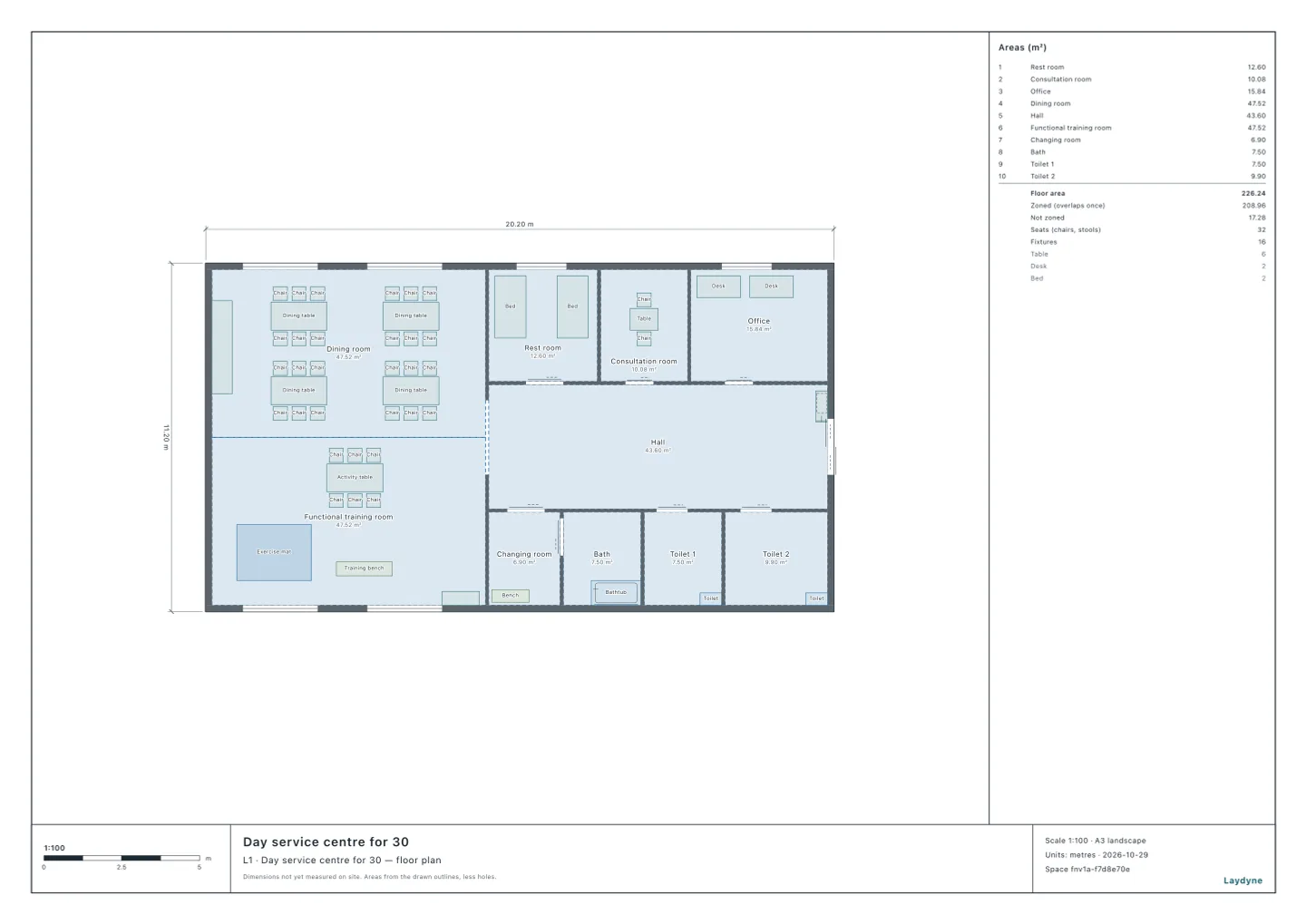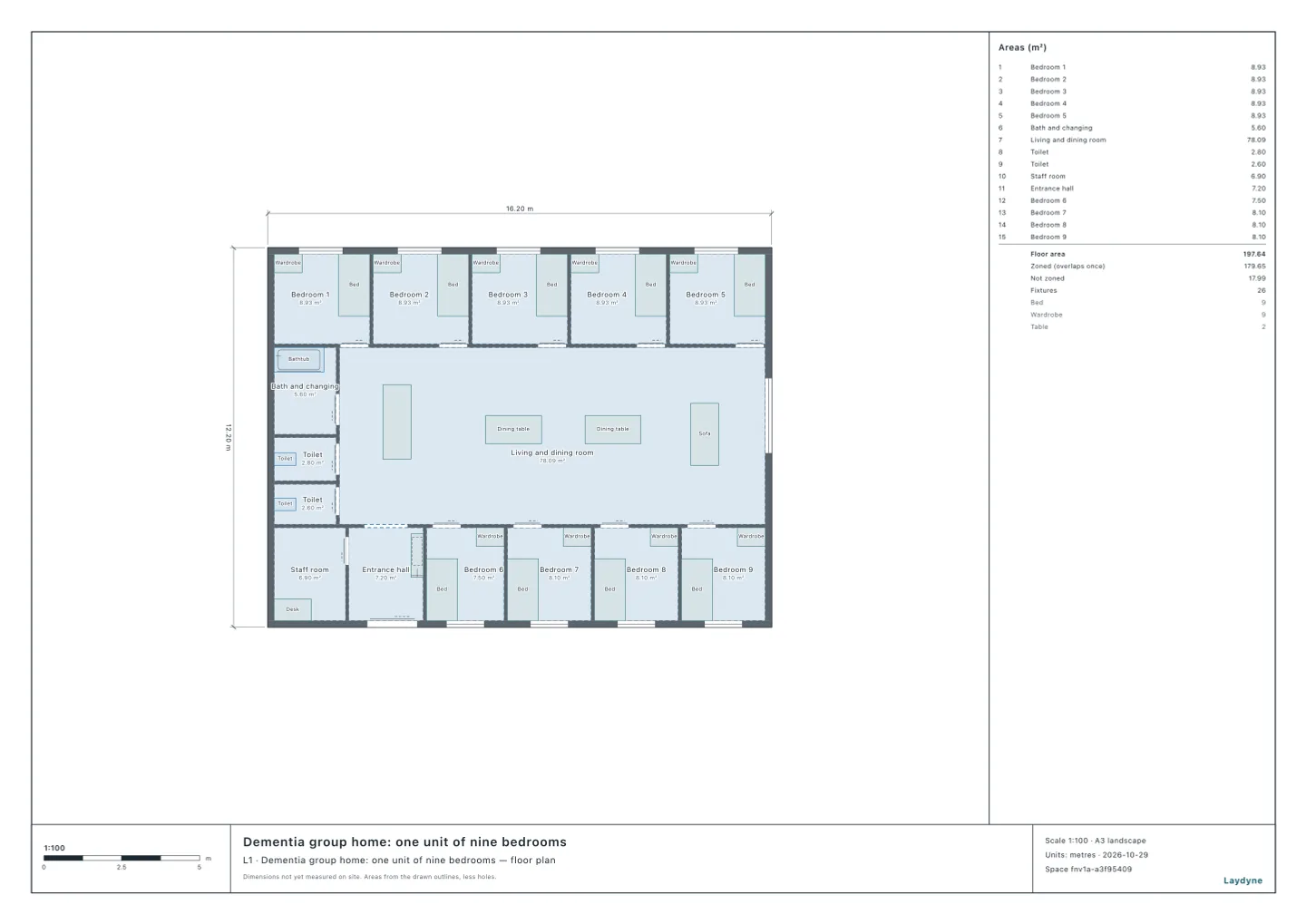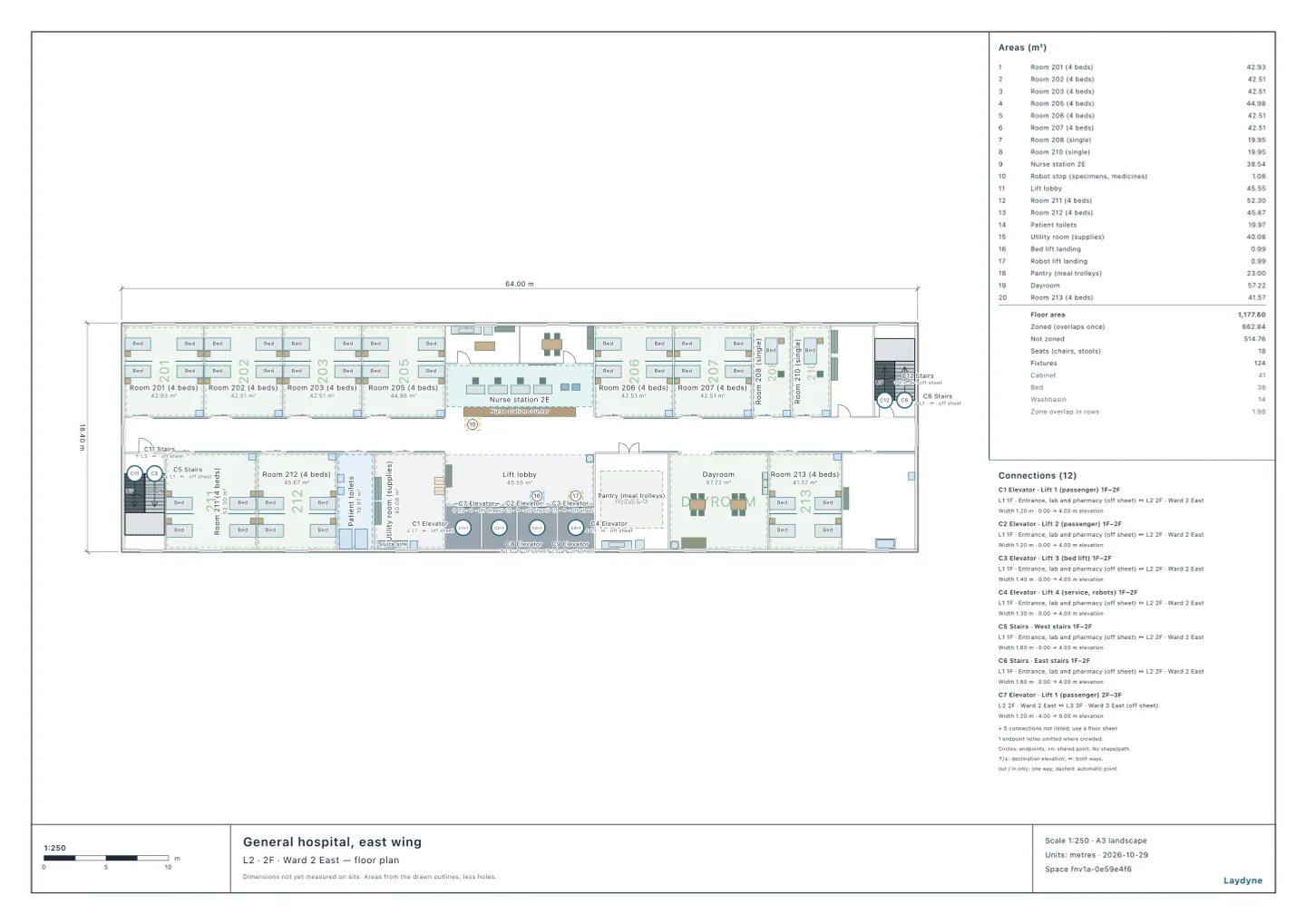
Care waits depend not only on the number of staff but on how often each person calls, how long each task takes and how people arrive (the spacing of the vans). Here are six examples that an AI simulated in earlier articles: a hospital ward, a group home, a nursing home unit, and a day service (a day centre for older people under Japan's long-term care insurance). The AI used the tool it calls over MCP (sweep_process_parameters), and each figure is the mean of 20 runs.
1. By the staff
| Example | Set-up | What is measured | Result |
|---|---|---|---|
| A ward at night (38 beds, 8 minutes per call) | Two nurses, each patient calling once a night | Wait after a call bell (mean) | 0.8 minutes |
| A ward at night (38 beds, 8 minutes per call) | Two nurses, each patient calling twice a night | Wait after a call bell (mean) | 4.3 minutes |
| A ward at night (38 beds, 8 minutes per call) | Three nurses, each patient calling twice a night | Wait after a call bell (mean) | 0.7 minutes |
| A group home at night (9 rooms, 10 minutes per call) | One carer, each resident calling once a night | Waiting for a carer (mean) | 0.8 minutes |
| A group home at night (9 rooms, 10 minutes per call) | One carer, each resident calling twice a night | Waiting for a carer (mean) | 3.3 minutes |
| A group home at night (9 rooms, 10 minutes per call) | Two carers, each resident calling twice a night | Waiting for a carer (mean) | 0.2 minutes |
| A nursing home unit's lunch (two needing full help) | One carer | Time for those needing full help to finish | 61.6 minutes |
| A nursing home unit's lunch (two needing full help) | Two carers | Time for those needing full help to finish | 40.0 minutes |
| A nursing home unit's lunch (two needing full help) | Three carers | Time for those needing full help to finish | 38.8 minutes |
| A day service's bath (10 bathers, one tub) | Two carers | Waiting for a carer | 7.4 minutes |
| A day service's bath (10 bathers, one tub) | Three carers | Waiting for a carer | 0.4 minutes |
| A day service's morning vital signs (30) | One taking them, vans 3 minutes apart | Wait (mean) | 21.5 minutes |
| A day service's morning vital signs (30) | One taking them, vans 6 minutes apart | Wait (mean) | 15.5 minutes |
| A day service's morning vital signs (30) | Two taking them, vans 3 minutes apart | Wait (mean) | 7.3 minutes |
| A ward's dinner (38 beds, one meal trolley) | Two handing out | A tray to the bed (mean) | 17.7 minutes |
| A ward's dinner (38 beds, one meal trolley) | Three handing out | A tray to the bed (mean) | 12.0 minutes |
| A ward's dinner (38 beds, one meal trolley) | Four handing out | A tray to the bed (mean) | 9.2 minutes |
2. What they show
- Twice the calls, far more than twice the wait. On the ward, with two nurses the wait rises from 0.8 to 4.3 minutes when each patient calls twice a night; three nurses bring it to 0.7 minutes. At the group home, one carer's 0.8 minutes becomes 3.3 minutes, and two carers bring it to 0.2 minutes.
- A second carer helps; a third helps less. The nursing home unit's lunch for those needing full help takes 40.0 minutes with two carers instead of 61.6, but still 38.8 with three.
- Spread out the arrivals. At the day service, with one person taking the vital signs, vans 6 minutes apart instead of 3 cut the wait from 21.5 minutes to 15.5; with two people taking them, the wait is 7.3 minutes.
3. The articles
- How many nurses on a ward at night?
- Is one carer enough on a group home's night shift?
- How many staff for lunch in a nursing home unit?
- How many baths a day at a day service centre?
- How many staff for the morning vitals at a day service?
- How long is the evening meal round on a ward?
4. How to ask an AI
On this ward (as drawn, 38 beds), compare the wait after a call bell with two and three nurses at night, and with each patient calling once and twice a night, 20 runs each.
5. What this does not cover
- How often people call, and the times for help, meals, baths and the vital signs, are each article's assumptions. Replace them with your own records.
- The staffing standards set by law (the fewest staff allowed) are not checked here.