Waits in a restaurant depend not only on the number of seats but on their shape (tables for four or for two, or a counter), on how people arrive, where they queue and who does what. Here are seven examples an AI simulated in earlier articles: a lunch, a ramen shop, a hotel breakfast, a staff canteen, a buffet, a café and an izakaya (a Japanese pub serving small dishes). The AI used the tool it calls over MCP (sweep_process_parameters), and each figure is the mean of 20 runs.
1. By the set-up
| Example | Set-up | What is measured | Result |
|---|---|---|---|
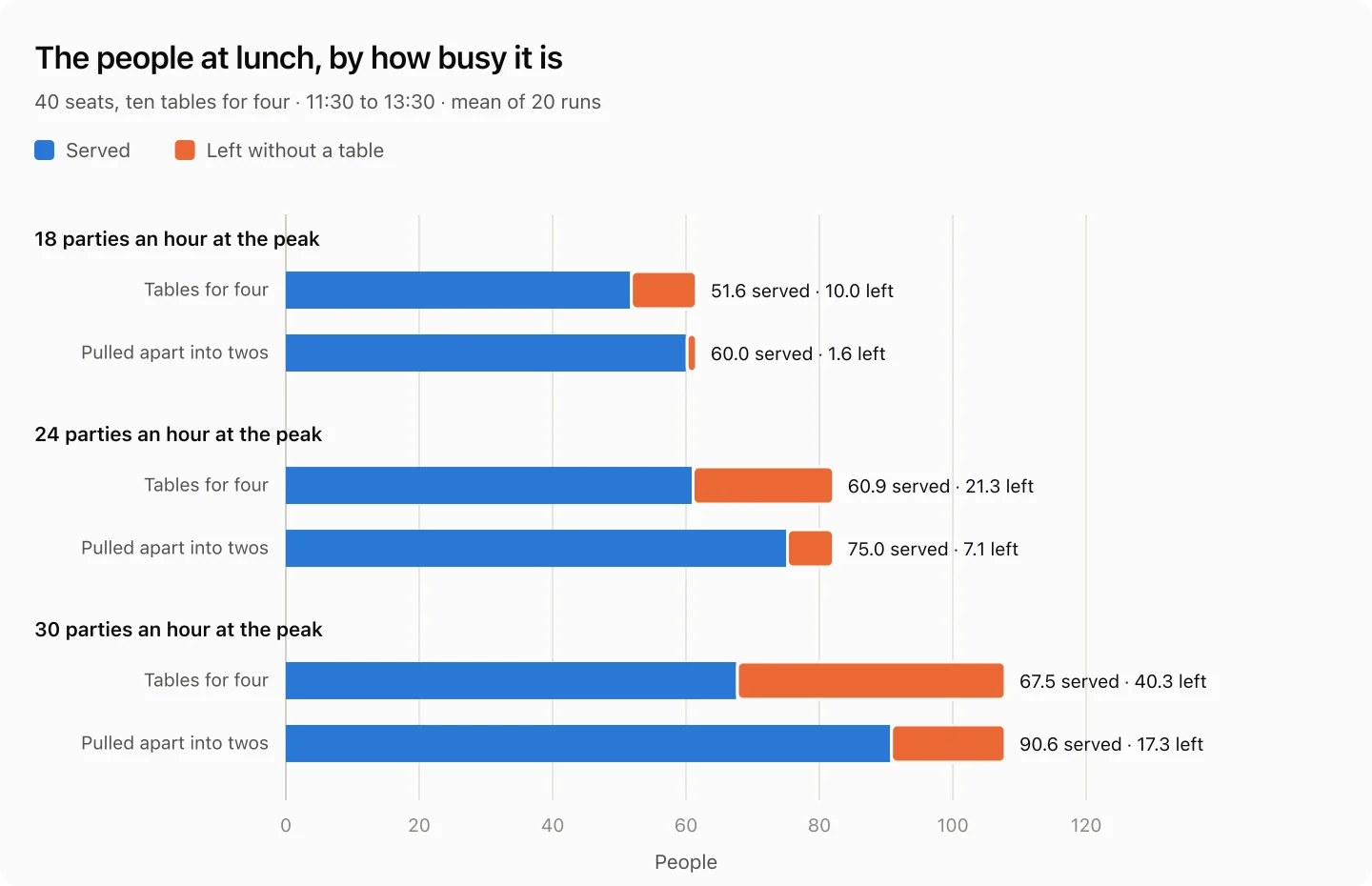
| A 40-seat lunch (24 parties an hour) | Tables for four kept whole | Parties seated | 27.5 parties |
| A 40-seat lunch (24 parties an hour) | Pulled apart into tables for two | Parties seated | 33.8 parties |
| A ramen shop (20 parties at noon) | 10 seats | Waiting for a seat | 2.5 minutes |
| A ramen shop (20 parties at noon) | 12 seats | Waiting for a seat | 0.9 minutes |
| A hotel breakfast (240) | 24 tables for two (48 seats) | Time to a seat (mean) | 13.3 minutes |
| A hotel breakfast (240) | 18 tables for two and a 12-seat counter (48 seats) | Time to a seat (mean) | 3.4 minutes |
| A hotel breakfast (240) | 24 tables for two and a 12-seat counter (60 seats) | Time to a seat (mean) | 0.7 minutes |
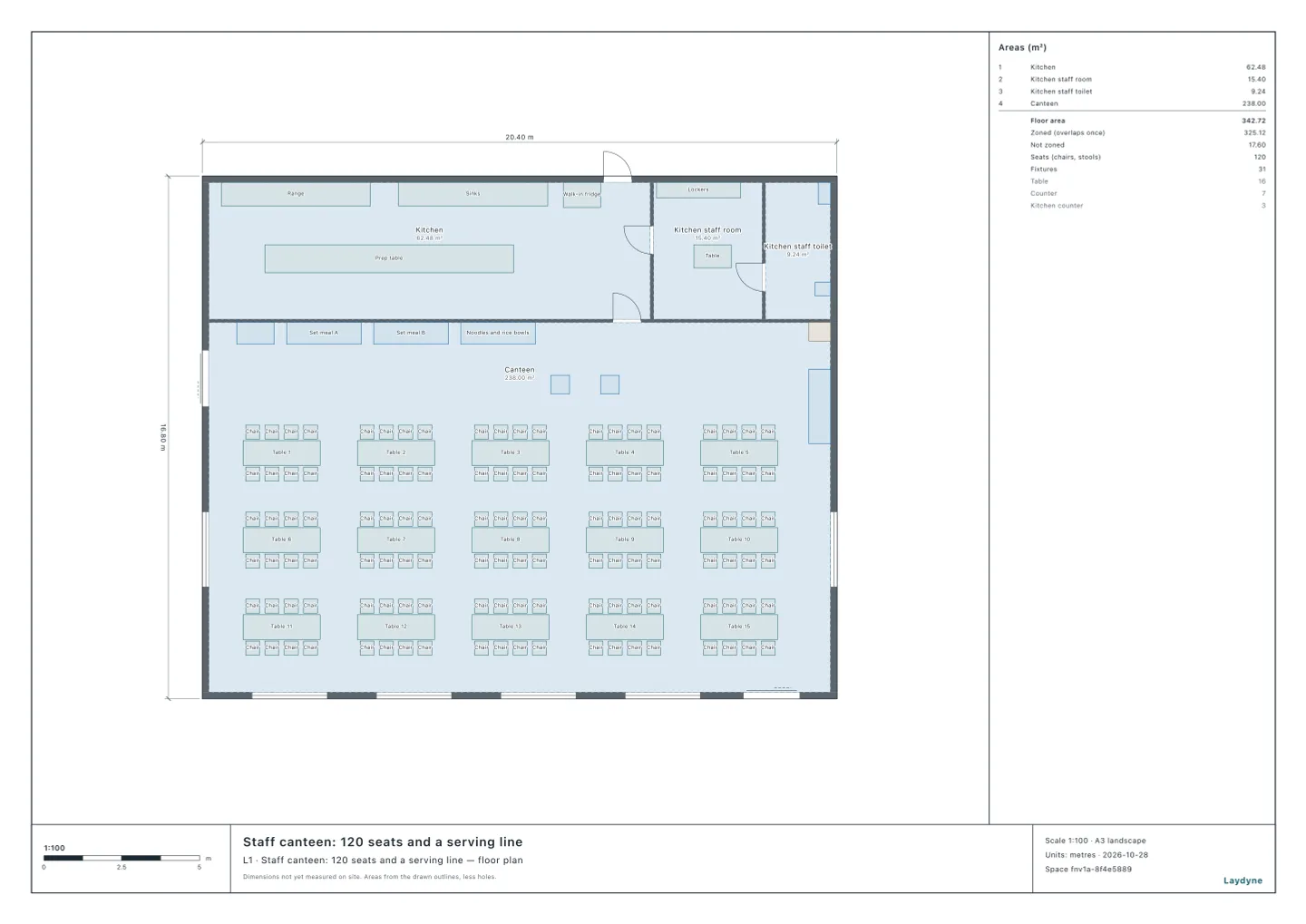
| A staff canteen (240, 80 seats) | One lunch break | Waiting for a seat (mean) | 583.0 seconds |
| A staff canteen (240, 80 seats) | Two lunch breaks | Waiting for a seat (mean) | 172.7 seconds |
| A staff canteen (240, 80 seats) | Three lunch breaks | Waiting for a seat (mean) | 9.8 seconds |
| A buffet for 200 | Everyone at once, one side | A guest from the seat and back | 17.1 minutes |
| A buffet for 200 | Everyone at once, both sides | A guest from the seat and back | 9.2 minutes |
| A buffet for 200 | Tables called every 60 seconds, both sides | A guest from the seat and back | 2.3 minutes |
| A café's morning | Two cashiers, two baristas | Time to a drink | 2.3 minutes |
| A café's morning | One cashier, two baristas | Time to a drink | 5.4 minutes |
| A café's morning | Two cashiers, one barista | Time to a drink | 8.8 minutes |
| An izakaya (9 groups an hour from 19:00 to 21:00) | Groups of one or two wait for a table | Groups that left | 5.6 groups |
| An izakaya (9 groups an hour from 19:00 to 21:00) | Groups of one or two wait for the counter | Groups that left | 4.2 groups |
2. What they show
- The shape of the seats matters more than their number. Pulling the 40-seat lunch's tables apart into tables for two seats 33.8 parties instead of 27.5. At the hotel breakfast, the 13.3 minutes to a seat with 24 tables for two fall to 3.4 with 18 tables and a 12-seat counter, the same 48 seats (single guests no longer take a table for two to themselves).
- Spread out the arrivals. At the staff canteen, still with 80 seats, the wait for a seat is 172.7 seconds with two lunch breaks and 9.8 with three. At the buffet a guest takes 9.2 minutes with both sides open, and 2.3 with tables called every 60 seconds as well.
- Put staff where the work backs up. At the café, the wait for a drink is 5.4 minutes with one cashier and 8.8 with one barista: which one you cut matters. Two more seats at the ramen shop cut the wait for a seat from 2.5 minutes to 0.9.
- Change the seats groups wait for. At an izakaya with 9 groups an hour from 19:00 to 21:00, 5.6 groups leave when groups of one or two wait for a table. When they wait for the counter, this falls to 4.2 groups.
3. The articles
- How do you turn more tables at lunch?
- How many seats for a ramen shop?
- How many seats does a hotel breakfast room need?
- How many seats for a staff canteen?
- How long is the buffet queue?
- How many people does a café need for the morning rush?
- Which seats does an izakaya run short of?
4. How to ask an AI
In this restaurant (as drawn, 40 seats), with 24 parties an hour at the lunch peak, compare how many parties get a table with the tables for four kept whole and pulled apart into tables for two, 20 runs each.
5. What this does not cover
- How many parties come and how big they are, and the times to eat, cook and pay, are each article's assumptions. Replace them with your own bills and arrivals.