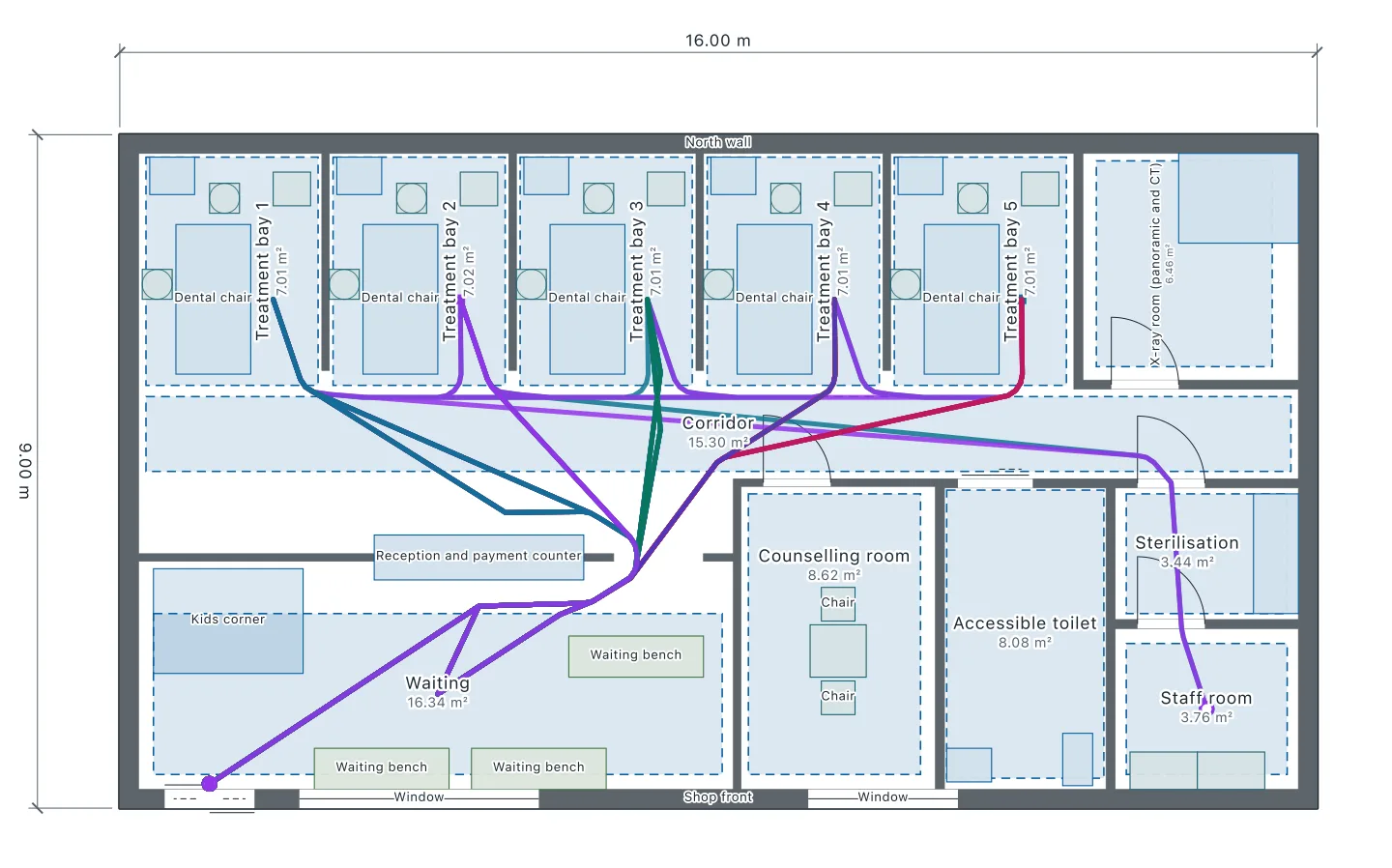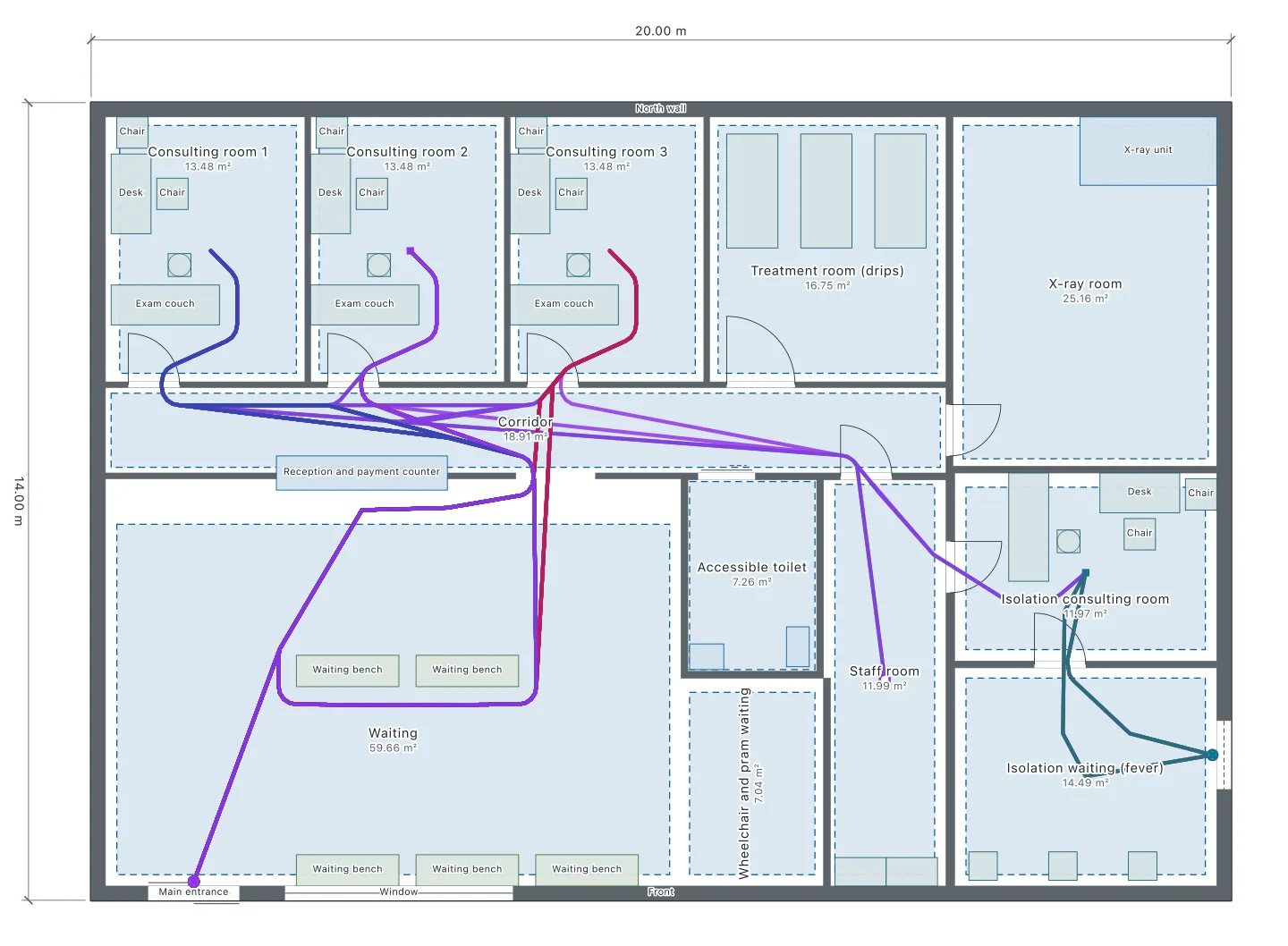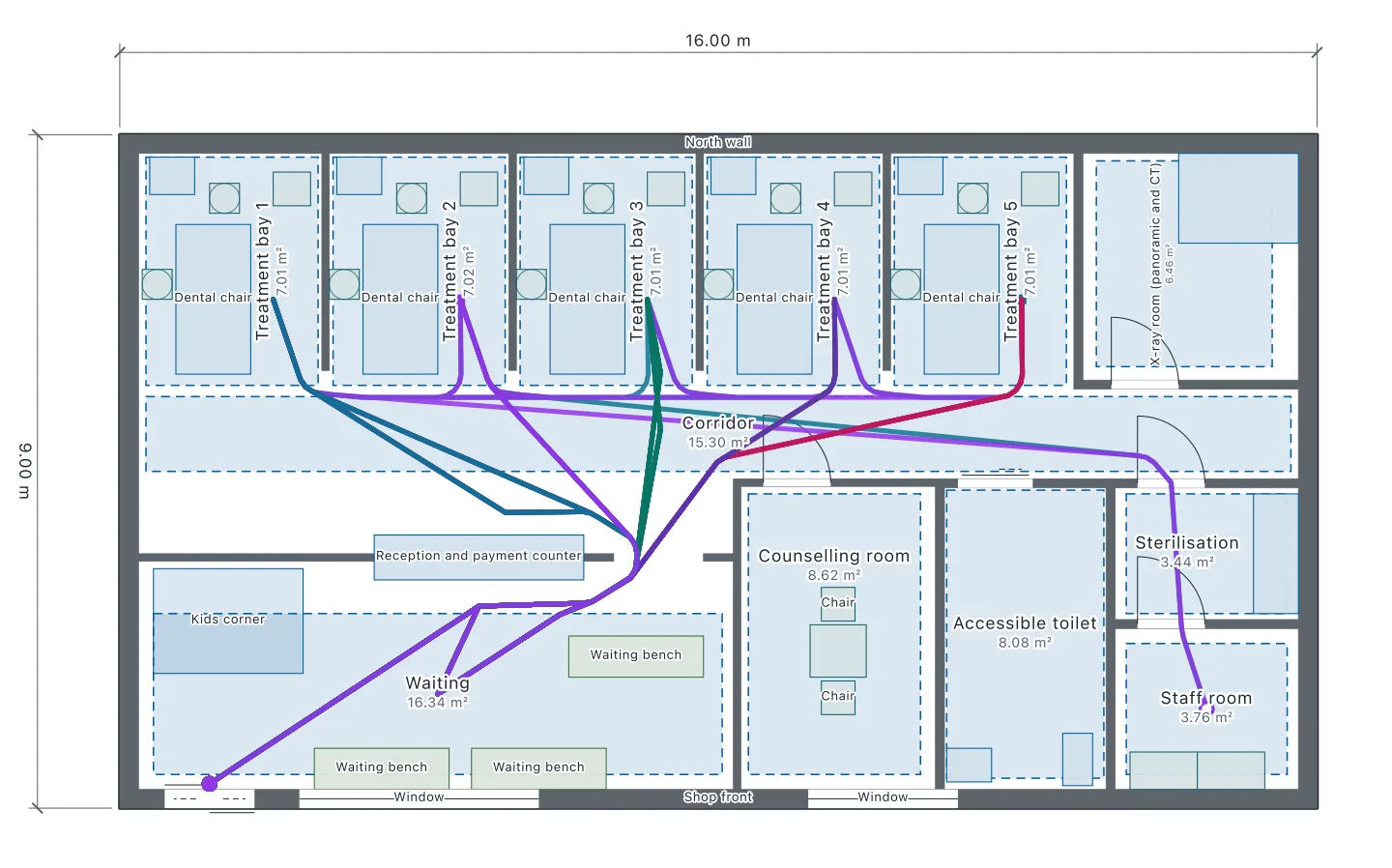
Waits depend not only on the staff, chairs and machines but on the booking slots, on who does which job, and on where people wait. Here are seven examples an AI simulated in earlier articles with the tool it calls over MCP (sweep_process_parameters); each figure is the mean of 20 runs.
1. The waits, by the set-up
| Example | Set-up | What is measured | Result |
|---|---|---|---|
| A dental clinic (five chairs, a morning's bookings) | 30-minute slots, two dentists | Waiting for a free chair | 9.4 minutes |
| A dental clinic (five chairs, a morning's bookings) | 30-minute slots, three dentists | Waiting for a free chair | 2.8 minutes |
| A dental clinic (five chairs, a morning's bookings) | 45-minute slots, two dentists | Waiting for a free chair | 0.1 minutes |
| A clinic (two doctors, a morning) | Walk-ins | From arrival to leaving | 25.8 minutes |
| A clinic (two doctors, a morning) | Half booked | From arrival to leaving | 21.0 minutes |
| A clinic (two doctors, a morning) | Everyone booked | From arrival to leaving | 14.0 minutes |
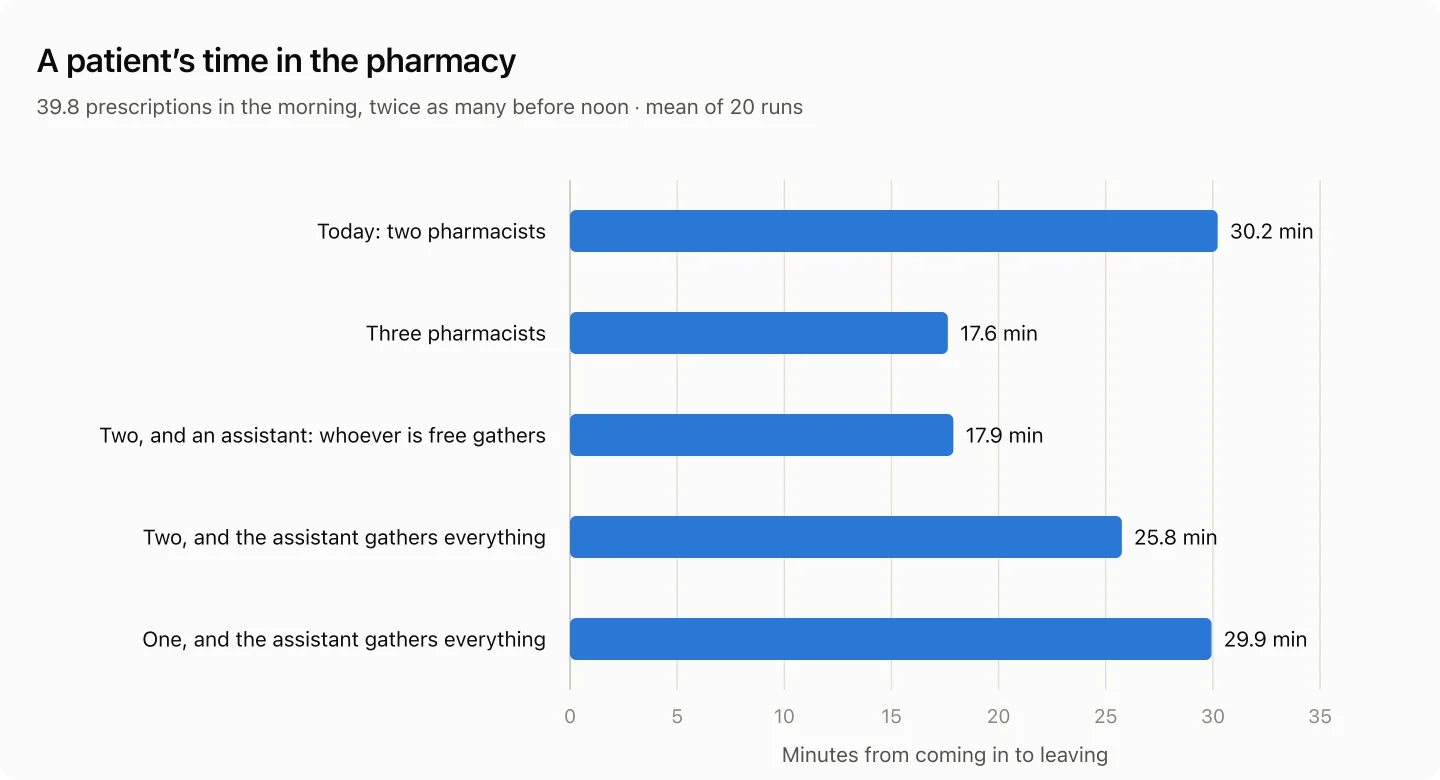
| A dispensing pharmacy (a morning) | Two pharmacists | From arrival to leaving | 30.2 minutes |
| A dispensing pharmacy (a morning) | Three pharmacists | From arrival to leaving | 17.6 minutes |
| A dispensing pharmacy (a morning) | Two pharmacists and an assistant (whoever is free picks) | From arrival to leaving | 17.9 minutes |
| A dispensing pharmacy (a morning) | Two pharmacists and an assistant (the assistant picks everything) | From arrival to leaving | 25.8 minutes |
| A hospital's blood tests (150 patients in a morning) | Four staff | Mean wait | 20.8 minutes |
| A hospital's blood tests (150 patients in a morning) | Five staff | Mean wait | 12.2 minutes |
| A hospital's blood tests (150 patients in a morning) | Six staff | Mean wait | 8.2 minutes |
| An orthopaedic clinic's rehabilitation | Two traction machines, two water beds | From the waiting room to leaving | 28.6 minutes |
| An orthopaedic clinic's rehabilitation | Three traction machines, two water beds | From the waiting room to leaving | 25.2 minutes |
| An orthopaedic clinic's rehabilitation | Three traction machines, three water beds | From the waiting room to leaving | 22.1 minutes |
| A health check (60 people in a training room) | Arriving by department, one ECG bed | Time at the venue | 69.3 minutes |
| A health check (60 people in a training room) | Arriving by department, two ECG beds | Time at the venue | 29.8 minutes |
| A health check (60 people in a training room) | Booked times, two ECG beds | Time at the venue | 18.9 minutes |
| A vaccination day (120 people) | Two booths, ten waiting chairs | Time at the venue | 47.9 minutes |
| A vaccination day (120 people) | Three booths, ten waiting chairs | Time at the venue | 46.7 minutes |
| A vaccination day (120 people) | Three booths, fifteen waiting chairs | Time at the venue | 19.4 minutes |
2. What they show
- The slots and the bookings. At a dental clinic with two dentists, the wait for a free chair is 9.4 minutes with 30-minute slots and 0.1 minutes with 45-minute slots, though the bookings fall from 30 to 20. At the clinic, the 25.8 minutes with walk-ins becomes 14.0 minutes with everyone booked.
- Who does what. The pharmacy takes 17.9 minutes with an assistant added and whoever is free picking the medicines, close to the 17.6 minutes with three pharmacists. With the assistant picking everything, it takes 25.8 minutes.
- More than one place to wait. The vaccination day takes 46.7 minutes even with three booths if there are only ten waiting chairs, and 19.4 minutes with fifteen. The rehabilitation takes 25.2 minutes with a traction machine added, and 22.1 minutes with a water bed added too.
- One bed or one person makes the difference. A second ECG bed cuts the health check from 69.3 minutes to 29.8, and going from four staff to six cuts the wait for blood tests from 20.8 minutes to 8.2.
3. The articles
- How do you cut the waits at a dental clinic?
- Do bookings cut the waits at a clinic?
- How do you cut the wait at a pharmacy?
- How long is the wait for a blood test at a hospital?
- How long is the wait for rehabilitation at an orthopaedic clinic?
- A health checkup venue: how many ECG beds?
- A vaccination site at work: how many booths and chairs?
4. How to ask an AI
In this dental clinic (as drawn, five chairs), compare how long patients wait in the waiting room and at the chair with 30- and 45-minute morning slots and with two and three dentists, 20 runs each.
5. What this does not cover
- How many patients come and when, and the times for consultations, dispensing, blood tests and treatments, are each article's assumptions. Replace them with your own reception and payment records.