How many robots you need depends not only on how fast they are but on the people around them, and on the other places where they wait: lifts, stations and forklifts. Here are seven examples an AI simulated in earlier articles, by the number of robots, with the tool it calls over MCP (sweep_process_parameters). Examples with random arrivals give the mean of 20 runs; those without (the night cleaning, the floor scrubbing and the office deliveries) are one run each.
1. By the number of robots
| Example | Robots | What is measured | Result |
|---|---|---|---|
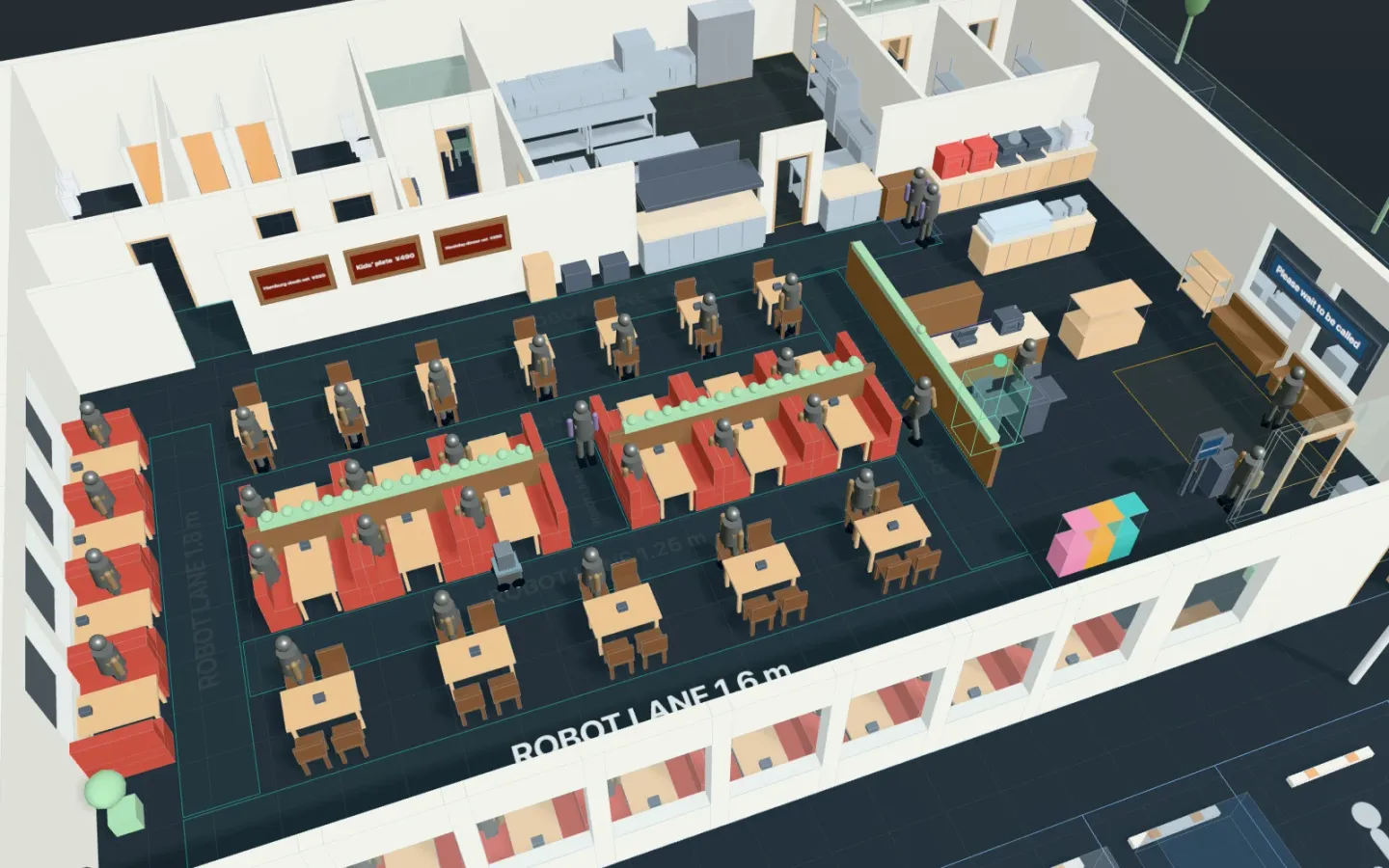
| Serving robots (a family restaurant, three floor staff) | 1 | Dishes the floor staff carried (of 73 parties) | 30.2 parties |
| Serving robots (a family restaurant, three floor staff) | 2 | Dishes the floor staff carried (of 73 parties) | 7.5 parties |
| Serving robots (a family restaurant, three floor staff) | 3 | Dishes the floor staff carried (of 73 parties) | 1.0 parties |
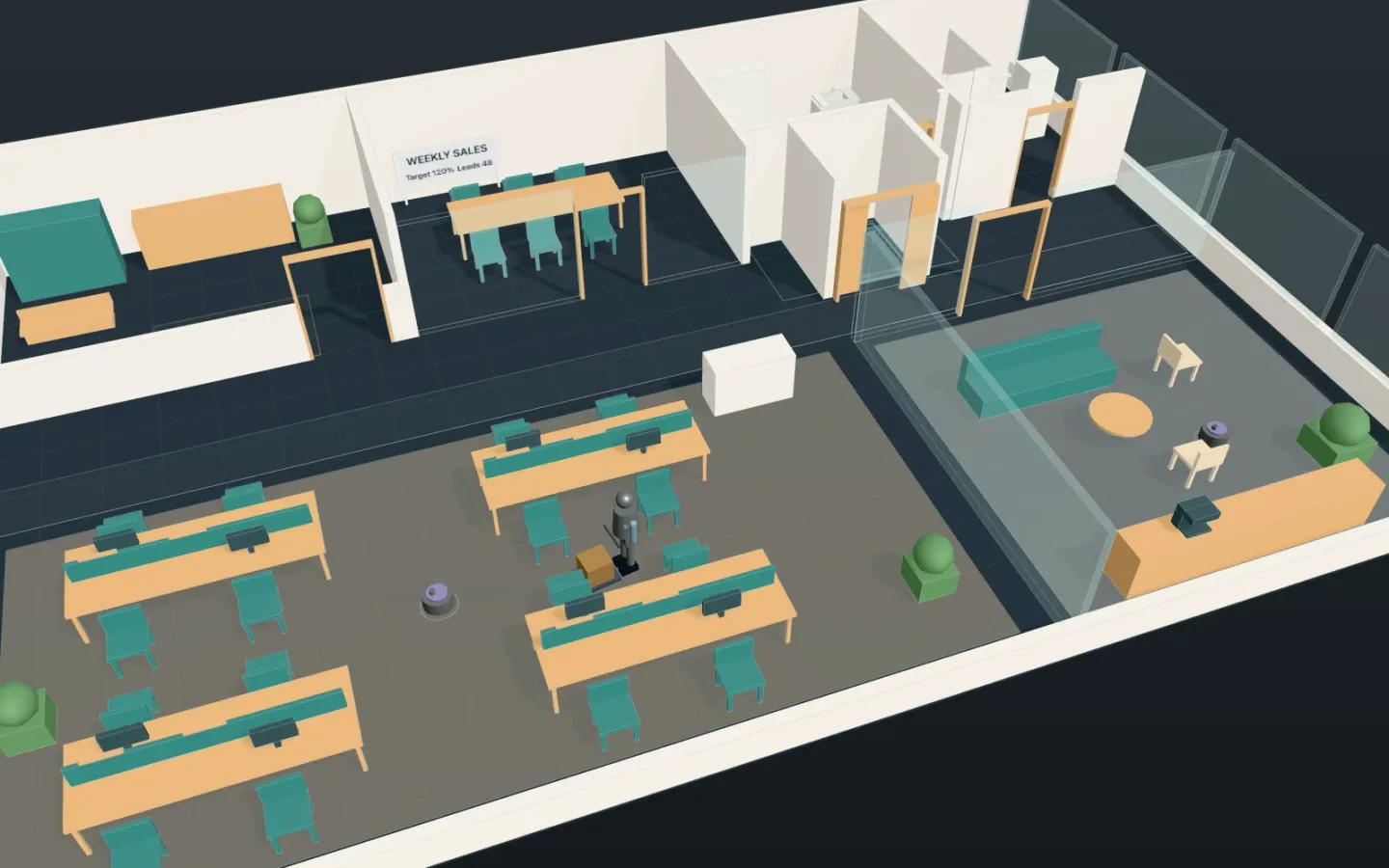
| Robot vacuums (an office's night cleaning) | Two cleaners, no robots | Done at, staff hours | 0:33, 5.10 staff hours |
| Robot vacuums (an office's night cleaning) | One cleaner, two robots | Done at, staff hours | 1:15, 3.25 staff hours |
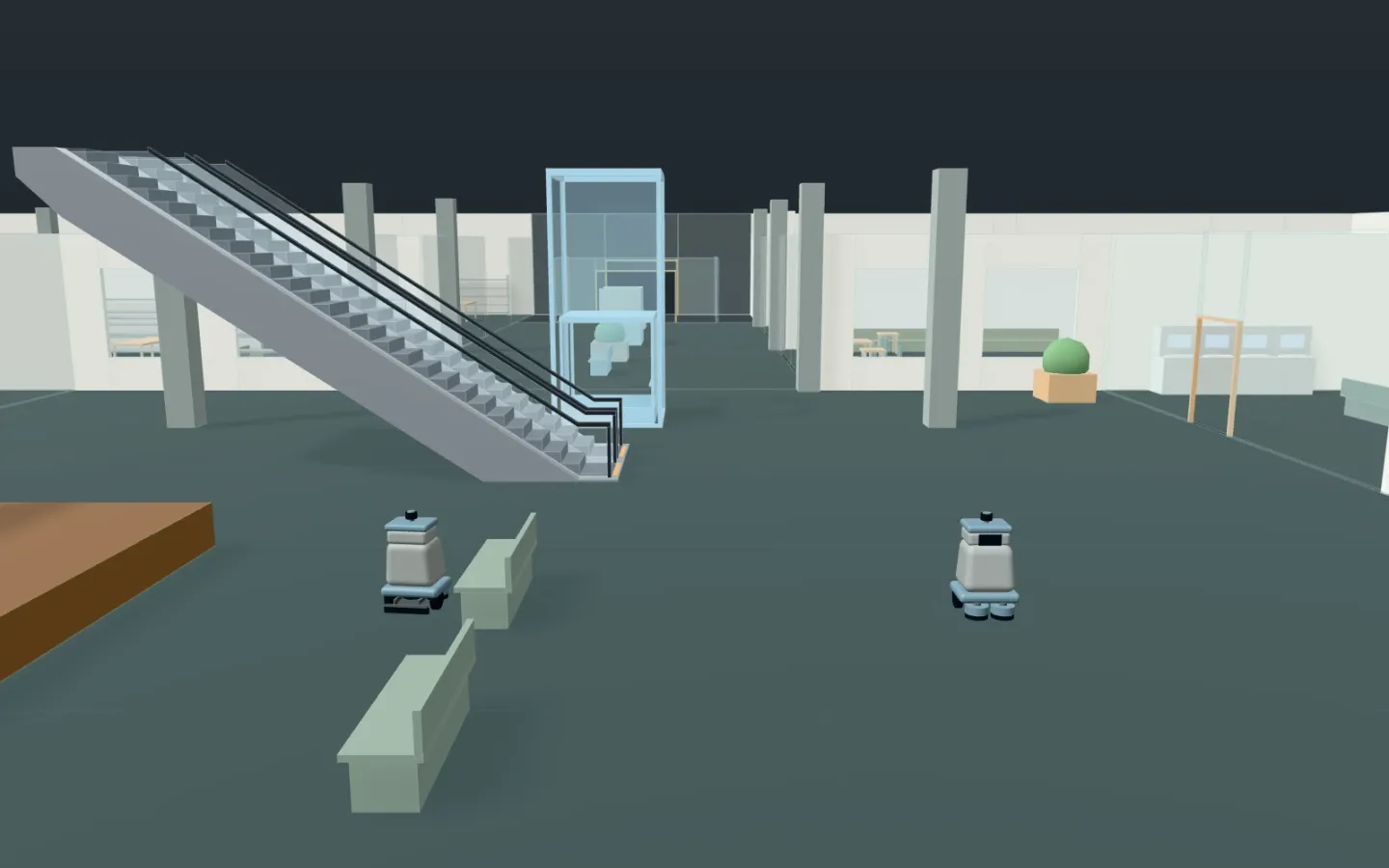
| Floor scrubbers (a mall at night, one fill point) | 2 | The last section done at | 6:20 |
| Floor scrubbers (a mall at night, one fill point) | 3 | The last section done at | 4:27 |
| Floor scrubbers (a mall at night, one fill point) | 4 | The last section done at | 0:59 |
| Delivery robots (a hospital's specimens) | 2 | A specimen to the lab | 17.2 minutes |
| Delivery robots (a hospital's specimens) | 2, the meal trolleys on the bed lift | A specimen to the lab | 8.4 minutes |
| Delivery robots (a hospital's specimens) | 3 | A specimen to the lab | 8.4 minutes |
| Delivery robots (a hospital's specimens) | 3, the meal trolleys on the bed lift | A specimen to the lab | 5.2 minutes |
| Picking robots (a warehouse) | 16 | A line takes | 479.3 seconds |
| Picking robots (a warehouse) | 24 | A line takes | 320.8 seconds |
| Picking robots (a warehouse) | 32 | A line takes | 320.1 seconds |
| Delivery robots (an office's parcels) | 1 | The last parcel handed over after | 44.2 minutes |
| Delivery robots (an office's parcels) | 2 | The last parcel handed over after | 25.3 minutes |
| Delivery robots (an office's parcels) | 4 | The last parcel handed over after | 13.7 minutes |
| AMRs and forklifts (a parts factory) | Two AMRs, one forklift | An inbound and an outbound truck | 17.9 and 23.1 minutes |
| AMRs and forklifts (a parts factory) | Three AMRs, one forklift | An inbound and an outbound truck | 17.9 and 23.1 minutes |
| AMRs and forklifts (a parts factory) | Two AMRs, two forklifts | An inbound and an outbound truck | 6.1 and 8.6 minutes |
2. What they show
More robots stop helping once something else decides: 32 picking robots take 320.1 seconds a line against 320.8 with 24, and a third AMR leaves a factory's inbound trucks at 17.9 minutes while a second forklift brings them to 6.1.
- A second robot helps; more may not. A second serving robot cuts the dishes the floor staff carry from 30.2 parties to 7.5, and a third to 1.0. Picking robots go from 479.3 seconds a line with 16 robots to 320.8 with 24, but 32 robots still take 320.1 (the wait moves to the lanes at the stations).
- Something else may decide. At the parts factory a third AMR leaves the trucks at 17.9 and 23.1 minutes; a second forklift brings them to 6.1 and 8.6. At the hospital, moving the meal trolleys to the bed lift alone gets a specimen to the lab in 8.4 minutes, the same as a third robot.
- Robots with people. In the office's night cleaning, one cleaner and two robots take 3.25 staff hours, 36% fewer than two cleaners' 5.10, but finish at 1:15 instead of 0:33.
- The number sets the finish. The mall's floor scrubbers finish at 6:20 with two, 4:27 with three and 0:59 with four. The office's last parcel is handed over after 44.2 minutes with one robot, 25.3 with two and 13.7 with four.
3. The articles
- How many serving robots?
- Can robot vacuums cut the night cleaning crew?
- How many floor-scrubbing robots?
- How many delivery robots does a hospital need?
- How many picking robots (AMRs)?
- How many office delivery robots?
- Which gets trucks off the docks sooner, an AMR or a forklift?
4. How to ask an AI
In this restaurant (as drawn, 73 parties at a weekday dinner), how do the dishes the floor staff carry and how far they walk change with one, two and three serving robots? Compare 20 runs of each.
5. What this does not cover
- The guests, parcels and orders that come, and the robots' speed, batteries and work times, are each article's assumptions. Put your own site's records in their place.
- Robots passing each other or people, collisions and avoiding them are not computed (the waits at lifts and stations are).