Office and factory managers, the councils and schools that run shelters, and designers deciding how many toilets a building has
How many toilets does an office, a factory or a shelter need?
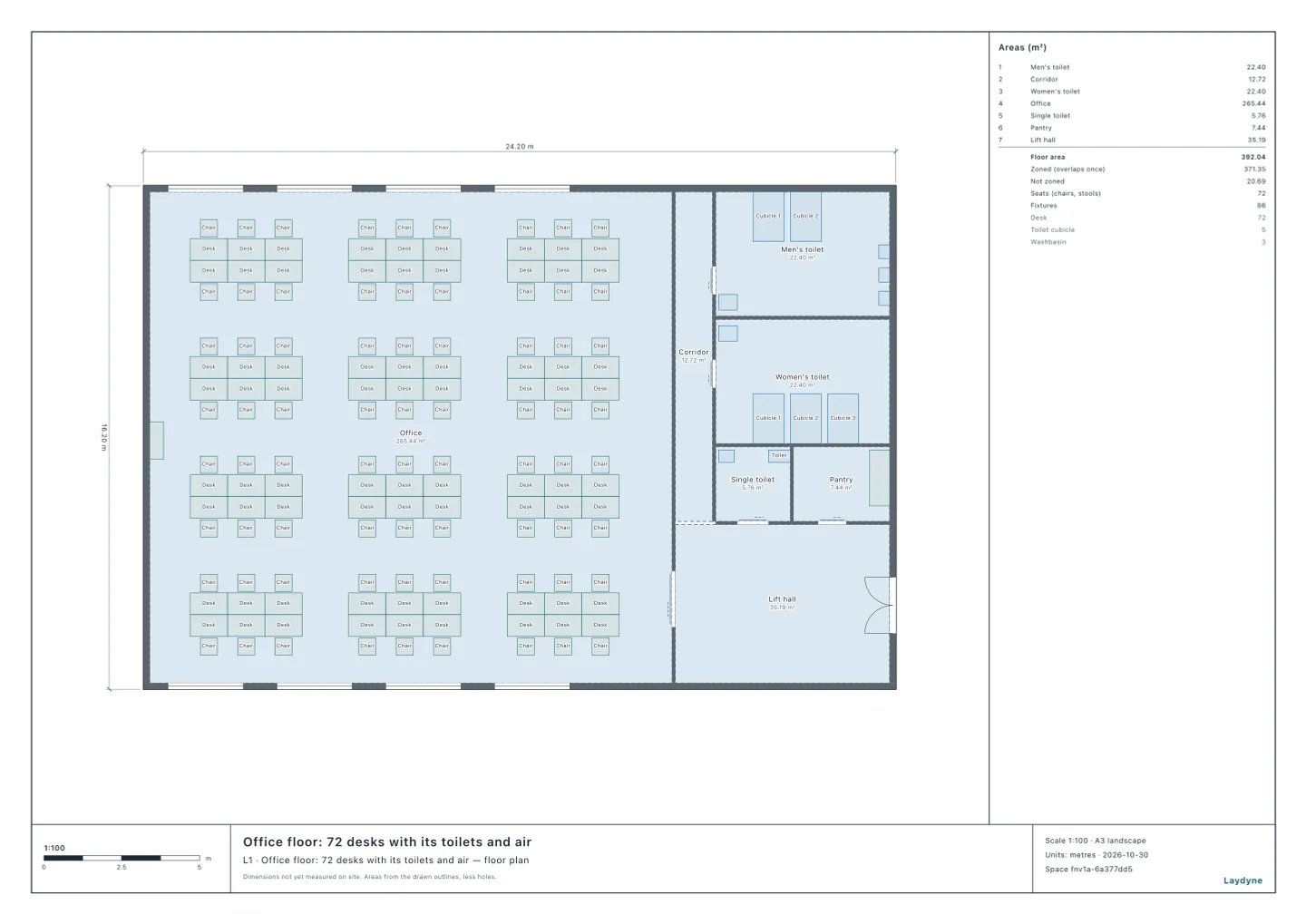
An office of 72 seats (40 men, 32 women) needs 3 cubicles and a urinal. Queues still form: in a shelter men wait 87.3 minutes on average, and one basin keeps a man 10.7 minutes away from his desk.
The flow
You
Your AI
Laydyne
You1Ask how many toilets are needed, and how long the wait isGive the people at work at one time, or the people in the shelter.
Laydyne2Count the toilets the rules requireOrdinance on Health Standards in the Office, Article 17; Ordinance on Industrial Safety and Health, Article 628.check_space→ 40 men and 32 women: one men's cubicle, one urinal, two women's cubicles.
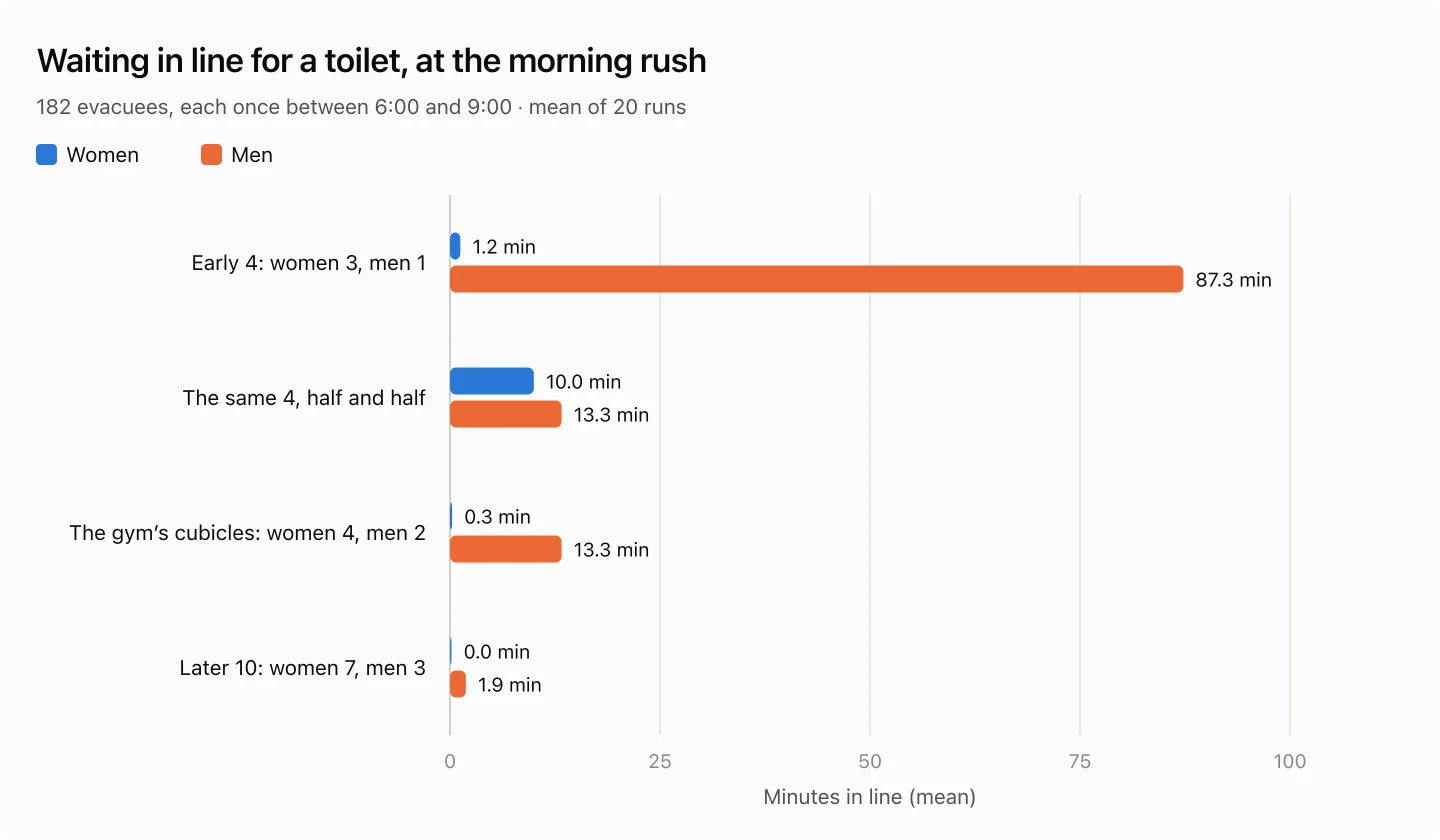
Laydyne3Simulate everyone going at onceCompare the counts and the ways people arrive.run_process_scenariosweep_process_parameters→ A shelter's first four toilets, three to one: men wait 87.3 minutes.
In Japan, the number of toilets is set by the Ordinance on Health Standards in the Office for offices, by the Ordinance on Industrial Safety and Health for factories and other workplaces, and, for shelters, by the Cabinet Office's guideline. Here are the counts an AI checked in earlier articles, and the waits when everyone goes at the same time, found with the tools it calls over MCP (check_space, and the simulation tools run_process_scenario and sweep_process_parameters). An office of 72 seats with 40 men and 32 women at work needs one men's cubicle, one urinal and two women's cubicles, and a shelter of 182 people needs 4 toilets at first and 10 later on.
1. The rules
Where
Rule
Count
An office
Ordinance on Health Standards in the Office, Article 17
One men's cubicle per 60 men at work at one time, one urinal per 30 men, one women's cubicle per 20 women
A factory or workshop
Ordinance on Industrial Safety and Health, Article 628
The same as an office
A single toilet for anyone (one cubicle walled on all four sides)
Article 17-2 of the office ordinance, Article 628-2 of the industrial ordinance
Each single toilet takes 10 people off the numbers each count is based on (each count keeps at least one); with up to 10 people at work at one time, one single toilet is enough
A shelter
The Cabinet Office's guideline (revised December 2024)
One per 50 people at first, one per 20 later on, three for women to each one for men
2. Offices and factories: how many
Facility
At work at one time
Men's cubicles
Urinals
Women's cubicles
Enough
An office of 72 seats (one single toilet)
40 men, 32 women
2 (1 needed)
3 (1)
3 (2)
Yes
An office of 72 seats (no single toilet)
40 men, 32 women
2 (1)
3 (2)
3 (2)
Yes
A machine shop (one single toilet)
9 men, 1 woman
―
―
―
Yes (10 or fewer)
A machine shop (one single toilet)
10 men, 2 women
0 (1)
0 (1)
0 (1)
No
A single toilet saves a urinal. With a single toilet for anyone, the office counts urinals for 10 fewer men, and needs one urinal instead of two.
Over ten people, separate toilets for men and women. The machine shop's single toilet is enough for up to 10 people at work at one time; with 12 people it needs men's and women's toilets.
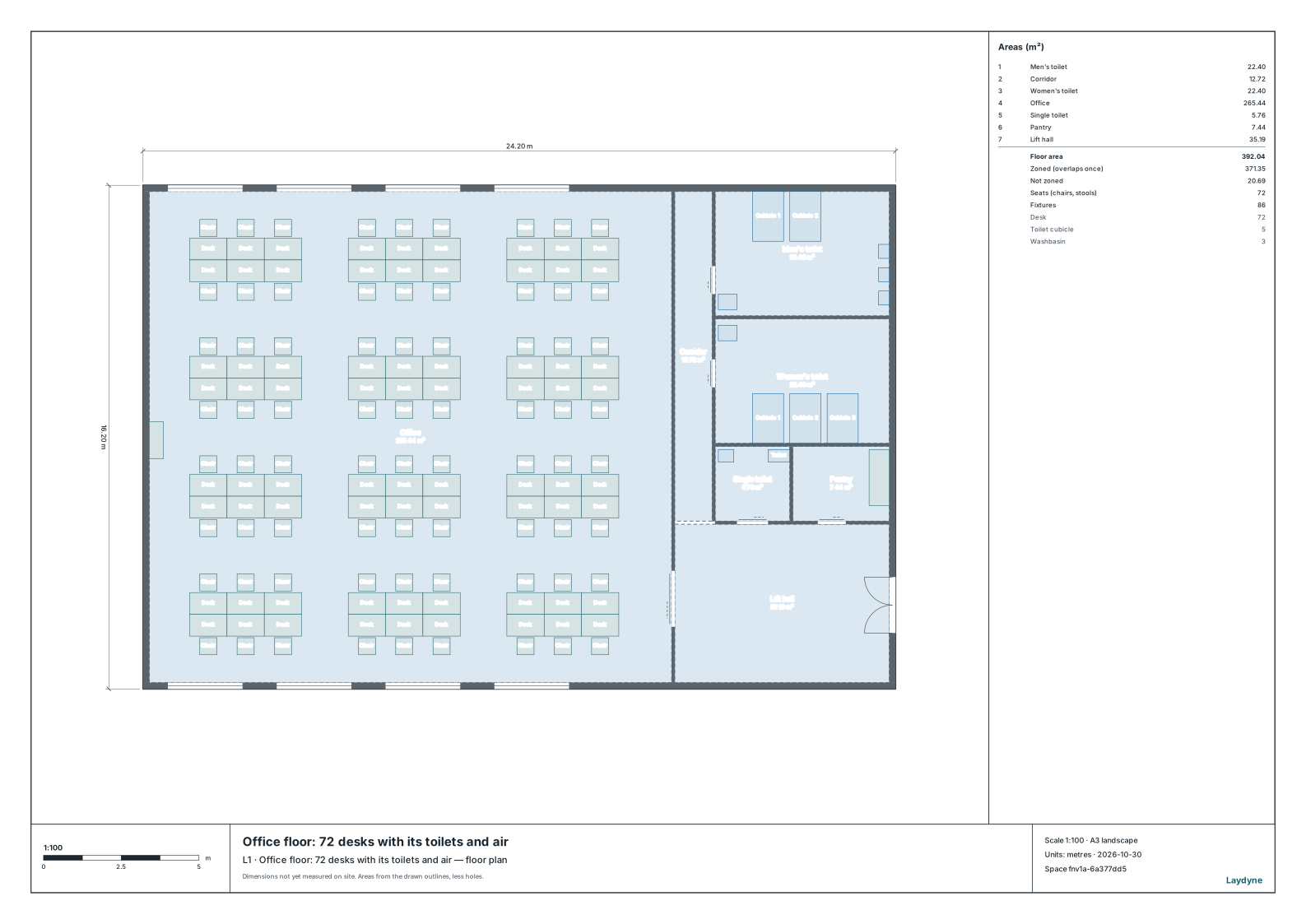
The office of 72 seats: its men's and women's toilets and a single toilet
3. Shelters: how many
Stage
182 people ÷ people per toilet
Women's
Men's
At first (one per 50)
3.64
3
1
Later on (one per 20)
9.1
7
3
A school gym's floor of 640 m² holds 182 people at 3.5 m² each. The toilets are split three to one, each count rounded up.
4. How long when everyone goes at once
Where
As set up
Mean wait
Longest wait
A shelter's morning (182 people), women
The first four, three for women and one for men
1.2 min
6.8 min
A shelter's morning (182 people), men
The first four, three for women and one for men
87.3 min
158.3 min
A shelter's morning (182 people), women
The four, two and two
10.0 min
26.0 min
A shelter's morning (182 people), men
The four, two and two
13.3 min
31.0 min
A school's break (4 in 10 go), girls
Three cubicles
5.9 min
12.7 min
A school's break (4 in 10 go), girls
Six cubicles
2.0 min
4.8 min
Two tour buses at a service area, women (14 cubicles)
30 minutes apart
0.3 min
2.7 min
Two tour buses at a service area, women (14 cubicles)
At the same time
1.0 min
6.0 min
Three to one, and men wait in the morning. Split as the guideline says, three for women and one for men, the shelter's first four toilets keep women waiting 1.2 minutes on average and men 87.3 minutes. Split two and two, women wait 10.0 minutes and men 13.3 minutes.
Double the girls' cubicles. With 4 in 10 pupils going at the break, girls wait 5.9 minutes on average with three cubicles and 2.0 minutes with six.
How people arrive. Two tour buses arriving together instead of 30 minutes apart raise the women's longest wait from 2.7 minutes to 6.0 minutes, and the longest line from 13.6 people to 33.7.
The washbasins, too. At the end of an office's lunch, with 3 in 10 people brushing their teeth, one washbasin keeps even a man who uses a urinal 10.7 minutes away from his desk (8.6 minutes of it waiting at the basin); with two basins, 4.1 minutes (1.3 minutes).
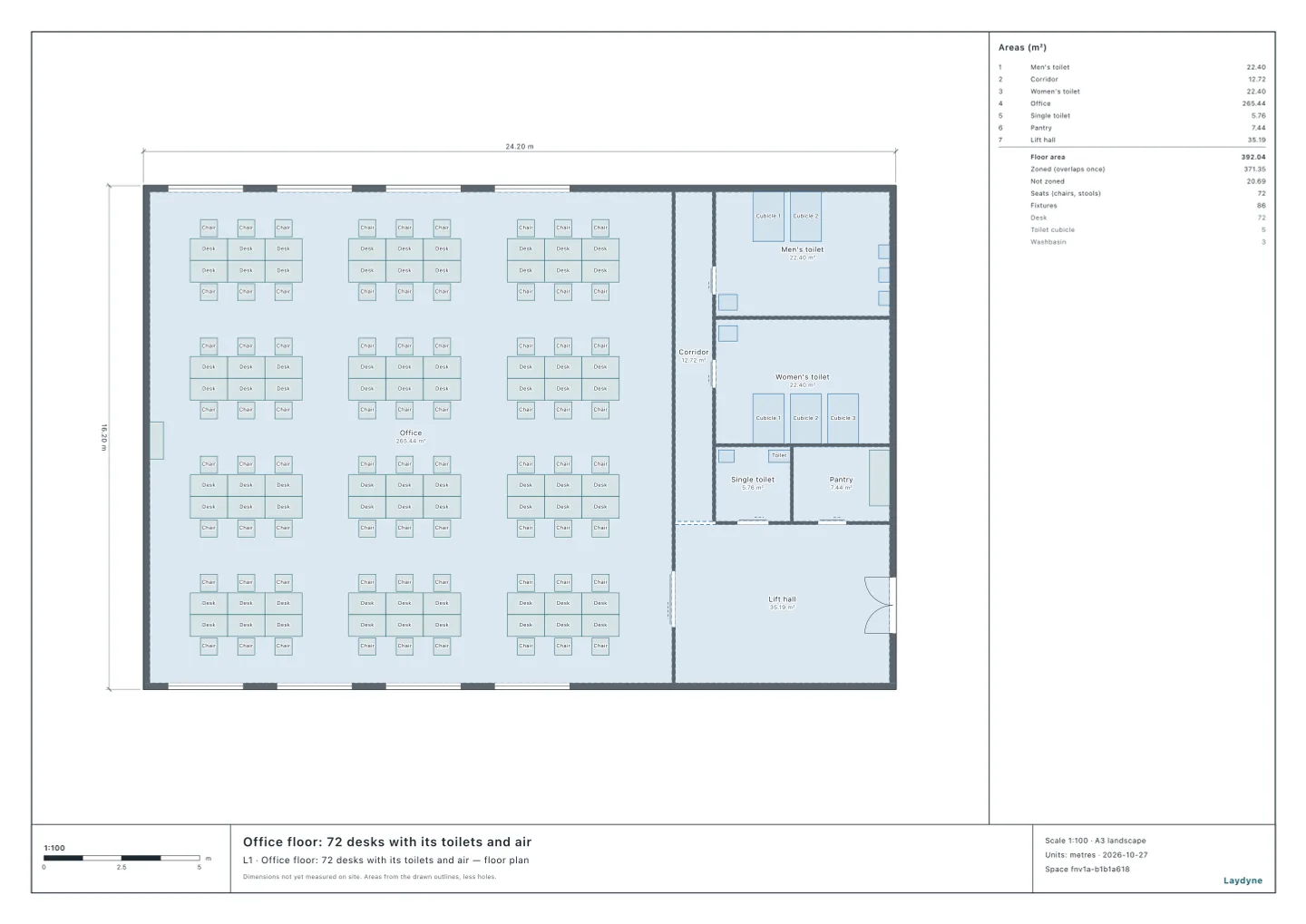
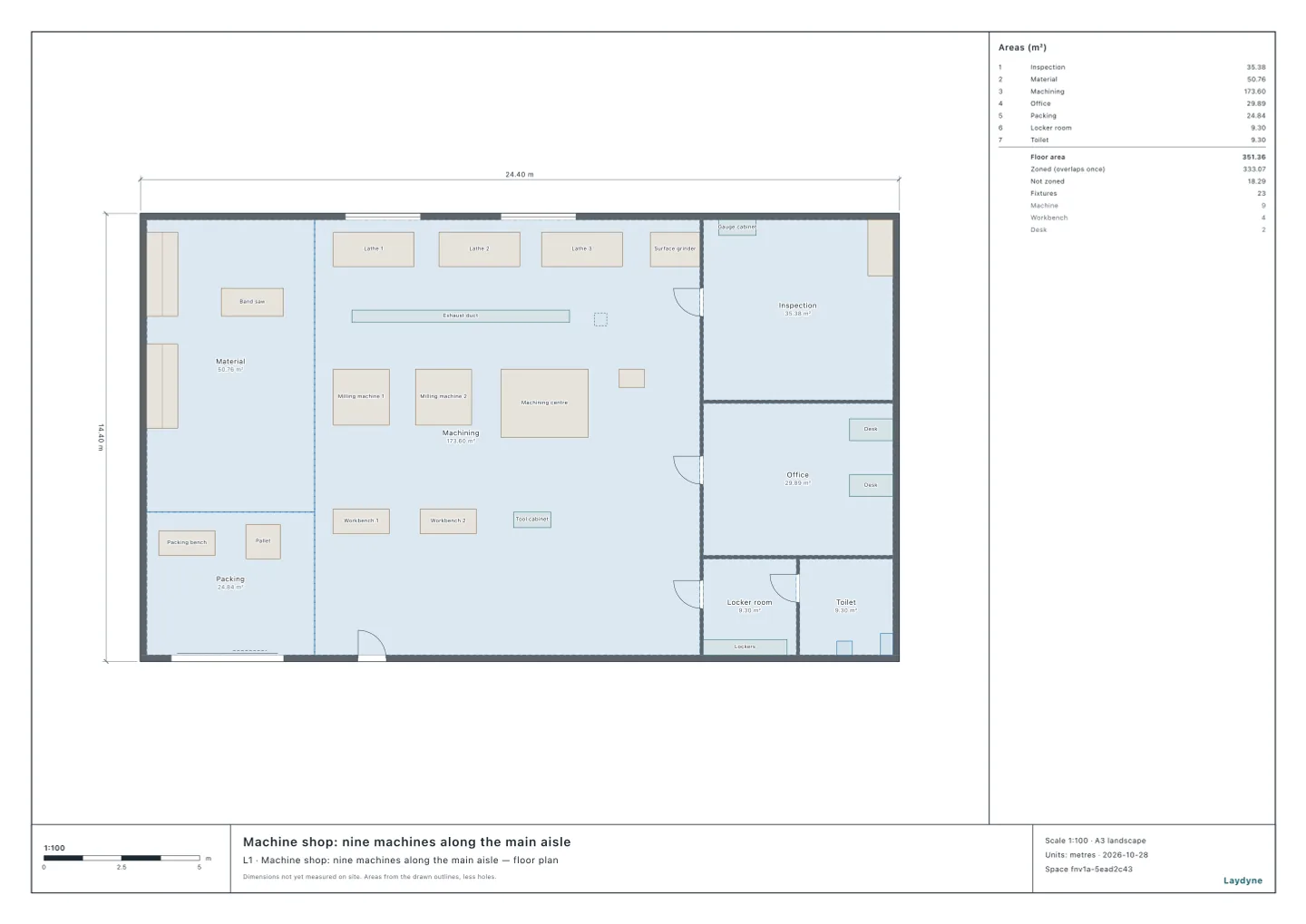
On this floor (as drawn) 40 men and 30 women work at one time. Are there enough toilets under Japan's Ordinance on Health Standards in the Office? If everyone goes to the toilets within 10 minutes at the end of lunch, how long do they wait?
7. What this does not check
The waits come from simulations with assumed numbers of people, shares going and times taken: put in your own building's.
The Act on Maintenance of Sanitation in Buildings, local bylaws and the rules for accessible toilets are not in these tables.